
Malaysia emerges as semiconductor hub despite high household debt
Malaysia is positioning itself as a critical testbed for Southeast Asia and Muslim markets, serving as a semiconductor back-end hub and a global leader in Halal certification, though high household debt levels make consumers extremely price-sensitive.
Malaysia is becoming a key center for semiconductor back-end processes and Halal certification, though a household debt-to-GDP ratio of 84.8% has created extreme price sensitivity among consumers. While the country serves as a strategic logistics hub, high loan repayment burdens mean local buyers may decide on purchases based on differences of just 1–2 Ringgit.
Malaysia is gaining attention as a key "testbed" for entering Southeast Asia and Muslim markets. Beyond being a neighbor to many nations, it serves as a center for the semiconductor back-end industry and a market that sets the standard for global Halal certification. However, the high household debt rate in the country results in extreme price sensitivity among consumers, a variable that South Korean companies must consider.
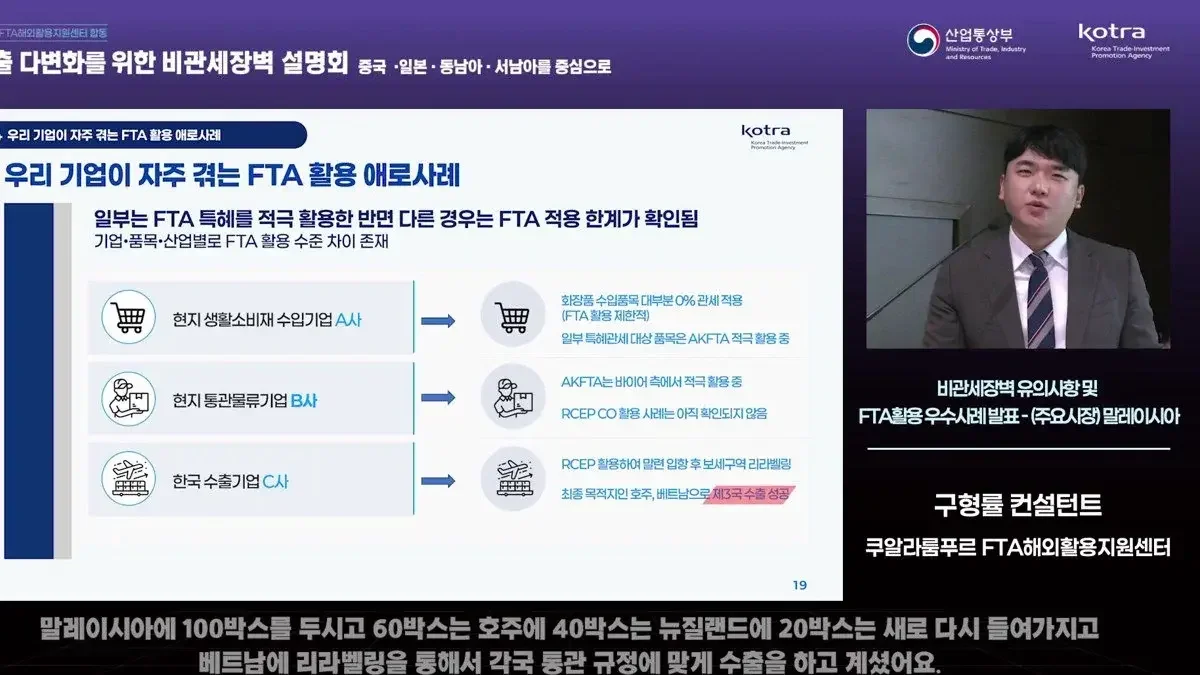
The structural characteristics and export strategies of the Malaysian market were discussed during the "2026 Briefing on Non-Tariff Barriers for Export Diversification" released by KOTRA TV. Koo Hyeong-ryul, a consultant at the Kuala Lumpur FTA Utilization Support Center, explained that contrary to the general perception of Malaysia as an oil-producing nation, it is actually a country specialized in the semiconductor industry, importing semiconductors to undergo back-end processes (packaging, testing, OSAT) before re-exporting them to the United States, Taiwan, and Singapore.
A hub for semiconductor back-end processes, global Halal, and logistics
Malaysia possesses strengths in the semiconductor and electrical/electronic industries. The structure involves South Korean memory and system semiconductors moving to Malaysia for post-processing. In particular, memory semiconductors (such as HBM) and system semiconductor products at the pre-CPU stage are sent to Malaysia for packaging, testing, and OSAT processes before being re-exported to the United States, Taiwan, Singapore, and Hong Kong. This provides a favorable environment for companies in the semiconductor and industrial goods sectors.
With strong refining capabilities, Malaysia imports gasoline from South Korea to meet the demand for gasoline and diesel required to support its high domestic automobile ownership rate, while South Korea imports natural gas from Malaysia, maintaining close industrial cooperation. While natural gas is steadily imported through long-term contracts between the Korea Gas Corporation and Malaysia, semiconductor manufacturing equipment is also entering South Korea.
In terms of market entry, Malaysia offers two strong attractions. The first is the "maturity of the Halal market." Malaysia's Halal certification system is highly advanced, having ranked first in the Global Halal Competitiveness Index for several years. This serves as an important bridgehead for companies aiming to enter Middle Eastern (GCC) markets such as Saudi Arabia or the UAE in the future. The second is its status as a "logistics hub." It possesses Port Klang, which is among the top 10 in the world, and the Port of Tanjung Pelepas in Johor, making it easy to utilize logistics networks in connection with Singapore.
Recently, opportunities in the data center and AI cloud sectors have also been growing. This is because the Malaysian government is working to attract high-value-added industries based on abundant water resources and affordable power infrastructure. In particular, through cooperation with the United States-based Arm Group, the country is seeking to expand into the semiconductor front-end industry, opening new opportunities for technology-centered companies.
High household debt and purchase decisions decided by "1–2 Ringgit"
While market potential is high, unexpected variables exist in actual consumer settings. Koo warned of Malaysia's high household debt rate. The household debt-to-GDP ratio in Malaysia reaches 84.8%, and according to private surveys, the debt burden is so heavy that the principal and interest repayment ratio among borrowers is only about 33%. This suggests that actual consumption capacity is limited due to the burden of household loans.
Citing actual local cases, he analyzed, "It is common for an office worker with a monthly salary of 5,000 Ringgit (approximately 1.5 million won) to spend nearly 3,000 Ringgit (approximately 900,000 won) on loan repayments alone. As a result, with low consumption capacity, they react very sensitively to prices." In actual negotiations with local buyers, price competitiveness acts as a key factor for market entry, to the extent that a difference of just 1–2 Ringgit (approximately 300–600 won) can determine whether a purchase is made.
However, there are positive signals from a mid-to-long-term perspective. The disposable income of the elderly, who have repaid household debt, and those earning real estate rental income tends to increase, suggesting that consumption patterns will gradually diversify. Additionally, Malaysia has a highly developed digital payment environment, where even street vendors use QR Pay. This digital environment facilitates entry through e-commerce channels such as Shopee and TikTok.
Political stability and the importance of responding to non-tariff barriers
The political environment experienced by companies entering Malaysia is relatively stable. Since 2022, political stability has continued under the administration of Prime Minister Anwar Ibrahim, and the risk of corruption is evaluated as relatively lower than in other Southeast Asian countries due to the strong activities of the MACC. The fact that companies can respond through the MACC if there are unfair demands from public officials also serves as a protective measure.
However, a precise approach to the market's demographic structure and regulatory changes is required. Malaysia is a multi-ethnic nation where various ethnicities and religions, including the Malay (including Bumiputera), Chinese, and Indian populations, coexist. Koo emphasized, "Because consumption patterns and purchase intentions differ by ethnicity and religion, it is very important to precisely analyze these before selecting target customers and distribution channels." It is also noteworthy that there is a clear tendency for high favorability toward the Korean Wave to lead to actual consumption.
Recently, caution is required as customs standards for direct purchases and small-scale imports through e-commerce are being strengthened. Companies using Shopee or TikTok Shop are subject to the same general customs and non-tariff barrier regulations. Furthermore, Malaysia is strengthening economic cooperation through mega FTAs such as RCEP and CPTPP, and a bilateral FTA has been concluded with South Korea. Companies should strategically review various FTAs, such as RCEP, in addition to utilizing the existing ASEAN FTA.
Source: KOTRA TV (YouTube)


0Comments
Comments are currently disabled.