
Is the "1 billion won inheritance tax deduction" always guaranteed? Family relationships and prior gifts are variables
The common belief that no inheritance tax is due for assets up to 1 billion won does not apply in all cases…
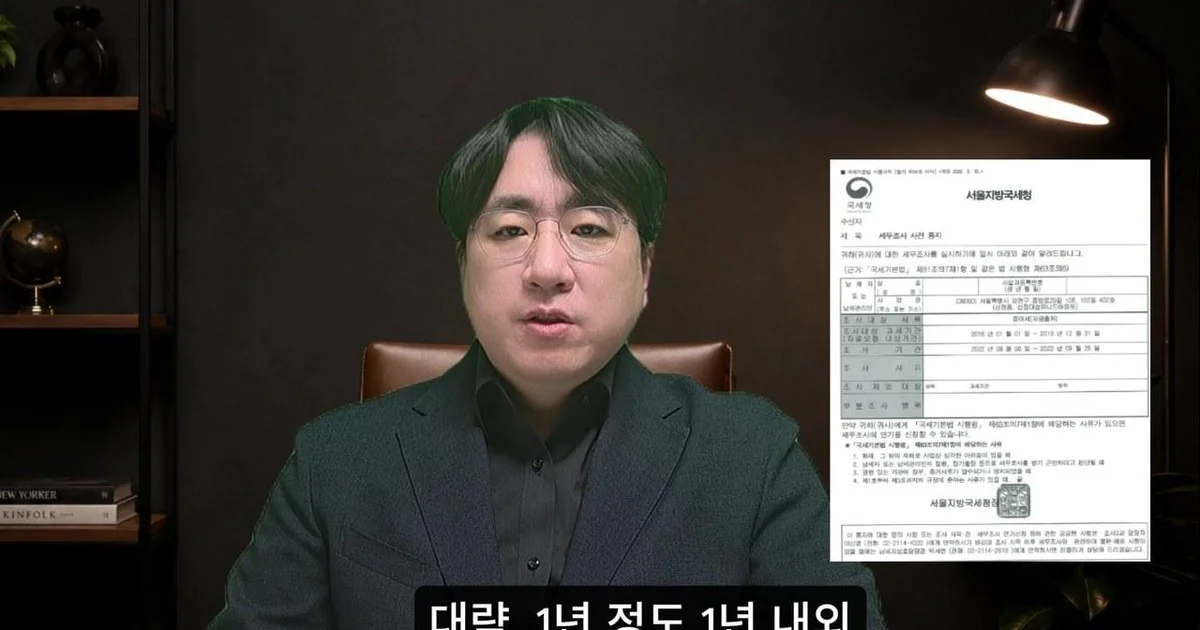
The common belief that 'no tax is due for up to 1 billion won' when calculating inheritance tax does not apply to all cases. This is because the inheritance tax deduction amount is determined not simply by the scale of the inherited property, but by the family relationships at the time of death and whether prior gifts were made. According to a video from the YouTube channel Semujosa-neun Peonpeontaekseu | Guksecheong Josaguk Chulsin, the core factors determining the inheritance tax deduction amount can be summarized into three main points.
Deduction limits vary by family composition... the presence of a spouse is key
The frequently mentioned '1 billion won deduction' assumes that a spouse is surviving. This figure is the sum of the 500 million won lump-sum deduction and the minimum amount of the spouse inheritance deduction, which is 500 million won. In other words, if a father passes away and the mother is present, a deduction of up to 1 billion won is possible by adding these two deductions.
However, depending on the situation, the deduction amount can decrease significantly. If the spouse has already passed away and only children are inheriting, the spouse inheritance deduction cannot be applied, so only the 500 million won lump-sum deduction is applied. Conversely, if a spouse inherits alone without children, the lump-sum deduction cannot be used, and the amount must be calculated by combining the basic deduction and personal deductions, making it dangerous to simply apply the figure of 1 billion won.
The spouse inheritance deduction is also not unlimited. If the amount actually inherited by the spouse is zero or less than 500 million won, only up to 500 million won is deducted. Furthermore, even if one tries to increase the deduction amount by allocating a large portion of the property to the spouse, the deduction is only possible up to the smaller of the legal inheritance share and the inherited property. The presenter emphasized, "Inheritance tax numbers are split by family relationships, not property."
Prior gifts within 10 years are added to the inheritance property, beware of 'tax bombs'
Calculating inheritance tax based only on currently held assets may lead to unexpected tax burdens. This is because inheritance tax is calculated by adding assets gifted within 10 years prior to death to the inherited property. Since both gift tax and inheritance tax have progressive tax rate structures, the tax burden can increase sharply during the aggregation process, such as the tax rate bracket rising from 30% to 40%.
In particular, unreported gift assets require caution. Not only cash transfers through account transfers, but also cases where support for a Jeonse deposit resulted in helping with real estate acquisition can be detected through a reverse calculation process. The presenter explained, "Gifts that passed through without reporting do not disappear just because time passes," adding that inheritance tax and gift tax can in principle be imposed for 10 years, and if judged as fraudulent activity or tax evasion, the imposition period extends to 15 years.
Inheritance tax is a 'determined tax amount'... importance of filing deadlines and responding to tax investigations
Inheritance tax is not a tax that ends just by filing. It has a 'determined tax amount' structure where the taxpayer files, and the tax authorities review it to finalize the tax amount. Therefore, it is important to complete an accurate filing within 6 months from the date of death. This is because the burden of additional taxes incurred if the filing deadline is missed is very high.
Following the inheritance tax filing, a tax investigation may proceed for about one year. If a notice of preliminary assessment is received based on the investigation results, a 'request for review of appropriateness before taxation' can be filed within 30 days from the date the notice is received. The presenter advised, "Responding at this stage is a way to expand your options rather than disputing after the bill has been issued."
Meanwhile, regarding the recently discussed amendment to transition to an inheritance acquisition tax, they added, "Inheritance tax is calculated based on the laws in effect at the time of death," and noted that since the amendment currently under discussion has not passed the National Assembly of the Republic of Korea, one must prepare thoroughly based on the current laws and regulations.



0Comments
Comments are currently disabled.