
"Fiscal Dominance" to emerge as a force twice as powerful as monetary policy, changing economic trends in 2027
Economic expert Kim Kwang-seok predicts that "Fiscal Dominance," where fiscal policy diverges from monetary policy…
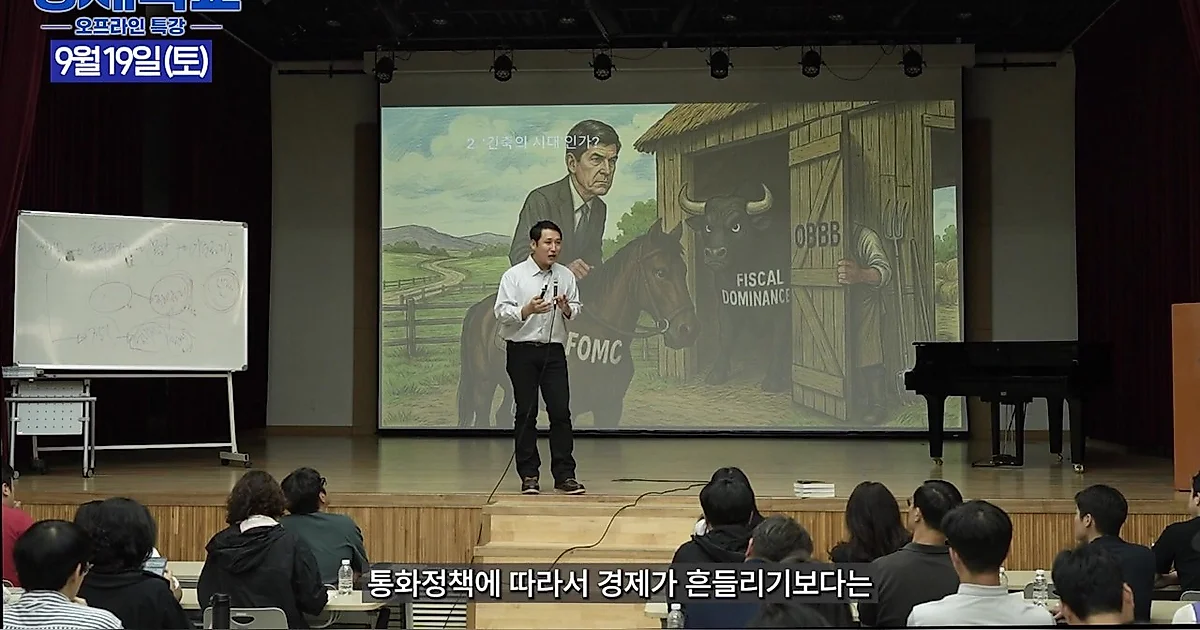
It is projected that 'fiscal policy' rather than monetary policy will emerge as the key variable determining the economic flow in 2027. While fiscal policy and monetary policy have moved in the same direction until now, analysis suggests that a phenomenon called 'Fiscal Dominance,' where the flows of the two policies diverge, will appear in the future.
Price refraction triggered by the Middle East war and changes in monetary policy
Through a video on the 'The Man Who Explains the Economy (Kim Kwang-seokTV)' channel, economic expert Professor Kim Kwang-seok explained the recent global economic trend as a 'price refraction' caused by the Middle East war. According to the video, the Middle East war induced a rise in international oil prices, which stimulated inflation and resulted in raising inflation expectations. This led to a rise in government bond yields, acting as a factor that exerts downward pressure on the market.
In particular, the downward economic pressure caused by the war induced governments in various countries to inject fiscal funds. As major countries increased the issuance of government bonds to expand fiscal policy, a phenomenon occurred where government bond yields rose. In response, central banks decided to raise benchmark interest rates to stabilize prices and government bond yields. The speaker analyzed, "By raising the benchmark interest rate, there was a movement to curb inflation expectations and simultaneously provide confidence in the Federal Reserve and others to strengthen the trend of purchasing government bonds, thereby controlling government bond yields."
This trend appeared worldwide. Major countries, including South Korea, the United States, the Eurozone, Japan, Australia, and New Zealand, shifted to an interest rate hike stance in response to the refraction of the inflation rate. The speaker explained, "If there had been no Middle East war, international oil prices would have stabilized around the 50 dollar level, and the price flow would not have been refracted either."
Transition from the 'Era of Pivot' to the 'Era of Fiscal Dominance'
Analysis continued regarding the terms defining recent economic phases. The speaker defined the period from mid-2024 to mid-2026 as the 'Era of Pivot (policy shift),' during which the inflation rate descends toward 2% and seeks the neutral interest rate. It is explained as a phase of gradually adjusting interest rates after the period of raising rates to catch inflation.
However, 2027 is projected to show a pattern different from the existing flow. The speaker named this 'Fiscal Dominance,' stating, "In 2027, a phenomenon will appear that flows against the previous trends." During the past pandemic economic crisis, accommodative monetary policy and expansionary fiscal policy moved in the same direction, and during the tightening transition period in 2022, both monetary and fiscal policies operated in a tightening manner together.
However, the speaker's core argument is that in 2027, a point will occur where the stance of monetary policy and the flow of fiscal policy differ. The speaker emphasized that one must pay attention to the phenomenon where fiscal policy's influence leads the market, saying, "When discussing liquidity, many people only think of interest rate cuts, but in fact, the power of fiscal policy is at least twice as large as monetary policy."
The key to economic forecasting is sharing 'judgment criteria'
The speaker also mentioned the attitude toward economic forecasting. Rather than drawing specific conclusions, he emphasized the importance of having 'principles' and 'criteria' to judge the flow of the economy. This was explained with the intent of quoting Federal Reserve Chair Kevin Warsh's speech at the Jackson Hole Economic Policy Symposium, saying, "He did not come to make decisions, but to talk about principles."
Economic conditions can be refracted at any time depending on various variables such as the continuation of the Middle East war or geopolitical instability. The speaker advised, "When variables such as geopolitical instability that occur from time to time emerge, one should draw scenarios and respond with judgment criteria on how the inflation and benchmark interest rate stance may change each time."



0Comments
Comments are currently disabled.