
"Principal Guarantee is the Most Dangerous Asset"... John Lee: "If You Have 20 Years Left, You Must Invest 100% in Stocks"
John Lee warns that "safe assets" focused on principal guarantees can threaten retirement security due to the declining value of money.
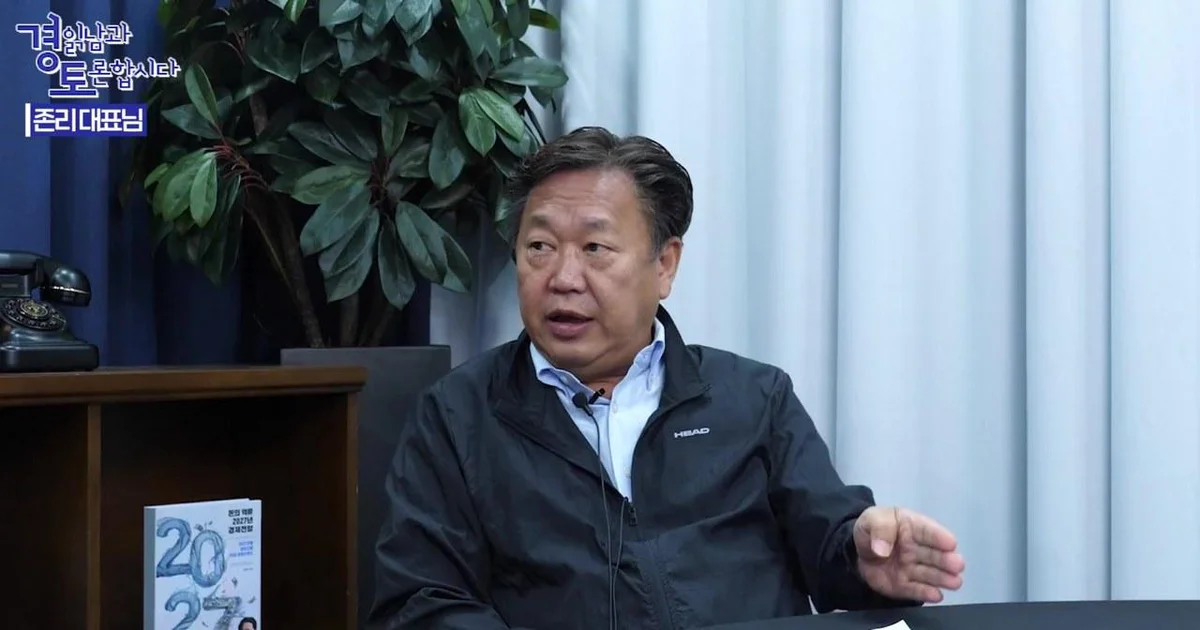
It has been pointed out that 'safe assets' that guarantee the principal of an asset can actually become the most dangerous assets that threaten old age. The analysis suggests that investment methods centered on principal guarantees, which do not consider the decline in the value of money, are hindering asset formation.
According to a video from the 'Let's Debate with the Man Who Reads the Economy' show on the The Man Who Explains the Economy (Kim Kwang-seok TV) channel, the featured guest, CEO John Lee, pointed out the problems of the Korean financial system, which is heavily focused on principal-guaranteed products in the management of retirement funds such as retirement pensions. CEO John Lee criticized, saying, "People say that places where the principal is guaranteed are safe assets, but in fact, that is the most dangerous asset," and "I work hard at my job, but my money doesn't come out from under the covers."
"10 billion won 10 years ago and 10 billion won now are different... Principal guarantee is a word game"
CEO John Lee emphasized that one must be wary of the 'illusion effect' held by principal-guaranteed products. He explained that just because the number of cash assets is maintained, it does not mean the asset is preserved. He said, "Many people think that if they maintained 10 billion won with a principal guarantee 10 years ago, they didn't lose money, but in fact, thinking that they didn't lose it is dangerous." In particular, he argued that the concept of principal guarantee is a 'word game' and 'being deceived by marketing' in terms of real value, stating, "The value of money continues to fall, so 10 billion won 10 years ago and 10 billion won now are completely different money."
In this regard, he also expressed awareness of the problems regarding the current status of retirement pension management in Korea. He pointed out that while in the United States, asset-formation-centered financial companies like Fidelity or Charles Schwab handle retirement pensions, in Korea, insurance companies and banks lead the way, and funds are concentrated in principal-guaranteed products. CEO John Lee emphasized, "Retirement pensions are for achieving economic freedom when you retire," and "If you have 20 years left until retirement, you must go 100% into stocks. This is because the volatility over a period of 20 years is meaningless."
Furthermore, he mentioned the 'Matching' system as the direction in which Korea's financial system should be improved. He suggested that a method like the American model, where companies provide a certain amount of subsidy to help employees' (DC type) retirement pension investments, is necessary. CEO John Lee suggested, "If my retirement pension is the DC type, the company should also help through financial education," and "For example, if one invests 1 million won a month, if there were a matching system where the company subsidizes at least 300,000 won, funds would steadily flow into the stock market." Additionally, regarding the phenomenon of funds being concentrated only overseas, he added, "Efforts should be made so that investments are made in Korean companies so that market capitalization can grow like in the United States."
"Trading is not investing... Must abandon the habit of trying to time the market"
He also strictly distinguished between 'trading' and 'investing' in terms of investment methods. CEO John Lee criticized the method of looking at charts and setting target prices or stop-loss prices as merely trading, not investing. He said, "Most people think that predicting prices is investing," and "Thinking that you must stop-loss if the stock price falls, or watching newspapers and broadcasts to time the market, is the most incorrect investment method."
Emphasizing the importance of continuous investment, he said, "Whether it rains or snows, there must be an investment." Rather than being swayed by short-term returns, the key is the habit of steadily investing a certain percentage of one's salary (e.g., 10–15%). CEO John Lee added, "Instead of being happy that a 20% return was achieved, you should think about why today's return is important when it is money to be withdrawn 20 years later," and "Suddenly stopping while running a marathon is not investing." He expressed regret that many investors obtain fragmentary information through YouTube or friends and are buried only in return figures, failing to explain the reason 'why they are investing.'
"For those in their 20s, 100% stock-type ETF for pension savings fund is recommended"
Regarding specific design plans to secure a stable income of around 3 million won per month in old age, he presented differentiated strategies by age group. CEO John Lee suggested, "If you are in your 20s, you should open a pension savings fund account and put 100% into stock-type ETFs." However, regarding the stock proportion limit (70%) under Korean law, he expressed regret, saying, "This is incomprehensible. It is because people in their 20s have plenty of time."
He continued, "Those in their 30s should lower the stock proportion a bit more, and those in their 40s should reduce the proportion as they age, but basically, most investments must be made in stocks to make a monthly pension of 3 million won possible." Pointing out the current structure where Korean assets are excessively tied up in real estate or principal-guaranteed bonds, he suggested that the financial system and education must proceed in parallel so that these funds can flow into the stock market. He particularly urged a change in the education system, emphasizing, "There is no competitiveness in the score competition centered on Korean, English, and Math. An entrepreneurial spirit must be taught, and a general change in thinking is necessary."
Finally, regarding economic independence, although there is a perception that "there is no hope for young people," CEO John Lee emphasized the need to induce participation in the capital market through education and policy, saying, "If your goal is not buying a house but achieving economic freedom, you can be free at any time."
0Comments
Comments are currently disabled.