
"Private Education Expenses are Evidence of Illiteracy, Not Investment"... The Urgency of Financial Education for Wealth Accumulation
To solve the chronic issues of high private education spending and financial illiteracy in Korean society…

To solve the problems of private education expenses and financial illiteracy, which are pointed out as chronic issues in Korean society, a fundamental shift in the educational paradigm is necessary. While the act of pouring massive costs into private education for a child's future is perceived as a kind of 'investment,' it is pointed out that this is an action that deviates from the essence when viewed from the perspective of financial civilization.
"Private Education Expenses are the Result of Financial Illiteracy, Not Investment"
According to a video from The Man Who Explains the Economy (Kim Kwang-seok TV), the presenter cited the 'Edu-poor' phenomenon as one of the unique characteristics of Korea. The explanation is that the psychology of parents trying to guarantee their children's future by increasing private education expenses—believing it can replace retirement preparation—is a phenomenon that appears in the absence of financial education.
The presenter defined this phenomenon as a result of 'financial illiteracy.' Citing the case of Japan, they mentioned the absence of financial education as one of the reasons for the high elderly poverty rate. The analysis suggests that the reason the elderly in Japan live with their children or grandchildren and experience economic difficulties is that they did not receive financial education to manage assets and perform future planning. In the video, the situation where people cannot plan for the future due to a lack of financial education was explained by giving the example of grandmothers holding cash at 7-Eleven stores in Japan while living and working with their children or grandchildren.
On the other hand, it was emphasized that the secret of the Jewish people, who make up only 2% of the US population but hold 25% of the assets, lies in early financial education and learning 'how to invest in oneself.' It was also mentioned that instead of simply telling children to study well, Jewish people teach them to be 'number one.' Here, being number one means occupying an unrivaled position in all fields, such as business or music, not just in studies. The presenter pointed out that the secret to being number one is to "go where no one else is," and noted that the intense competitive structure where everyone crowds into specific occupational groups like doctors or civil servants is a problem that occurs in a state lacking financial education.
The 'Source of Wealth' Seen Through the Cases of Levi's and Lazard
The video explained the principles of wealth creation through historical examples. During the 19th-century US Gold Rush, most people rushed in as miners to dig for gold, but true wealth went to those who identified that demand. Levi Strauss, a poor tailor, identified the demand of miners and built great wealth by making durable jeans. Noticing that the pants miners wore at the time tore easily, he manufactured jeans using sturdy canvas material used to cover wagons. Furthermore, he created the origin of the Levi's brand by developing Blue Jeans treated with a substance that snakes dislike, for miners who were dying from snake bites.
Additionally, the case of the famous American financial firm Lazard was mentioned. During the Gold Rush, five brothers accumulated wealth by developing businesses targeting those digging for gold instead of digging for gold themselves. After going through a business making denim fabric, they moved to Europe, and based on their experience in Europe, they seized even greater wealth through the financial industry, such as bond trading. Ultimately, it emphasized that the core of wealth lies in 'finance,' not simple labor or resource extraction.
"Long-term Investors Win 100%"... Investment Principles and Methodology
Regarding investment philosophy, the presenter asserted, "Investment is not a game of swings (short-term trading)." They stated that who starts earlier and invests for the longest time determines the success or failure of wealth. In particular, they claimed, "I have never heard of a long-term investor losing. Short-term investors either lose or win, but as long as they do not choose companies that will be delisted, long-term investors basically succeed." Conversely, they criticized moving hastily simply to make money quickly as being closer to 'gambling' rather than investment.
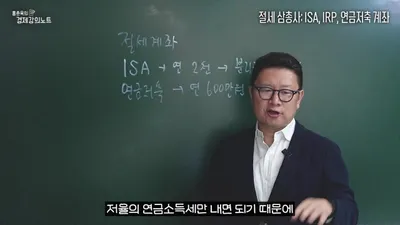
As for specific investment methodologies, utilizing a 'Pension Savings Fund' account was ranked as the top priority. The explanation is that investing in an ETF using accounts with tax benefits is the most efficient starting point. The presenter advised actively utilizing tax benefits, saying, "Pension savings fund accounts, anyway, do not get delisted except for the funds themselves." For example, if an investor aged 25–30 invests 1 million won every month, they suggested methods such as setting the proportion of stock-type ETF to about 70–80% and diversifying investments into the US and Korean markets. However, they added that whether to invest in the US or Korea is within the realm of one's own judgment.
The presenter strongly criticized the act of investing by only listening to others and then experiencing delisting as 'irresponsible behavior' and a 'shameful thing.' This is because jumping into specific stocks without fundamental thoughts about investment is dangerous. Finally, the presenter suggested that for the Korean economy to leap forward, the financial advancement of the nation and the financial civilization of individual citizens are urgent. They delivered a message that instead of just education centered on Korean, English, and Math, Korea must foster financial talent to lead the country by combining 'entrepreneurship'—the spirit of taking a different path from others—with 'financial education.'

0Comments
Comments are currently disabled.