
"AI Speed Regulation is an Illusion"... AI Investment Cycle Expected to Continue as Technology Gap Widens
Analysis suggests that the "AI speed regulation" theory is unlikely to disrupt the AI investment cycle…
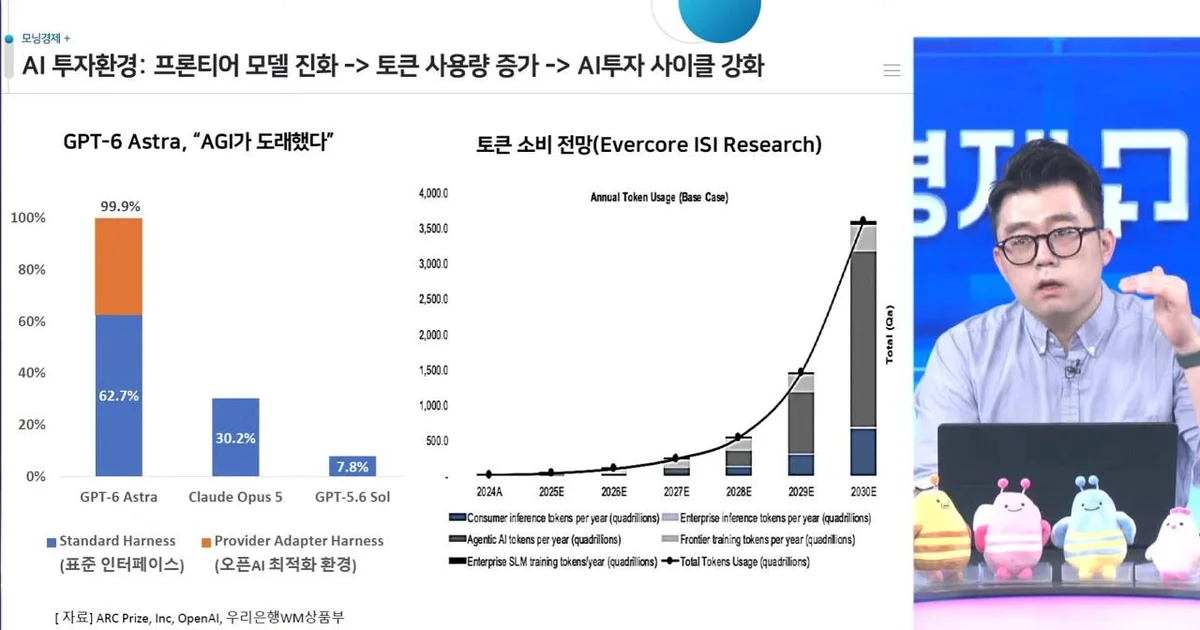
An analysis has emerged stating that the 'AI speed regulation theory' recently raised in some market circles is unlikely to be a variable that breaks the actual AI investment cycle. This is due to the outlook that the technological gap between AI models is widening again, and the amount of data (tokens) that AI must process in the future will increase explosively. Kim Hyun, an investment product strategy manager at Woori Bank, presented the current AI investment environment and future strategies for the semiconductor market through the YouTube channel 'Morning Economy Plus' released on the 23rd.
US AI Secures Technology Gap, 'Speed Regulation Theory' is a Strategic Defense Mechanism
Recently, voices have been emerging, centered around frontier model developers such as Anthropic or OpenAI, suggesting that the speed of AI development should be regulated. Regarding this, Kim provided an interpretation based on the technical background and the interests of the companies. Looking at the Intelligence Index (AI model intelligence index), there is a trend where US models are once again securing a technical gap from Chinese models. In particular, the analysis shows that US models hold an advantage in 'reasoning ability' and 'long-term task execution ability,' which go beyond simply answering questions to solving unknown problems.
Kim explained, "Companies advocating for speed regulation are in a position where they feel the threat that the speed of existing AI is too fast after having secured a technical gap," and "Looking behind the scenes, there may also be an intention to block the route for latecomers to catch up quickly while maintaining technical status." In other words, since the direction of regulation is not to reduce computing power itself but to strengthen supervision and regulation, it is judged not to be an issue that touches the AI investment cycle itself, which is led by semiconductor companies like NVIDIA.
Surge in 'Token Usage' Predicted... Semiconductor Investment Cycle Remains 'Upward'
The evolution of AI models leads directly to massive data processing volumes. The latest models, such as the recently emerged GPT-6 (Astra), have gone beyond the level of utilizing trained data and have significantly increased their reasoning ability to solve tasks they encounter for the first time on their own. Kim said, "The improvement in this reasoning ability means that AI will perform tasks such as coding by itself for long periods or searching for materials, which means it will use an enormous amount of tokens."
In fact, the market sees AI investment continuing. Major institutions such as Evercore ISA predict that token usage will increase by about 20 to 30 times compared to the present by 2030. Accordingly, the capital expenditure (CAPEX) outlook for hyperscalers is being adjusted upward without ever breaking. Kim predicted, "With the emergence of AI agents, demand for CPUs will increase, and as the reasoning process becomes more sophisticated, a strong cycle across the entire semiconductor industry will continue, following with demand for memory semiconductors."
TSMC Price Increases and Japan's Materials, Parts, and Equipment in Focus... Rise of the East Asia Supply Chain
In terms of investment strategy, it is necessary to pay attention to the East Asian semiconductor supply chain connecting South Korea, Taiwan, and Japan. TSMC, a core company in Taiwan, is seeing steady revenue growth driven by demand for NVIDIA's AI accelerators, and there is a possibility that price increases related to AI semiconductors will proceed by about 10% next year. In particular, as the expansion of supply for the most advanced 3nm and 2nm processes is scheduled, a phase of earnings expansion where price increases and volume increases occur simultaneously is expected to continue.
The Japanese semiconductor market is also securing new growth engines under strong government support. The Japanese government is promoting the revival of the semiconductor industry through a roadmap of approximately 10 trillion yen by 2030 and 68 trillion yen by 2040. As global fabs, such as the TSMC plant in Kumamoto and the Micron plant in Hiroshima, are established in Japan, orders for materials, parts, and equipment (collectively) centered on cutting-edge processes are expected to increase. Kim added, "As the technical difficulty of AI semiconductors increases, the frequency of use of high-margin products will rise, and there is a market outlook that the operating profit margins of Japanese materials, parts, and equipment companies will rise to the 30% level within the next 2 to 3 years."



0Comments
Comments are currently disabled.