
National Pension Reduction Criteria Relaxed... Possible to Receive 1.05 Million Won at Age 60
Due to amendments to the National Pension Act, the reduction system for pension recipients and the credit system for recognizing contribution periods have changed. Kim In-eung explains the key details of the revised law and efficient pension strategies on the YouTube channel 'Finance with Toad Tax Accountant'.
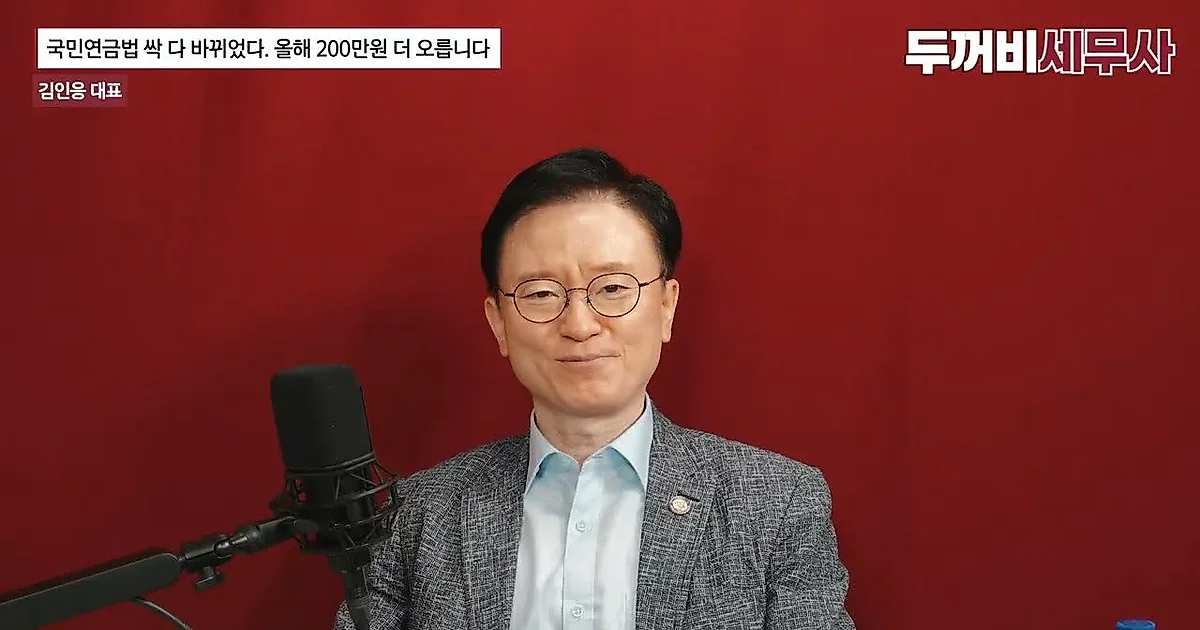
Starting this year, the pension reduction system that cuts pension amounts and the credit system that recognizes contribution periods will change following the amendment of the National Pension Act. Kim In-eung appeared on the YouTube channel 'Finance with Toad Tax Accountant' to explain the main contents of the revised National Pension Act and efficient pension receipt strategies.
Raising Reduction Criteria and Expanding the Credit System
The National Pension reduction system has changed significantly starting this year. Previously, for recipients exceeding the 'A-value' (3.19 million won), which is the average income of National Pension subscribers, the pension was reduced by 5% to a maximum of 50%. However, starting this year, this threshold has been raised to 5.19 million won, an increase of 2 million won. However, Kim explained that since this is based on earned income, the actual income level subject to reduction could be around 6.4 million won when considering tax-free income such as meal allowances and automobile driving allowances.
The credit system, which provides additional recognition for contribution periods, has also been expanded. In the case of military credit, whereas 6 months was previously recognized uniformly for the military service period, the scope of recognition will now expand up to 12 months by considering the actual service period. The childbirth credit also used to not recognize the first child, but starting this year, 12 months for the first child, 12 months for the second child, and 18 months for the third child are each recognized, and the application limit has been abolished. Kim mentioned that when a married couple receives childbirth credit, they can make choices such as concentrating the pension amount toward the side with weaker pension benefits to match the timing of receipt.
Insurance Premium Rate Increase and Utilizing the Additional Payment System
The National Pension insurance premium rate is scheduled to increase step-by-step to 13% by 2033, starting with an increase of 0.5%p from 9% last year. The income replacement rate has been increased from the existing 41.5% to 43% starting this year, which applies to contributions made after January 1, 2026.
In the case of the additional payment (supplementary payment) system for paying unpaid insurance premiums, it may be advantageous to pay early considering the trend of increasing insurance premium rates. Kim gave an example where, if a local subscriber's income is 1.5 million won, paying the additional premium this year would cost 5.7 million won, but by 2033, they would have to pay 7.8 million won, and recommended not delaying since the available period for additional payments may decrease. However, he added that simply paying early is not the only answer, as the pension amount received later also increases if the income used as the basis for calculating premiums rises.
Voluntary Continued Coverage May Be More Advantageous Than Early Pension
Cases of applying for early old-age pension are increasing due to economic difficulties or to maintain eligibility as a dependent for health insurance. While early pension advances the timing of receipt, the pension amount is reduced by 30%. Kim explained that considering the reflection of inflation rates and the characteristics of pensions, receiving early pension may be economically disadvantageous unless it is unavoidable.
As an alternative, Kim suggested the 'Voluntary Continued Coverage' system. By utilizing this system, which maintains National Pension coverage even after age 60, one can increase the pension amount. Using his own case, Kim stated that he increased his monthly pension amount by 70,000 won through voluntary continued coverage for four years, and the period to recover the invested cost (BEP) was only about 7 years. This is faster than the time it takes to recover the principal when choosing early pension.


0Comments
Comments are currently disabled.