
China could overtake South Korea in semiconductors within five years
Economics Master Kwak Soo-jong warned that China's semiconductor technology has reached a level comparable to South Korea's, potentially leading to South Korea being overtaken within five years. He also highlighted risks in the AI industry due to delays in data center construction in the United States.
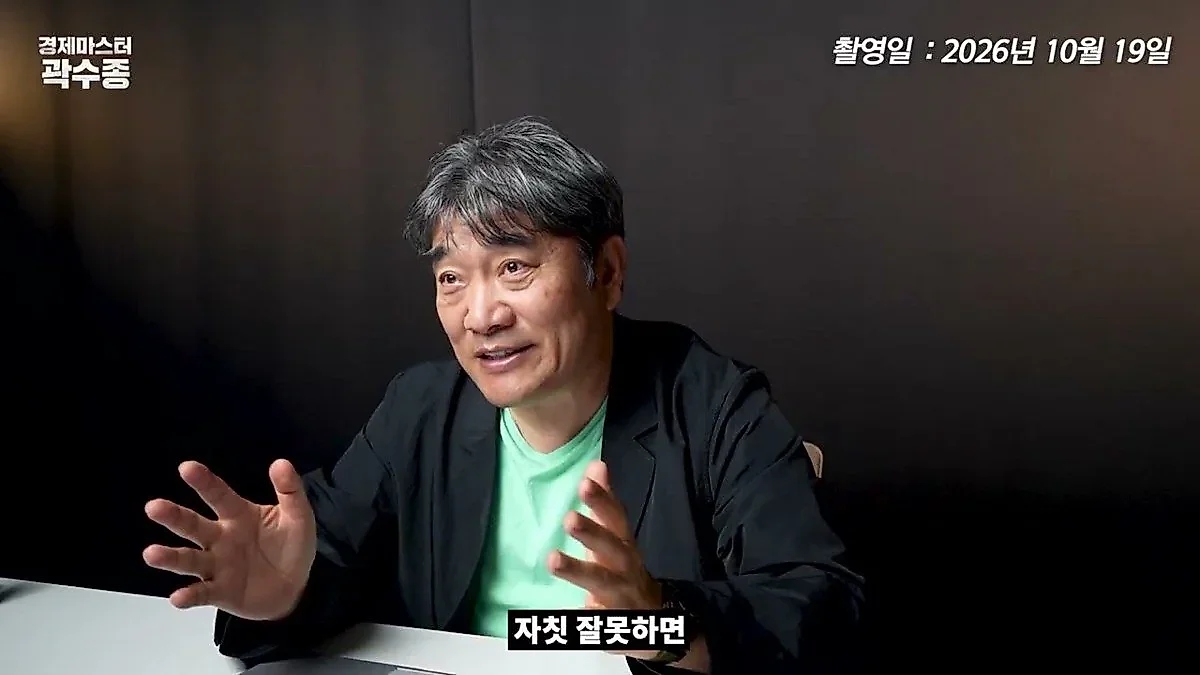
Economics Master Kwak Soo-jong warned that China's semiconductor technology has reached parity with South Korea, potentially leading to a fierce "chicken game" competition within the next two to three years. While Chinese firms like CXMT and YMTC are rapidly narrowing the gap by producing HBM 3E prototypes, Kwak noted that China could potentially jump directly to HBM 5 technology.
Warnings have emerged that China's semiconductor technology has risen to a level comparable to South Korea's, and that South Korea could be overtaken by China within the next five years. Global economic uncertainty is increasing due to the Fed's high interest rate stance, high oil prices caused by the Middle East situation, and volatility in the AI industry resulting from delays in the construction of data centers in the United States.
Economics Master Kwak Soo-jong warned of a "chicken game" crisis facing the South Korean semiconductor industry in a recent analysis. Kwak diagnosed that "China has already caught up to South Korean semiconductor technology at the same speed, and its technological status has reached the same level." He specifically pointed out that Chinese memory semiconductor companies CXMT and YMTC are rapidly narrowing the technology gap, such as by producing HBM 3E (High Bandwidth Memory) prototypes. Kwak added that it is naive to think China is merely staying at HBM 3E, noting that semiconductor technology establishment has a structural characteristic where multiple stages of future technology are developed simultaneously from the moment one is started. He explained that the possibility must be left open that China could jump directly to the HBM 5 stage while narrowing the gap.
Data Center Construction Delays and AI Industry Liquidity Risks
Concerns regarding semiconductor demand are growing as the construction of data centers, which are core infrastructure for the AI industry in the United States, faces setbacks. Kwak pointed out that U.S. state governments have been strictly reviewing or delaying data center permit procedures due to reasons such as power consumption, environmental assessments, and cost issues. He analyzed that as major states including New York, Virginia, Texas, and Indiana delay data center construction through executive orders and other means, stock price volatility for hyperscalers (large-scale cloud providers) and semiconductor companies is intensifying.
Indeed, the fact that the stock price of CoreWeave, one of the AI-related companies, has fallen by more than 50% from its peak is a reflection of the liquidity risk in the market. Kwak mentioned the growing pains of the AI industry, stating that "projections that semiconductor demand would decrease in a situation where data center construction is delayed by about one year have already been raised for several months." However, he drew a line against the view that AI itself is a bubble, believing that the flow of technological development will continue. Kwak acknowledged the growth potential of AI, mentioning a forecast that the GDP scale of the United States economy could increase by more than 50%, from 30 trillion dollars to a level of 44 trillion dollars, due to the full-scale opening of the AI industry.
China's Technological Pursuit and Semiconductor Market Chicken Game Scenarios
China is betting its survival on technological self-reliance, not staying merely within memory semiconductors but attempting to independently develop EUV lithography equipment, which is a core piece of U.S. equipment. Kwak predicted that China is closely following the roadmaps of South Korea and Taiwan, and that a fierce chicken game will occur within the next 2 to 3 years between China, which will lead with low-cost products, and South Korea and Taiwan, which will promote high-performance products. He particularly warned that China is working to secure AI-related technological capabilities such as NPU (Neural Processing Unit).
To explain this competitive structure, Kwak used the analogy of a "neighbor's hotteok (sweet pancake) shop." He said it is a natural economic psychology for a shop selling kkwabaegi (twisted doughnuts) to analyze the secret recipe and switch businesses to make hotteok if the neighbor's hotteok shop does well. He suggested that South Korea needs intense survival strategies to avoid being technologically caught by China, stating, "Competition will break out between the large volume of medium-to-low-end products released by China and the high-performance products from South Korea and Taiwan."
U.S. Election Variables and the Task of 'Technology Alliance' for the South Korean Economy
Amid these crises, Kwak suggested a 'technology industry alliance' as the direction for the South Korean economy to take. He argued that South Korea must move away from the past method of "each person seeking their own survival" and consider how closely its industrial structure can be linked to the quantum computing technology or AI technology ecosystem of the United States. He emphasized, "When quantum computing prototypes led by Google and IBM emerge around 2027–2028, the speed of AI development will accelerate even further," and "The key to survival is how strongly South Korea can be connected to the U.S. AI and quantum technology through a powerful supply chain."
Finally, Kwak noted the November midterm elections as a political variable in the United States. He analyzed that if the Democratic Party of Korea controls the Senate as well, there is a possibility that the Democratic Party of Korea will flexibly operate economic policies to stimulate the economy, which could be a positive variable for the stock market. He explained, "If the economy worsens while the Democratic Party of Korea is the majority party, they are likely to actively engage in economic stimulus, such as interest rate cuts, to avoid handing the initiative over to the Republican Party." He advised that rather than being swept up in the overheated atmosphere of the market, a calm attitude is needed to closely examine interest rates, inflation, and changes in technological hegemony.
Source: original video (YouTube)
0Comments
Comments are currently disabled.