
KOSPI enters undervalued zone despite structural economic hurdles
Professor Kim Young-ik analyzed recent domestic financial market trends on "Kim Young-ik's Economics School," noting that while the KOSPI has entered an undervalued territory, a trend-driven rally faces significant obstacles.

The KOSPI entered an undervalued zone on October 15 following a significant correction, though Professor Kim Young-ik warned that any potential short-term rebound may occur within a broader downward phase. While South Korea's economic growth forecast was revised upward to 3.3% by the IMF, the country is projected to grow slightly below the global average this year and next.
The South Korean stock market has entered an undervalued zone following a significant correction, though a sustained upward trend remains uncertain due to various economic hurdles, according to Professor Kim Young-ik.
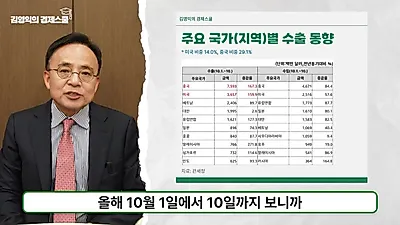
During an analysis of recent domestic financial market trends on "Kim Young-ik's Economics School" on the 17th, Professor Kim stated that the KOSPI has entered an undervalued area following its recent adjustment. Using a valuation method that compares the KOSPI to average daily export volumes, Kim explained that while the KOSPI market capitalization was overvalued by approximately 76% relative to the money supply in May, the bubble burst, leading the index into undervalued territory as of October 15. "When evaluated by average daily exports, the KOSPI entered the undervalued zone on October 15," Kim said, adding, "In this sense, it seems the KOSPI could see a sufficient rebound."
IMF growth forecast upward revision and South Korea's economic position
Changes in the recent economic outlook from the IMF were also cited as a major variable. Following its July update, the IMF revised its global economic growth forecasts in October, specifically raising growth projections for countries benefiting from AI. South Korea was classified as one of these beneficiaries, with its economic growth forecast for this year being revised upward by 0.7 percentage points from 2.6% in July to 3.3%. This suggests South Korea is among the countries with the highest upward revisions in this forecast, while growth forecasts for the Middle East and Central Asia were lowered.
The overall global economic trend is slowing. While the global economy grew at an average annual rate of 3.7% from 2000 to 2019, it is expected to slow to 2.9% through 2025. The IMF projected global economic growth at 3.0% this year and expects it to remain at 3.4% next year. Kim analyzed that "because governments spent excessive amounts of money to overcome the 2008 and 2020 recessions, and central banks released liquidity, the debt of various economic agents has increased significantly, causing the global economy to grow at a lower rate than in the past."
However, Kim maintained a cautious stance regarding the medium-term trend of the South Korean economy. He noted that while South Korea recorded high growth averaging 7% annually from 1980 to 2009—double the global average of 3.4%—it has fallen below the global average since 2010. "South Korea is projected to grow slightly lower than the global average this year and next year," Kim said, pointing out that South Korea's share of global GDP is on a declining trend.
Possibility of end to rate hike cycle and KOSPI rebound outlook
Regarding the upcoming decision by the Monetary Policy Board of the Bank of Korea next week, Kim placed weight on the possibility of a "base rate freeze." The Bank of Korea previously raised the base rate twice in a row from 2.5% to 3.0%. While some in the market speculate on further hikes, Kim predicted that this rate hike cycle is likely to conclude at 3.0%.
He cited shrinking consumption and a slowdown in employment growth as reasons. "Looking at consumption, which is a component of GDP excluding semiconductors, it has fallen below the GDP trend starting this quarter," Kim analyzed. "Although the inflation rate exceeds the 2% target, this is largely due to supply-side effects from rising oil prices rather than the demand side." In fact, market interest rates have already reflected the expected end of the Bank of Korea's rate hikes and the possibility of an economic slowdown, with the average yield on 3-year Treasury bonds falling from 3.99% in September to 3.96% as of mid-October.
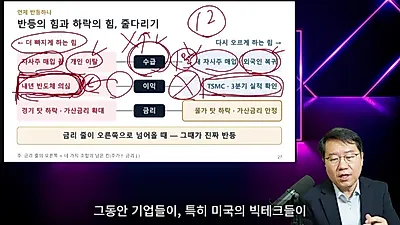
Regarding the stock market, Kim warned that while a short-term rebound is possible, it should not be interpreted as a trend-driven rise. Using trend analysis via the HP Filter, he projected, "As of October 15, the KOSPI has fallen about 24% below its trend, so there will be a short-term rebound." However, noting that the leading index entered a downward phase after peaking in July, he added, "It is highly likely to be a rebound within a downward phase and will likely remain at a certain level." He also explained that the narrowing of the long-term and short-term interest rate spread reflects the bond market's expectation that an economic slowdown will occur.
Caution is also required regarding capital flows. According to data released by the Bank of Korea for August, the growth rates for both new M2 and old M2 (including beneficiary securities) are decreasing. The money supply growth rate dropped from 12.2% in June to 9.9% in August, signifying that money is being withdrawn alongside interest rate hikes. "Following the recent stock market adjustment, less money is flowing into the stock market, and the scale of customer deposits and equity funds has decreased significantly," Kim diagnosed. "For stock prices to rise in the future, KOSPI dividend yields must increase and bank deposit rates must decrease, but recently, dividend yields have fallen and bank rates have risen, causing money to move to banks."
US market risks and exchange rate volatility
The movements of overseas markets also require close attention. While the US stock market has remained robust recently, Kim noted the emerging risks within US AI companies. Specifically, he warned that the "credit spread" between high-yield bond yields and Treasury yields has recently been rising.
"The widening of the credit spread suggests that risks in the US stock market are increasing," Kim said. "A significant shock could hit the US market soon; in such a case, while the South Korean market, which has already experienced shocks, might be relatively less affected, the shock from the US could eventually have a negative impact on our market again." Regarding US inflation, he mentioned that September consumer prices were higher than market expectations and suggested that inflation in the fourth quarter could reach around 4% due to rising oil prices, potentially leading the Federal Reserve to raise interest rates. However, based on recent consumption contraction and employment slowdown, he predicted that a rate hike in December would not be easy and that rate cuts would begin in either the first or second half of next year.
Regarding the exchange rate, Kim analyzed that there is a possibility of a short-term rebound as the KRW-USD exchange rate has plummeted from around 1,550 won to around 1,340 won. He noted that the exchange rate has entered a downward trend and will proceed toward the 1,270 won level, which he previously identified as the appropriate incentive.
Source: original video (YouTube)

0Comments
Comments are currently disabled.