
Hong Chun-uk suggests rebalancing strategies to survive market volatility
Dr. Hong Chun-uk analyzes the Fear & Greed Index to diagnose market conditions and offers specific strategies for protecting assets during market downturns.
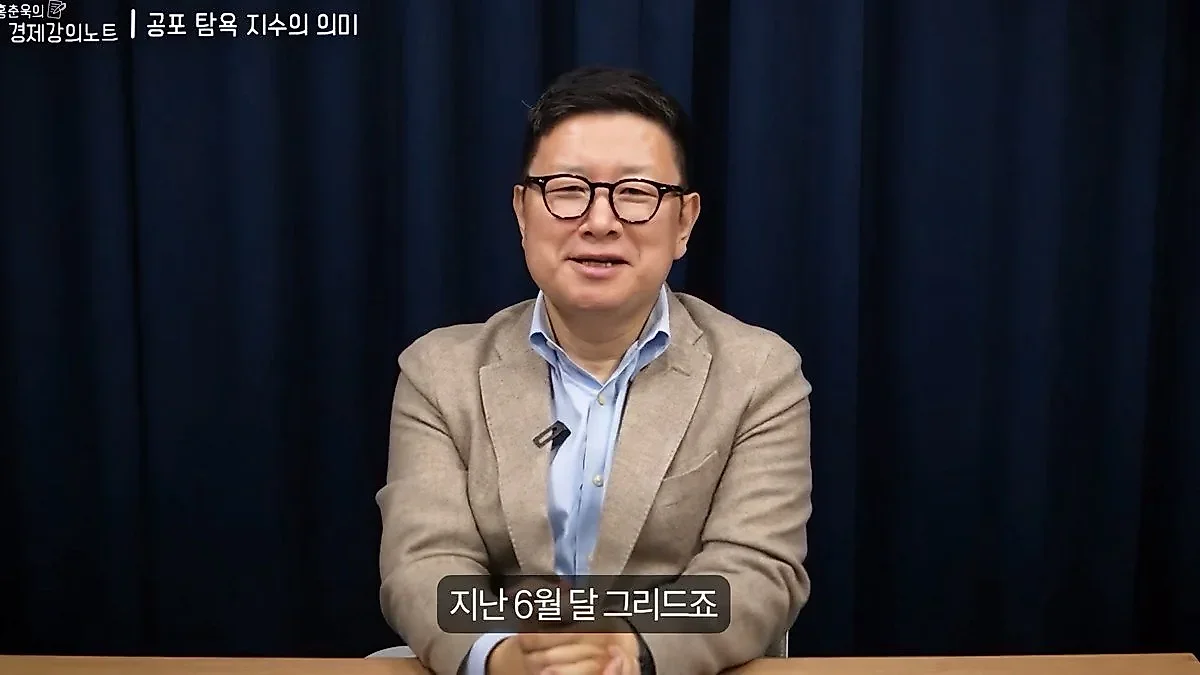
Dr. Hong Chun-uk warned that South Korean market volatility can be excessive due to structural vulnerabilities, noting that the VIX Index exceeding 30 has historically coincided with KOSPI crashes averaging between 30% and 80%.
As market volatility increases and investor anxiety reaches its peak, experts must determine the criteria for reading and responding to market fear. Dr. Hong Chun-uk has diagnosed current market conditions using the Fear & Greed Index, a metric representing market anxiety, and presented specific response measures to protect assets during a bear market.
Market Sentiment via 7 Indicators: The Fear & Greed Index
The Fear & Greed Index shared by Dr. Hong is a metric used by global financial media, such as CNN, to represent the sentiment of market participants with a number between 0 and 100. A value closer to 100 signifies a state of "extreme greed" where capital is concentrated in the stock market, while a value closer to 0 signifies "extreme fear" as investors flee the market.
This index is calculated by combining seven detailed sub-indicators. These include price momentum (comparing the S&P 500 Index to its 125-day moving average), strength (the ratio of stocks hitting new highs versus new lows), stock price breadth (the direction of trading volume), and the put/call ratio (comparing the trading volume of put and call options). These are combined with the VIX Index, which represents market volatility, the preference for safe assets through the spread between stock and bond yields, and the credit spread, which reflects the difference in credit ratings among companies, to determine the final index.
Dr. Hong particularly emphasized the importance of the credit spread. He explained that as the interest rate gap widens between blue-chip companies (e.g., Apple, Coca-Cola) and companies with low credit ratings, the market enters a stage of extreme fear.
VIX Index Surpassing 30 is a 'Warning Signal': Vulnerability of the South Korean Market
Mentioning the VIX Index, a core element of the fear index, Dr. Hong warned that caution is required when the VIX Index exceeds 30. Historically, during major economic crises such as the Asian Financial Crisis, the 2000 IT bubble burst, the 2008 global financial crisis, and the 2020 COVID-19 pandemic, the VIX Index exceeded 30, and during these times, the South Korean stock market experienced crashes averaging between 30% and 80%.
Interestingly, recent volatility in the South Korean market has shown a tendency to be excessive compared to the volatility of the United States market. Dr. Hong attributed this to the supply and demand structure of the South Korean market. He analyzed that the market possesses structural vulnerabilities where even minor shocks cause significant tremors due to the intensified concentration on specific large-cap stocks like Samsung Electronics and SK hynix, the concentration of funds in single-stock leveraged ETFs, and the rebalancing structure of the National Pension Service. Dr. Hong expressed regret that despite growth in GDP and national income, market stability has actually decreased compared to the past.
"Rebalancing with Eyes Closed"... 3 Strategies to Survive a Bear Market
How should investors act when the market plunges? Dr. Hong presented three response strategies based on investment styles. First, he emphasized that for momentum investors, strictly adhering to pre-set "stop-loss lines" is a mark of skill. Citing a past case where he warned when the KOSPI Index fell below the 7,100–7,200 level (the neck line), he stated that cutting losses according to principles is key to protecting assets.
On the other hand, for "contrarian investors" aiming to buy low by utilizing market shocks, rebalancing (asset reallocation) is the core. He argued that when the market is gripped by fear and assets are ignored by everyone, boldness is required to sell other assets to increase the weight of those specific assets. If investing in individual stocks is difficult, he recommended switching to ETFs, an indirect investment method.
Regarding the "difficulty of buying at the bottom" experienced by many investors, Dr. Hong offered the practical advice that one must "do it with eyes closed." He stated, "No one can know the bottom and the peak of the market," and suggested that rather than trying to time the market, one should move mechanically according to pre-determined rules. He revealed that he recently performed rebalancing according to his model's criteria when the KOSPI recently plunged.
If selling United States stocks to buy South Korean stocks is psychologically too painful, he suggested "cash-utilization rebalancing" as an alternative. Instead of touching existing investment assets, this method involves injecting held cash, such as bank deposits, to bring the weight of declined assets back to the target level. Dr. Hong concluded, "These difficult times are when an investor's skill is revealed, and I hope you ask yourself whether you are prepared for the next downturn through this crisis."
Source: original video (YouTube)


0Comments
Comments are currently disabled.