
Wearable robots to provide essential first-person data for Physical AI
KAIST Professor Gong Gyeong-cheol suggests that wearable robots will serve as essential platforms for collecting first-person data necessary to advance Physical AI. He argues that hardware must handle physical noise to allow AI to function effectively in the real world.
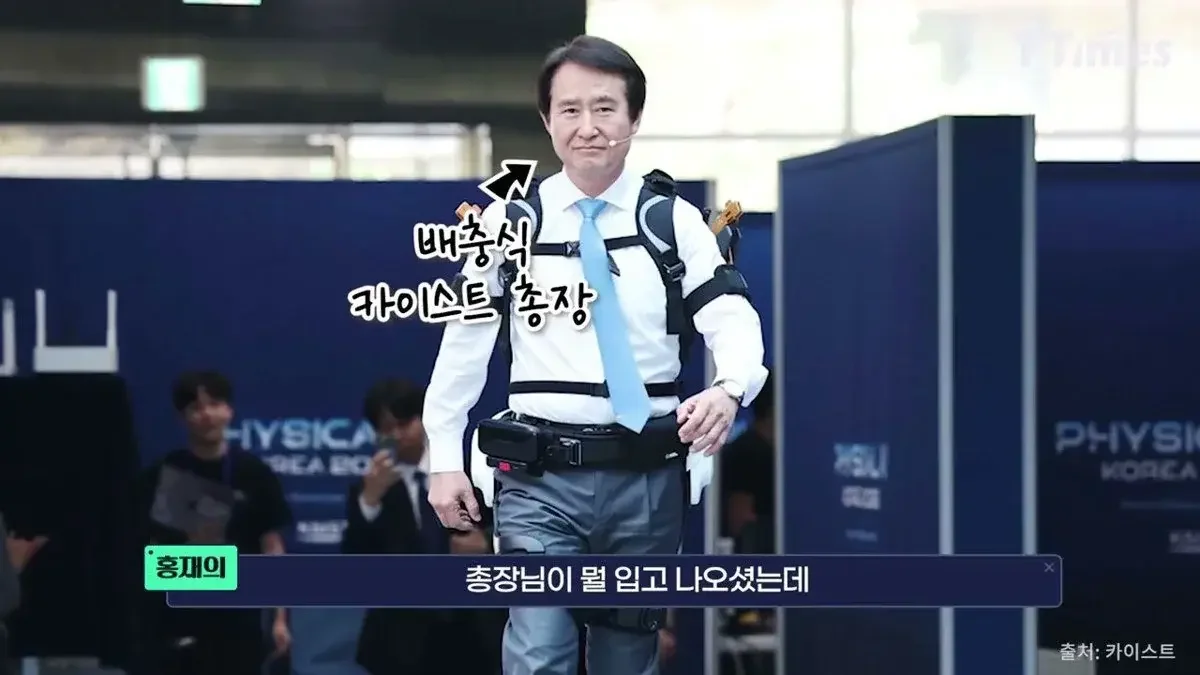
KAIST Professor Gong Gyeong-cheol says wearable robots will serve as vital first-person data collection platforms to help humanoid robots navigate unpredictable physical environments. By capturing human-centric data like foot force and reactions to slippery floors, these devices can provide the sophisticated information needed to overcome the limitations of standardized factory or virtual training data.
As Artificial Intelligence (AI) moves beyond generating language and images into the era of "Physical AI" with physical presence, robot hardware technology and data collection methods are emerging as new focal points. In particular, wearable robots that assist human movement are gaining attention as a key platform to enhance the completeness of humanoid robots.
According to an interview with KAIST Professor of Mechanical Engineering and CEO of Angel Robotics Gong Gyeong-cheol, reported by T Times TV, success in the Physical AI era does not depend solely on the performance of software such as Large Language Models (LLMs). "Because robot movement is a sequence that includes the concept of time, even a 1% error is unacceptable," Gong emphasized, adding, "Rather than having AI process all the complex noise of the physical world, it should be resolved at the hardware level."
"Handling a hot cup is a matter of reflexes, not the brain"
Explaining how robots respond to physical environments, Professor Gong stressed the importance of "reflexes." When a human touches a hot cup, the immediate withdrawal of the hand is a result of reflexes occurring at the spinal cord level before the brain can even make a judgment. The same applies to robots. If a robot sends all information to a central controller (the brain) to judge whether an object is slippery or heavier than expected, the response speed becomes too slow.
"When a gripped object is slippery or heavy, the response should be handled at the actuator level immediately rather than sending it up to the brain," Gong said. His analysis suggests that hardware itself must possess the intelligence to control physical friction or inertia so that AI can implement precise movements without being swayed by the noise of the physical world. The video explains that by controlling backlash (the play between gears) or driving friction at the actuator level, robots can appear to follow ideal physical laws, much like the human body.
Wearable robots have already accumulated this high-level control technology. Due to the nature of being worn directly on the human body, safety standards and medical precision are essential. "Wearable robots have already completed one commercialization cycle by passing through the harsh regulations and safety standards of the medical industry," Gong explained. "The actuator control technology and safety mechanisms accumulated during this process are being integrated into the control philosophy of humanoid robots." Indeed, wearable robots have proven their effectiveness in rehabilitation therapy and have expanded into areas such as reports of deployment in the Russia-Ukraine war and the distribution of suits for musculoskeletal protection in industrial sites.
The value of 'first-person perspective' in determining data quality
In terms of "data," the core driver of Physical AI, the role of wearable robots is unrivaled. Much of the data currently used for AI training is created in standardized factory environments or virtual spaces. However, the actual physical world is full of unpredictable variables such as friction, temperature, and irregular terrain.
Gong pointed out that "real data comes from environments that include 'reasoned noise' caused by human intervention, not from standardized environments." This means that complex situations, where movements differ from person to person even when performing the same task and responses vary depending on the surrounding environment, are essential for learning. Questioning whether data obtained by a part-timer operating a robot in a simulated factory space is truly "real data," Gong emphasized that the complexity created by the "Human Factor" must be captured in the data.
In this process, wearable robots become a "first-person data collection platform" that can observe human movement most closely. "There is no tool as efficient as a wearable robot for measuring first-person perspective data, such as the force a foot feels when a person walks, the reaction on a slippery floor, or the movements when handling hot objects," Gong said. This can provide much more sophisticated and useful physical data than simply attaching a camera to observe a worker. The video explains that while attaching cameras to workers in places like China or India may cause discomfort, wearable robots can be industrially expanded by providing economic motivation to the data providers.
Need for hardware-based innovation beyond AI universalism
Gong advised caution against the "AI universalism" caused by the recent "GPT moment." He noted that the belief that the scale of data will solve all problems can be dangerous in the field of robotics. While a language model is successful if it produces plausible results with 99% probability, a robot can lead to physical collisions or accidents.
"It is not desirable to put all the noise of the physical world into AI training," he added. "Hardware must remove as much physical noise as possible so that AI can demonstrate its inherent intelligence." He explained that wearable robot actuators contain high-level control algorithms—sufficient to ensure safety even if a wire is pulled—and that such technology will become the core of Physical AI.
The Physical AI technology platform project recently pursued by KAIST is being conducted in this same context. KAIST aims to build a technical foundation that integrally provides robot actuators, data centers, sensory and motor intelligence algorithms, and sensors. Through this, the goal is to lay the foundation for South Korea as a whole to lead Physical AI innovation without becoming dependent on specific large corporations or U.S. big tech companies.
Source: original video (YouTube)

0Comments
Comments are currently disabled.