
AI technology to drive South Korea's first potential growth rebound in 40 years
South Korea's potential growth rate is projected to rise for two consecutive years due to AI-driven shifts in capital investment and productivity, marking a reversal seen for the first time in 40 years.
South Korea's potential growth rate is expected to rise for two consecutive years to 2.1% this year and 2.2% next year, marking a unique turnaround driven by AI-related semiconductor investments and productivity gains.
As the global economy enters a phase of entrenched low growth and weakening momentum, South Korea is diagnosed to experience an unusual rebound in its potential growth rate for the first time in 40 years. This is due to massive changes brought about by artificial intelligence (AI) technology, which are fundamentally altering the growth structure of the South Korean economy.
According to this analysis provided by The Man Who Explains the Economy (Kim Kwang-seok TV), a recent economic outlook report from the IMF evaluated that the South Korean economy has undergone a major turnaround for the first time in 40 years. While the global economy has continued a low-growth phase following the pandemic, and growth in 2026 is projected to be the lowest since the pandemic due to geopolitical risks such as wars in the Middle East, the IMF raised its global economic growth forecast by 0.1 percentage point, though the low-growth trend remains distinct.
AI grows 'LEGO blocks'... potential growth rate expected to rise for two consecutive years
In contrast, the trajectory of the South Korean economy is unique. The IMF projected South Korea's growth rate for this year at 3.3%. This is a significant upward revision from previous forecasts of 1.9% in April and 2.6% in July, representing an unprecedented scale of upward adjustment. Notably, it is not just the real growth rate, but the rebound of the "potential growth rate" that is significant. South Korea's potential growth rate, which had been falling below 2.0%, is predicted to rise for two consecutive years to 2.1% this year and 2.2% next year. This is the first time such an occurrence has happened in 40 years.
Professor Kim Kwang-seok explained the three components of potential growth—"labor input," "capital input," and "total factor productivity"—using a metaphor of LEGO blocks. In the case of South Korea, even though labor input is not increasing, new investments in AI-related semiconductors are expanding "capital input," and AI technology is boosting "productivity," which ultimately grows the entire block known as the potential growth rate. In particular, the trend of supplementing labor through the use of Agentic AI is accelerating this change.
South Korea overcomes energy shocks... AI hardware exports are key
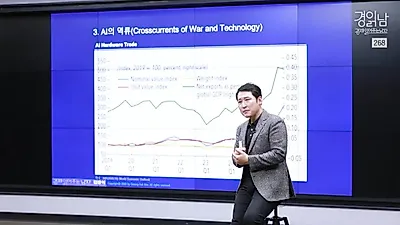
The reason South Korea was able to relatively well withstand the rise in oil prices and energy supply shocks caused by wars in the Middle East lies in the structural changes of the AI industry. According to the analysis model in the IMF report, countries that are net energy importers but simultaneously export AI hardware (semiconductors, materials, equipment, etc.) can offset economic damage because the export profits from the AI boom are greater than the shock of surging oil prices. South Korea and Taiwan are representative examples.
Indeed, looking at the overall export trends of South Korea, the AI hardware trade is increasing rapidly and driving the overall export growth trend. This creates a structure where the growth of the AI industry defends against the downward pressure brought by rising energy prices.
Arrival of the 'Electric Age' with lowered energy dependency
The reason the global economy has become less sensitive to energy shocks like past oil shocks can also be found in technological progress. This is because "energy intensity," the proportion of energy in GDP, is declining in the long term. In the past, there was an absolute dependence on fossil fuels for power production, but currently, the energy structure has diversified as the proportion of renewable energy and nuclear power increases.
"We have now entered the 'Electric Age,' where the method of producing electricity has shifted from being centered on crude oil and natural gas to being centered on renewable energy," Kim explained. "The combination of this change in energy structure and AI technology is a key factor in reducing the impact of energy supply shocks."
Source: original video (YouTube)


0Comments
Comments are currently disabled.