
AI technology is reshaping economic structures and the future of work
The advancement of artificial intelligence is fundamentally altering economic structures and job ecosystems, creating a divide between those who utilize AI and those replaced by it. As AI evolves from simple chat interfaces to autonomous agents, the nature of work is shifting from task execution to goal-setting and strategic oversight.
South Korea's potential growth rate has rebounded to 2.1% as the nation participates in the AI value chain, with the IMF projecting it could rank second globally in current account surplus size by 2026. This technological shift is transforming office work into a competition between those who utilize AI and those who are replaced by it.
The advancement of artificial intelligence (AI) technology is fundamentally changing economic structures and the ecosystem of occupations. As the gap widens between nations that contribute to the creation of AI and those that do not, a trend is emerging at the individual level where society is being divided into those who utilize AI and those who are replaced by it.
AI-driven 'Money Backflow' and Changes in the South Korean Economy
According to an analysis presented by the YouTube channel The Man Who Explains the Economy (Kim Kwang-seok TV), AI technology is causing a 'money backflow' in terms of macroeconomics. While global economic growth has been sluggish at 3.1% since the 2020 pandemic, South Korea is experiencing economic windfalls by participating in the AI value chain, recording a growth rate in the 3% range. In particular, South Korea's potential growth rate is showing an upward trend, rebounding to 2.1% for the first time in 40 years.
The influence of AI is also evident in corporate performance. Excluding past cases of Saudi Aramco, Samsung Electronics is showing record-breaking performance rarely seen in human history, leading to unprecedented exports and a current account surplus. According to a diagnosis by the IMF, South Korea is projected to rank second in the world in terms of current account surplus size in 2026, following China. This achievement is expected to lead to excess tax revenue of approximately 150 trillion won, which will influence the determination of the 2027 budget.
The End of Office Work and the Changing 'Rules of Work'
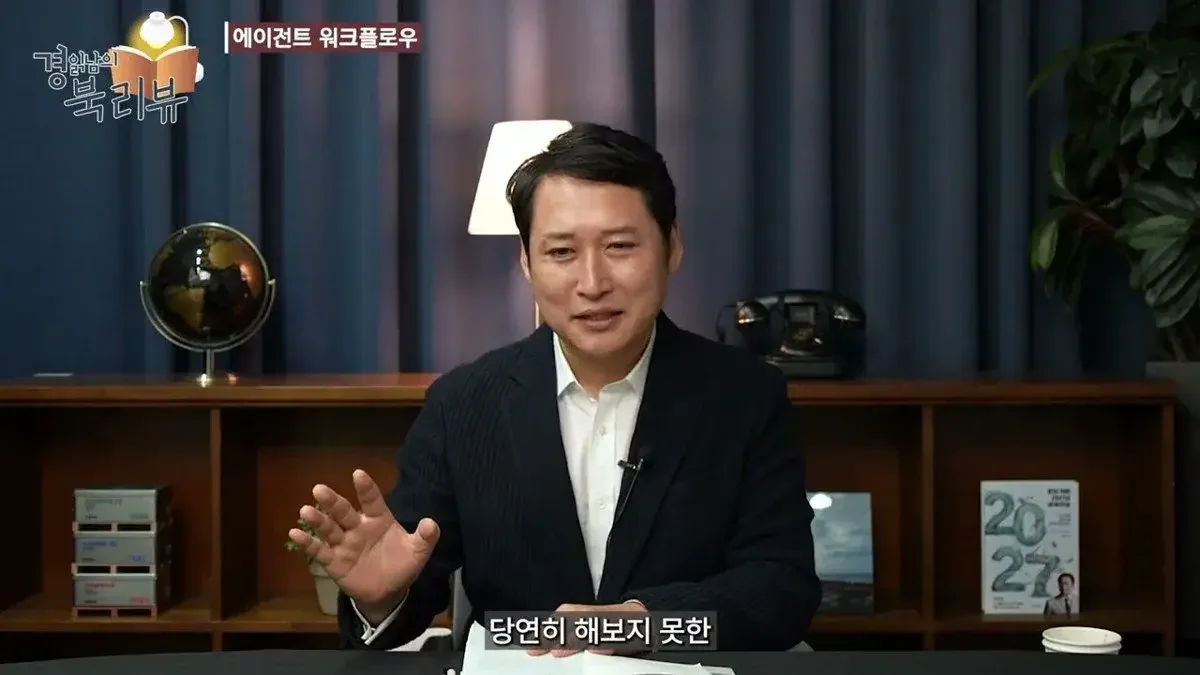
Technological progress is also changing the forms of occupations. The area that will face change first is office work. Based on the contents of the book 'Agent Workflow' by CEO Ro (Kim Da-sol) introduced by The Man Who Explains the Economy (Kim Kwang-seok TV), the core point is that it is not a fight between humans and AI, but a competition between people who use AI and people who are replaced by AI. With the introduction of AI, the 'rules of work' themselves are changing beyond a simple change of tools.
Human roles will change according to the generational evolution of AI. In the first generation 'chat-type AI' era, where the role was to answer questions, the human role was limited to asking questions. In the second generation 'reasoning AI' era, which analyzes problems and finds solutions, the human role expands to making judgments based on various scenarios. The following third generation 'Agentic AI' will reach a stage where it independently conducts research, planning, and execution once a goal is set; in this stage, humans must perform the role of instilling clear goals and standards in the AI.
Maximizing Productivity in the AI Era and Response Methods
AI tends to increase the amount of work that can be processed rather than reducing working time. While productivity can be increased as research, summarization, and drafting become possible in minutes through AI, the total volume of work to be processed increases, leading to a phenomenon where work density rises. Therefore, survival in the AI era depends on how to utilize AI to maximize output.
It is projected that by around 2027, the era of 'Physical AI,' where AI expands into the physical realm, will arrive. At that time, there is a possibility that not only office work but also blue-collar tasks will be significantly replaced. Ultimately, to survive in the changing environment, rather than adhering to existing ways of working, a new type of communication skill is required—one that recognizes AI as a persona or an equal collaborator and directs work by setting goals and standards.
Source: original video (YouTube)
0Comments
Comments are currently disabled.