
IMF raises South Korea's growth forecast to 3.3% on semiconductor demand
The IMF has raised South Korea's economic growth forecast to 3.3% for this year, driven by surging semiconductor exports, even as energy-driven inflation creates a gap between economic indicators and consumer sentiment.

The IMF has raised South Korea's economic growth forecast to 3.3% for this year, a significant jump from the 1.9% projected in April. This acceleration is driven by robust semiconductor exports, which reached $6.03 billion last month, even as rising energy and food prices weigh on consumer living costs.
The IMF has announced an upward revision of South Korea's economic growth forecast for this year to 3.3%, a 0.7 percentage point increase from the previous projection. This figure significantly exceeds the global average growth rate of 3.1% and the advanced economies average of 2.1%. The forecast has surged to 3.3% in just six months from the 1.9% projected in April, indicating that the momentum of the South Korean economy is accelerating faster than expected. The IMF explained that this growth rate is higher than the 2.3% projected for the United States.
Semiconductors, the Core of the AI Supply Chain, Drive Exports and Tax Revenue
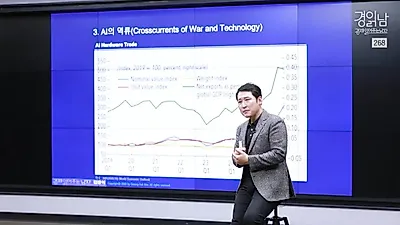
The primary driver behind the IMF's sharp increase in South Korea's growth outlook is the robust semiconductor exports resulting from expanded investment in artificial intelligence (AI). The IMF identified South Korea and Taiwan as key hubs in the AI hardware supply chain. As global demand for the construction of AI data centers and servers increases, the role of South Korean companies producing high-performance semiconductors, such as high-bandwidth memory (HBM), has grown. Essentially, increased AI investment creates a structure where South Korean exports rise.
The influence of semiconductors is clearly reflected in actual export indicators. Last month, semiconductor exports reached $6.03 billion, surpassing the $6 billion mark for the first time. Semiconductors account for nearly half of total exports. This strong semiconductor market has also directly impacted national finances. The government recalculated this year's expected tax revenue to 63 trillion won, an increase of 1 trillion won from the previous estimate, with more than half of this increase stemming from corporate taxes based on the performance of semiconductor companies. Both the rise in growth rates and the increase in tax revenue originate from the same cause: semiconductors.
The 'Bifurcation' Between Growth Rates and Perceived Economy
While economic indicators are improving, the reason the economy perceived by citizens remains low is due to the "bifurcation" characteristic of the economic structure. The IMF analyzed that future economic growth paths for countries will split into two branches depending on how deeply they are involved in the AI supply chain and how exposed they are to energy risks, such as war in the Middle East. This can be divided into three groups: the South Korea and Taiwan group, whose forecasts were raised due to semiconductor demand; the eurozone (1.1%) and Japan (0.7%) group, where consumption has contracted due to the burden of energy prices; and the Middle East and Central Asia group, where growth rates fell to -0.3%, 1 percentage point lower than in July, due to the suspension of energy exports.
South Korea occupies a unique position where these two forces act simultaneously. It is true that semiconductor exports are powerful enough to offset the negative repercussions of the war in the Middle East. However, South Korea's high dependence on energy imports remains a variable. To use the IMF's expression, the structure is one where semiconductors are "overwhelming" the shock of the Middle East war. Nevertheless, rising energy and food prices due to the aftermath of the Middle East war have increased the burden of living costs, causing individual economic leeway to decrease despite the rising economic growth rate. The IMF sets the global inflation forecast for this year at 4.7%, which significantly exceeds the 2% target of major central banks. The government also assessed that structural issues such as rising prices and interest rates, as well as polarization, remain.
Semiconductor Concentration Risk and Fiscal Soundness Management
While semiconductor-centered growth is a powerful driver, it is also a potential risk factor due to the excessive dependence of exports on a specific industry. The vulnerability of growth concentrated in semiconductors was demonstrated during the semiconductor super-cycle in 2018, when exports peaked at $126.7 billion, only to plummet to $93.9 billion the following year due to falling memory prices, causing the economy to falter. The IMF warned that global downside risks still exist, including tensions in the Middle East, trade disputes, raw material price volatility, and inflationary pressures.
Meanwhile, as the economic scale (the denominator) grows, the national debt ratio is showing a slight decline. The national debt ratio, which was expected to be 51.6% during the formulation of this year's budget, is projected to decrease to 50.6% due to effects such as the rise in the nominal growth rate. The government explained that the nominal growth rate forecast rose from 3.9% to 4.9%, and stated that this "denominator effect" had a significant impact on lowering the debt ratio. Since the nominal growth rate includes inflation, rising prices increase the nominal economic scale, resulting in a lower debt ratio. The government plans to secure fiscal buffers by adjusting the scale of government bond issuance using the increased tax revenue. However, the IMF advised that countries should secure fiscal space and manage soundness in the medium to long term.
Ultimately, the direction of the South Korean economy depends on how long the powerful energy of semiconductor exports can last and how much the increased growth rate can penetrate into the actual livelihood economy despite the burden of prices and interest rates. To understand future economic trends, it is necessary to monitor the semiconductor export statistics released on the 1st of every month, along with living cost indicators that show the gap between the growth rate and the perceived economy.
Source: original video (YouTube)


0Comments
Comments are currently disabled.