
Wedding halls maintain profits through food sales despite falling marriage rates
While the number of marriages is declining, the wedding industry maintains a robust profit structure as food costs, which account for 60% of total wedding expenses, drive the market.
Wedding halls are operating more like large-scale restaurants than traditional venues, with food costs accounting for over 70% of their revenue. Despite a decline in marriage ceremonies and guest numbers, the market remains stable as the average meal cost in Seoul has risen to approximately 80,000 won.
While it is widely predicted that the wedding industry is in crisis due to a sharp decline in the number of marriages, data reveals a different reality. Although the number of marriage ceremonies is decreasing, the cost per wedding is rising, allowing the market centered around wedding halls to maintain a solid profit structure.
According to an analysis by Lee Dong-yeol, CEO of Pitch Deck, shared by the channel Understanding: All the Knowledge in the World, the key keyword in the recent marriage market is "rising costs." Wedding gift money, which used to be around 50,000 won, has effectively become a baseline of 100,000 won. Coupled with inflation, the average meal cost per guest has soared to 60,000 won nationwide and approximately 80,000 won in Seoul. In the case of hotel weddings, meal costs can exceed 100,000 won. The average total cost for a wedding was surveyed at approximately 380 million won; excluding the 320 million won for housing costs, the pure wedding market size reaches about 50 million to 60 million won.
The essence of wedding halls is "large-scale restaurants," not "weddings"
An examination of the profit structure of wedding hall businesses reveals a pattern different from typical venues. While many believe that flashy hall interiors or rental fees are the core revenue sources, the true essence of a wedding hall is closer to a "food business." Meal costs account for approximately 60% of the total wedding cost, and more than 70% of wedding hall revenue is generated from food.
Lee Dong-yeol explained, "Wedding halls actually operate with a structure similar to large-scale restaurants." In fact, many wedding halls register their business purposes as Korean food or conventions and maintain their own cooking systems rather than outsourcing. The key factors determining the profitability of a wedding hall are not flashy decorations, but rather: ▲securing good locations and parking spaces, ▲appropriate food quality, and ▲efficient movement paths that allow for a fast turnover. Lee defined the core strategy of wedding halls as "selling reasonable food with the best movement paths at the fastest, highest turnover." Rental fees are effectively set at zero or low levels, creating a structure that earns profit through the meals provided to guests.
Polarized structure: Small "S-D-M" businesses vs. profitable platforms
The distribution of profits within the wedding industry is also imbalanced. Most companies representing the so-called "S-D-M" (studio, dress, and makeup) sector consist of small-scale individual entrepreneurs, resulting in low profitability. Conversely, marriage information companies, wedding planner agencies, and large wedding halls—which play the role of gathering and connecting customers—take relatively high profits. In short, companies that control customer touchpoints and achieve economies of scale monopolize the market's added value.
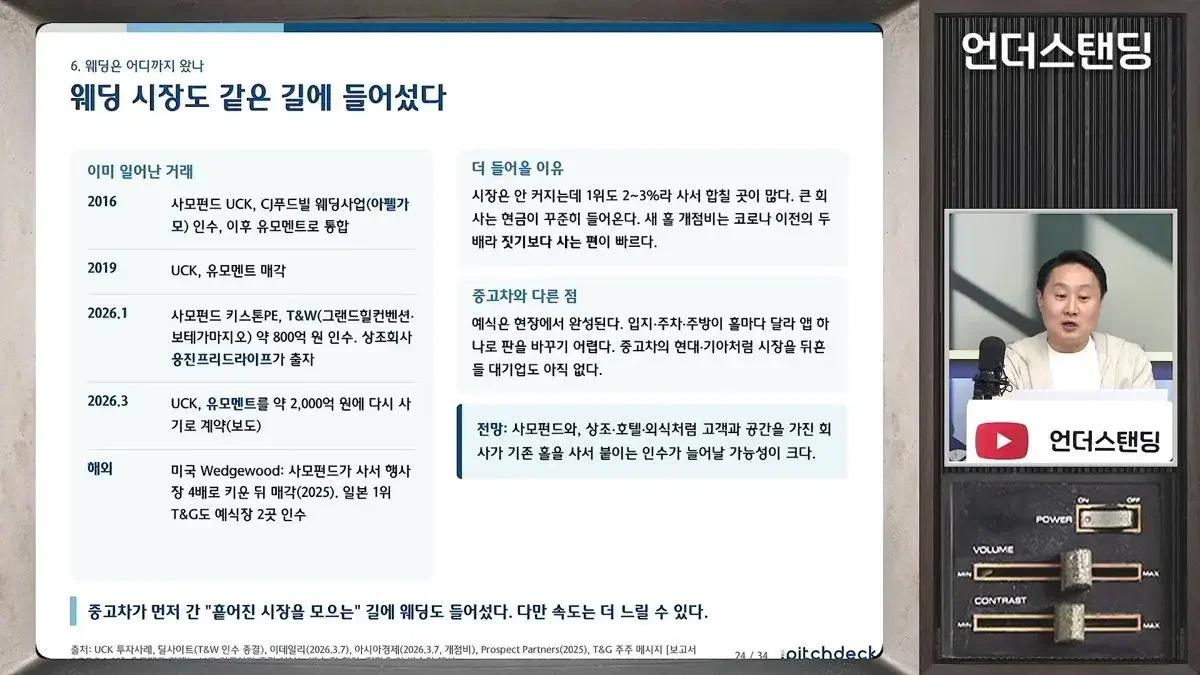
Due to these structural characteristics, the wedding industry is becoming a major target for private equity funds (PEF). Despite being a mature market with a decreasing number of marriages, it allows for easy prediction of revenue and costs and can generate stable cash flow. In fact, U Moment, which operates brands such as Apelgamo and The Classic 500, is a target for private equity M&A, recording an operating profit margin of approximately 15%. The market is undergoing active reorganization, with brands that were sold in the 130 billion won range in 2019 being traded again in the early 200 billion won range. As the cost of building new wedding halls rises significantly, it is becoming more advantageous to acquire existing companies to secure economies of scale.
Changes in wedding culture and the future of the market
The wedding culture currently enjoyed does not actually have a long history. Lee Dong-yeol analyzed that the modern form of weddings in South Korea has only been established for about 20 to 30 years. Following the tradition of weddings held in house courtyards and the strict family ritual rules of the 1960s and 70s, the current form—where "everything is resolved in one place"—was completed in the late 1990s when regulations on hotel weddings were relaxed. A decisive role in allowing hotel weddings in the late 1990s was played by a case of a groom who filed a constitutional petition against the prohibition of hotel weddings.
Recently, there has been a strong trend toward "small weddings," with the average number of guests decreasing from 339 in the past to around 260 this year. In Japan, a culture of strictly managing the number of guests through a reservation system has become established, and South Korea is also showing a trend of gradually shrinking in scale. However, in terms of market size, a massive market of approximately 4 to 5 trillion won has formed, even when excluding housing costs. This is comparable to the size of the used car market.
In the future, the wedding market is likely to be reorganized around large companies that secure economies of scale by acquiring high-quality existing businesses rather than constructing new wedding halls. It is expected that even if the number of marriages decreases, large companies will increase their market share and maintain or increase their pricing power.
Source: original video (YouTube)


0Comments
Comments are currently disabled.