
South Korea's potential growth rate to rise for first time in 40 years
South Korea is facing an unprecedented growth rebound as AI-driven technological advancements boost the nation's potential growth rate, a phenomenon not seen in 40 years.
South Korea's potential growth rate is projected to rise to 2.1% this year and 2.2% next year, marking a two-year increase driven by AI semiconductor investments and productivity gains. This rebound in fundamental economic strength is occurring for the first time in 40 years, even as the IMF expects global growth to hit its lowest point in 2026.
The South Korean economy stands at a crossroads for an unprecedented growth rebound for the first time in 40 years. Amid concerns over entrenched low growth, a "reverse flow of money" driven by artificial intelligence (AI) technology is lifting the potential growth rate, which serves as the fundamental strength of the South Korean economy.
According to an analysis of IMF economic forecasts presented by The Man Who Explains the Economy (Kim Gwang-seok TV), the South Korean economy is tracing a highly unusual growth trajectory. While the global economy remains in a low-growth phase following the pandemic, with growth expected to be at its lowest in 2026, South Korea has instead shown a pattern of historic upward revisions to its growth forecasts.
The IMF revised South Korea's growth forecast from 1.9% in April to 2.6% in July, and subsequently to 3.3% this October. This scale of upward revision is at an all-time high. Notably, not only is the real growth rate rising, but the potential growth rate—the economy's fundamental strength—is also rebounding. After falling below 2.0%, the potential growth rate is projected to rise to 2.1% this year and 2.2% next year, marking a rise for two consecutive years. This is a phenomenon appearing for the first time in 40 years in the history of the South Korean economy. Professor Kim Gwang-seok noted that South Korea's potential growth rate is expected to rank approximately 6th to 7th among major global economies, contrasting with other major nations like the United States, which are forecasting a decline in potential growth rates for next year.
Growth of 'Lego Blocks' driven by AI semiconductor investment
Professor Kim Gwang-seok attributed this rise in the potential growth rate to changes in its three constituent elements: labor, capital, and total factor productivity. The potential growth rate is the result produced by the combination of these three factors.
"Even if labor input does not increase, new investment in AI-related semiconductors is making capital input 'fatter,' while simultaneously, AI technology is boosting productivity," Kim analyzed. He explained that even without a quantitative expansion of the workforce, the combination of large-scale capital investment and productivity improvements—achieved by using methods such as Agentic AI to handle tasks—is increasing the resulting potential growth rate.
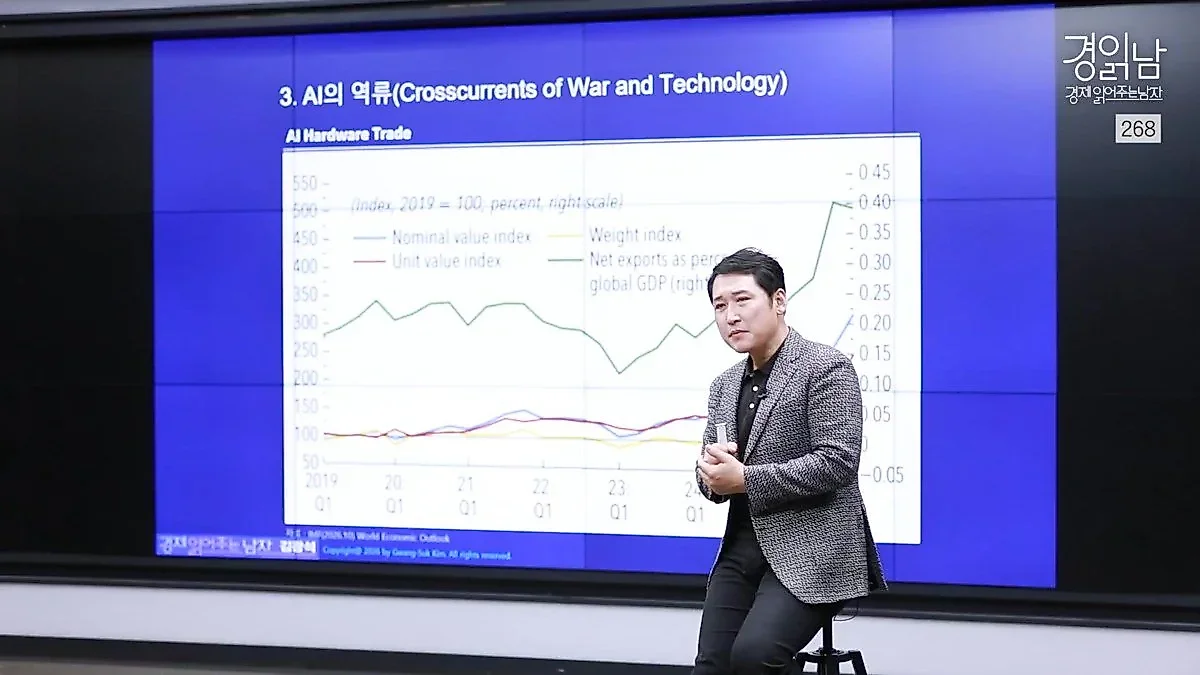
In particular, countries that export AI hardware, such as South Korea and Taiwan, are experiencing a "reverse flow" phenomenon where the export profits from the booming AI industry outweigh the energy price shocks caused by conflicts in the Middle East. According to the IMF analysis model, countries that are net energy importers but also export "AI Enabling Goods"—such as AI-related semiconductors, materials, and equipment—can offset the downward pressure of surging oil prices through strong AI exports. Looking at current overall export trends in South Korea, the rapid increase in AI hardware trade is leading this growth trend.
Falling 'Energy Intensity' mitigates oil price shocks
The reason the South Korean economy remains relatively resilient despite continuous supply shocks, with international oil prices exceeding the $100 per barrel mark due to geopolitical risks in the Middle East, can also be found in technological changes. According to the IMF report and Kim's analysis, this is because "Energy Intensity" (or "Oil Intensity")—the ratio of energy to GDP in the global economic structure—is continuously decreasing.
During the oil shocks of the 1970s and 1980s, energy supply disruptions dealt fatal blows to the global economy, but the current energy structure is vastly different from the past. Not only has the proportion of energy input required for economic growth decreased, but the methods of power production have rapidly shifted from a traditional focus on fossil fuels to renewable energy and nuclear power. "We have now entered the era of electricity, and rather than relying solely on crude oil or natural gas as in the past, renewable energy is contributing significantly," Kim explained.
As a result, an effect is appearing where the downward pressure caused by rising oil prices is mitigated compared to the past. "As the proportion of energy in GDP decreases, the effect of mitigating downward pressure from rising oil prices is appearing," Kim diagnosed, adding, "Technological advancement is lowering energy dependency and increasing economic resilience."
Source: original video (YouTube)



0Comments
Comments are currently disabled.