
KOTRA warns exporters that invoice prices differ from Japanese taxable prices
Lee Ui-jong, head of the FTA Overseas Utilization Support Center at the Korea Trade-Investment Promotion Agency (KOTRA) Tokyo Trade Center, warned that non-tariff barriers, rather than tariff rates, are the critical variable for exports to Japan.
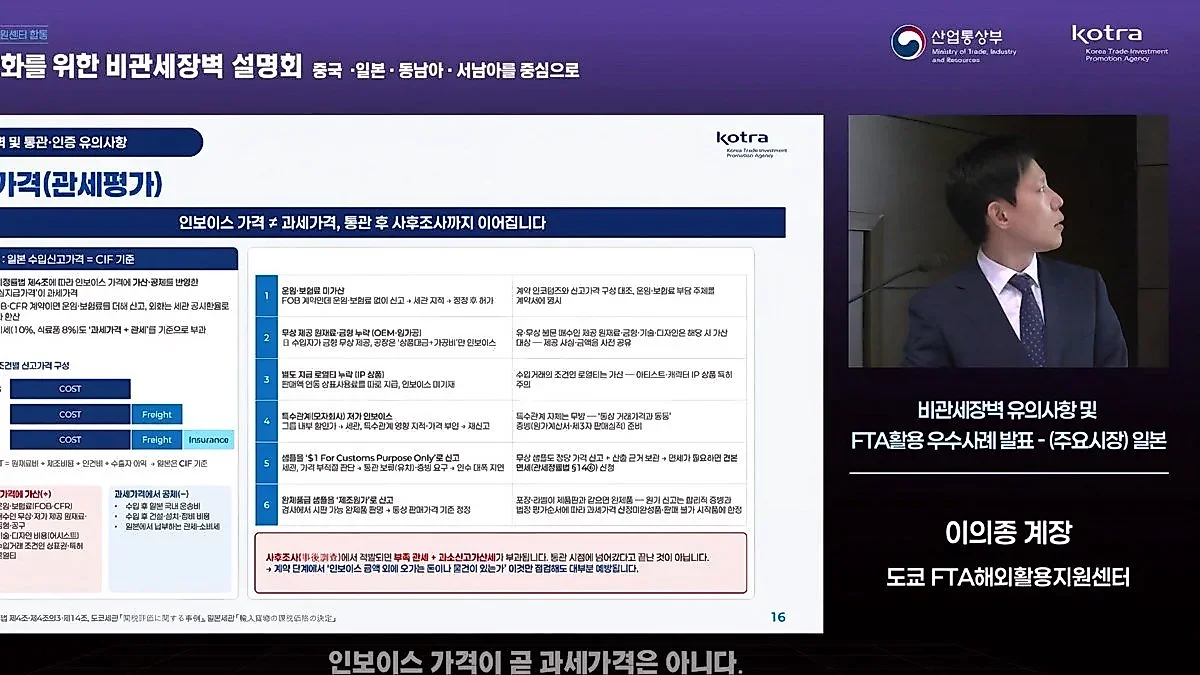
Lee Ui-jong of KOTRA warned that South Korean exporters must include freight, insurance, and royalties in declared prices to avoid customs delays in Japan, where the invoice price is not the taxable price. While semiconductor exports to Japan surged more than twofold this year, companies face risks if they fail to account for these costs during clearance.
What causes cargo exported to Japan to be halted at customs? Is it high tariff rates? Lee Ui-jong, head of the FTA Overseas Utilization Support Center at the Korea Trade-Investment Promotion Agency (KOTRA) Tokyo Trade Center, pointed out that the key variable for exports to Japan lies in "non-tariff barriers" rather than tariffs.
According to a video from the "2026 Briefing on Non-Tariff Barriers for Export Diversification" released by KOTRA TV, the trend of South Korea's exports to Japan is undergoing a change. While exports to Japan decreased by more than 4% compared to the previous year in 2025, leading to a larger trade deficit, exports from January to August this year showed a rebound, increasing by more than 14% compared to the same period last year. In particular, driven by demand for AI memory, semiconductor exports surged more than twofold, rising to the second-ranked export item.
Shift in export structure toward consumer goods like cosmetics and food
The composition of export items is also changing. While exports to Japan were centered on industrial goods in the past, consumer goods such as cosmetics and food have recently emerged as new growth axes. In the case of cosmetics, export value to Japan has exploded nearly eightfold from the $100 million range to the $1.1 billion range over the past 10 years. South Korea's share of the Japanese imported cosmetics market has reached 30.8%, ranking first for four consecutive years and surpassing France.
However, the results vary by item. While cosmetics and pharmaceuticals are growing, food and clothing have decreased significantly compared to before. This suggests that the center of Japanese exports is shifting toward "beauty and health." In relation to this, the Japanese government is considering a plan to lower the food consumption tax from 8% to 1% for two years starting next April, which is expected to open new opportunities for K-food companies.
Lee Ui-jong cited the polarization between cost-effectiveness and premium products, as well as the expanding demand for small packaging and health products due to single-person households and a super-aging society, as characteristics of the Japanese market. He emphasized, "With the weak yen and rising inflation, Japanese consumers are more price-sensitive than ever. Taking advantage of RCEP and meeting delivery dates without customs issues is what constitutes price competitiveness in the Japanese market."
"Invoice price is not the taxable price"... Caution against customs risks
The most important aspect for companies exporting to Japan to be careful of is the customs clearance process. While Japan's tariff rates themselves are low, the requirements are dense and operations are strict; if customs clearance is delayed, companies may face the worst-case scenario of having to return cargo in addition to incurring bonded warehouse storage fees.
In particular, Lee urged caution when calculating the declared price. While many Korean companies conduct contracts based on FOB (Free On Board) or CFR (Cost and Freight) terms, Japanese customs view the import declaration price based on CIF (Cost, Insurance, and Freight) terms. This means the price written on the invoice is not the taxable price used as the basis for imposing duties.
Therefore, when declaring imports, the freight and insurance costs missing from the invoice must be added. Additionally, raw materials, molds, technology/design costs provided by buyers for free or at low prices, and royalties paid according to transaction terms must also be included in the declared price. If these are omitted, it may be considered that the declared contents do not match the actual cargo, which can cause disruptions in customs clearance.
RCEP utilization and responding to non-tariff barriers are key
There is currently no bilateral FTA between South Korea and Japan. Therefore, the primary channel to receive actual preferential tariffs when exporting to Japan is RCEP. Through RCEP, Japan has agreed to phased abolition of tariffs on 83% of all items. However, as of the second quarter of this year, the actual utilization rate of RCEP stood at only 81.2%. This implies that even if companies know the tariff rates, some fail to receive actual benefits due to the burden of complex documentation, such as proof of origin.
Lee suggested ingredients and cost-effectiveness as key keywords for companies preparing to enter the Japanese market. For cosmetics, ingredients are vital, while for food, frozen, convenience, and health foods are promising. In the industrial goods sector, he recommended paying attention to the demand for semiconductor equipment/materials, data center infrastructure, and decarbonization-related materials, parts, and equipment in line with the Japanese government's large-scale investment plans through 2040.
Source: KOTRA TV (YouTube)
0Comments
Comments are currently disabled.