
Semiconductor boom delayed in boosting consumption as oil prices hit immediately
While a semiconductor boom is driving economic growth, the positive effects on private consumption are expected to take two years to materialize, whereas rising international oil prices are providing an immediate drag on spending.
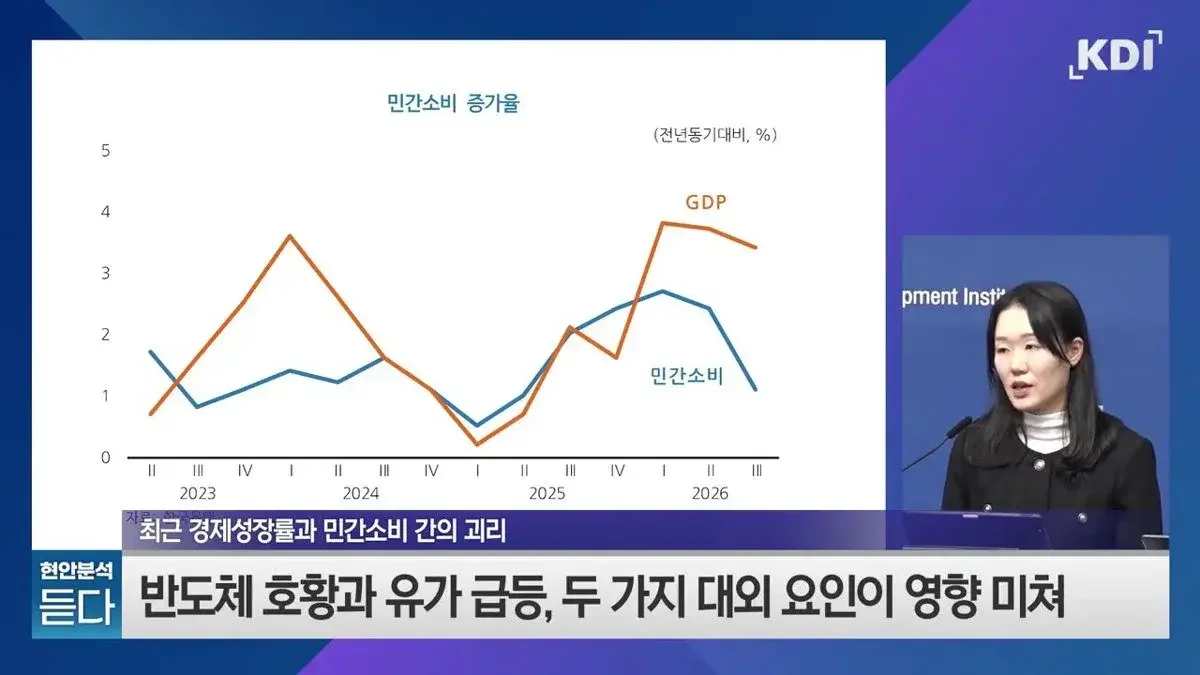
Rising international oil prices are causing an immediate 0.4 percentage point decrease in this year's consumption growth rate, while the positive effects of the semiconductor boom are not expected to appear until next year. The Korea Development Institute reports that while semiconductor price shocks peak approximately two years after they occur, oil price shocks impact households much faster.
While a record-breaking boom in semiconductor exports is driving up the economic growth rate, the improvement in private consumption felt by households remains slow. This is because the positive effects of the semiconductor boom appear with a time lag, while the negative impact of rising international oil prices is immediately pressuring consumption.
The Korea Development Institute (KDI) explained this economic situation in a recent issue analysis report analyzing the impact of the semiconductor boom and rising oil prices on private consumption. KDI research fellow Kim Ji-yeon diagnosed that while the growth trend of the economy is strong, the growth rate of private consumption is slowing, widening the gap with the economic growth rate. This divergence occurred due to the collision of two external factors: strong semiconductor exports driven by expanded AI infrastructure investment (an upward factor) and rising international oil prices caused by conflicts in the Middle East (a downward factor).
Semiconductor trickle-down effect takes '2 years'... Oil prices hit 'immediately'
KDI research fellow Ma Chang-seok analyzed that the rise in semiconductor export prices has significantly improved Gross Domestic Income (GDI) and increased real purchasing power. GDI is an indicator calculated by reflecting real trade profits or losses due to changes in terms of trade onto GDP, meaning that more imported goods can be purchased with the same export volume. In particular, as terms of trade are expected to improve significantly, with the semiconductor export price growth rate reaching 145.3% in 2026, the possibility of expanding household consumption capacity is greater than during past export booms.
However, it takes considerable time for these positive developments to lead to actual consumption. The transmission path of the semiconductor boom involves a process where increased corporate operating profits are passed to household income through bonuses or dividends, which then leads to increased employment, investment, and general consumption expansion. According to KDI's analysis, when a semiconductor price shock occurs, the impact on consumption shows almost no appearance during the first year and begins to react gradually after about one year. It was confirmed that the effect reaches its peak approximately two years (7 to 8 quarters) after the shock occurs. In the video, it was explained that a semiconductor price shock of a scale of 2.3 in the fourth quarter of 2025 and 3.2 in the first quarter of 2026 occurred, which is 2 to 3 times higher than typical price fluctuation levels.
In contrast, the speed at which rising international oil prices affect consumption is much faster. An oil price shock immediately reduces consumption right after it occurs, the effect grows for about three quarters, and only gradually disappears after a year and a half. This is because oil prices are directly linked to prices that have a direct impact on household consumption, such as fuel and heating costs. Currently, the economy is taking a "good medicine" in the form of semiconductors, but its effects have not yet appeared, while consumption is being constrained by the "side effects" of oil prices. In the second quarter of 2026, an oil price shock of a scale of 1.7, which is larger than usual, occurred due to the impact of conflicts in the Middle East region.
In the domestic situation, the increase in petroleum prices is being partially suppressed by the implementation of a maximum price system, but consumption is being constrained as rising international oil prices transfer to core inflation and related items such as travel and aviation services. Furthermore, as nominal wage growth has stagnated while the inflation rate has expanded, real wages decreased in the second quarter and continued to remain at low levels in the third and fourth quarters, analyzing that household consumption capacity is weakening relatively quickly.
Consumption improvement expected to expand next year... 'Non-semiconductor sector' is key
KDI research fellow Lee Seung-hee predicted the consumption flow for this year and next year based on this time lag. The impact of the semiconductor boom on private consumption this year is near 0%, but the rise in oil prices resulted in a 0.4 percentage point decrease in the consumption growth rate this year. In other words, this year's moderate consumption improvement is the result of the absence of the semiconductor effect combined with the immediate reflection of the oil price shock.
The situation is expected to change next year. As the positive effects of the semiconductor boom take full effect, the consumption growth rate is expected to be pulled up by about 0.6 percentage points next year. The negative effect from rising oil prices is expected to be limited to a 0.2 percentage point decrease, which is half the level of this year as the shock diminishes; consequently, the trend of consumption improvement is expected to expand more than this year next year.
However, KDI cautioned about future economic volatility. If the rise in oil prices continues due to the prolonged conflict in the Middle East, the constraint on consumption could be prolonged, as high market interest rates, a slowdown in the stock market, and low wage growth in the non-semiconductor sector continue to pressure household consumption capacity. Additionally, there is a possibility that the significantly expanded scale of bonuses and dividends recently in the semiconductor industry may not have been sufficiently reflected in the analysis model, which could act as an "upward risk" (positive variable) for the forecast.
Policy suggestions for sustainable consumption recovery
KDI suggested regarding the government policy direction, "Rather than inducing short-term increases in consumption expenditure, it is necessary to strengthen the foundation for sustainable consumption recovery by improving employment and income conditions." As the consumption improvement trend is expected to gradually expand from next year, the judgment is that the need for additional demand stimulation policies targeting the overall economy is not large.
In particular, if income improvement is concentrated only in specific sectors such as semiconductors, there is a concern that the consumption recovery will rely too heavily on the semiconductor cycle. Therefore, to ensure continuous consumption improvement, it was emphasized that the foundation for consumption recovery should be more broadly expanded by improving wage and employment conditions through enhancing productivity in the non-semiconductor sector.
Source: KDI (YouTube)



0Comments
Comments are currently disabled.