
The Power of Tesla's 'Shadow Mode'... Driving Data Being Collected Even from Vehicles Without FSD Support
Tesla is widening its technological gap by collecting driving data from vehicles that do not even use its FSD feature through a system called 'Shadow Mode'.
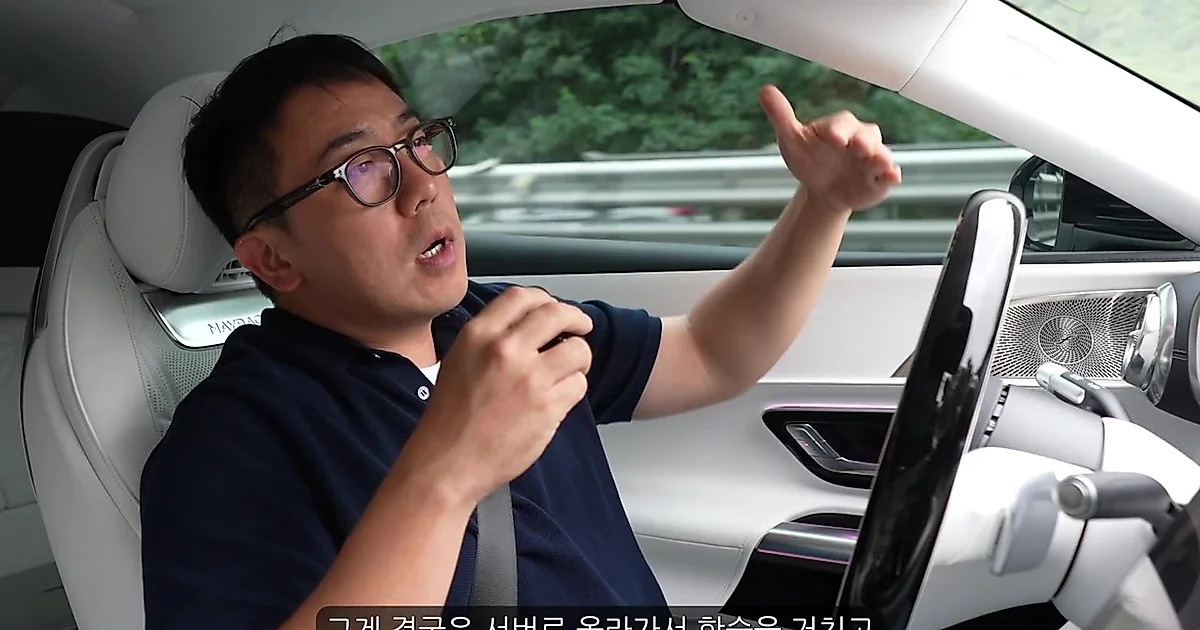
Tesla's autonomous driving software, FSD (Full Self-Driving), is widening the technological gap not just by being equipped in certain vehicles, but by absorbing data from vehicles that do not even use the feature. 'Shadow Mode', which Tesla utilizes, is identified as the core driving force behind this.
Tesla vehicles worldwide are providing data through 'Shadow Mode'
According to a MOTline video, Tesla is collecting driving data even from vehicles where the FSD feature is not activated. This is achieved through 'Shadow Mode', which Tesla has officially mentioned. Shadow Mode is a method where the FSD computer judges and calculates driving situations in real-time in the back-end, even though the vehicle does not actually control the driving.
The video explained the operating principles of Shadow Mode in detail. For example, in a situation with a specific sign when a person appears, the FSD computer independently judges 'where to stop' and 'how long to wait'. If this judgment matches the driver's actual movement, no separate data transmission is required, but if a point occurs where the driver's judgment and the FSD's judgment diverge, that data is classified as an exceptional situation.
The collected data is transmitted to Tesla servers in a compressed form when the vehicle connects online or uses Premium Connectivity services. As a result, it is as if millions of Tesla vehicles around the world are providing driving data to Tesla for artificial intelligence training. The presenter expressed this by saying, "It is like users are paying their own money to ride the cars while providing data as tribute to Tesla."
Tesla's data collection capability was not achieved in a short period. According to the video, Tesla began designing the chipset to run the FSD computer in 2016, and the first vehicles equipped with that chipset hit the road in 2019. Tesla has been continuously learning by collecting driving information from vehicles not equipped with FSD features since years before FSD was implemented. It is analyzed that through this, Tesla was able to achieve step-by-step development from the recently emerged e2e (end-to-end) based FSD Version 12 to the current Version 14.
Differences in driving perspectives by generation... The impact FSD will have on the younger generation
Regarding the market changes brought by the spread of autonomous driving technology, it was analyzed that the difference in driving perspectives between generations will be a decisive variable. The video focused on the characteristics of a generation that perceives driving as 'labor'. While existing driving enthusiasts value traditional values such as ride quality or engine sound, for the younger generation, driving itself may be a tiring act.
The presenter predicted, "If you ask the younger generation, such as those in their 30s, to choose between a car with a good exhaust sound and fun handling, and a car that drives itself, they will choose the latter with almost a 100% ratio." In other words, the analysis suggests that for a generation that avoids driving, autonomous driving technology like FSD can have a powerful impact that goes beyond simple convenience to change the market landscape. On the other hand, for the so-called 'Young Forty' generation who enjoy driving, a dilemma may arise between choosing a car with good ride quality or exhaust sound versus FSD, but for the younger generation, autonomous driving could be an overwhelming criterion for choice.
"Autonomous driving impossible for internal combustion engine vehicles" is a misunderstanding... No hardware constraints
Regarding whether internal combustion engine vehicles can perform autonomous driving, technical misunderstandings were corrected. While some view it as difficult to equip high-performance autonomous driving systems in internal combustion engine vehicles, the explanation states that this is not true. This is because Tesla's FSD computer has a very low power consumption level of less than 100W and is driven by a low-voltage system at the 12V or 14V level, not a high-voltage battery system.
In fact, internal combustion engine models like the Mercedes-Benz S-Class are already equipped with L2+ level hardware, including NVIDIA chipsets and numerous cameras and radars. However, differences exist in terms of control compared to electric vehicles. While electric vehicles can precisely control motor output numerically, internal combustion engine vehicles must also consider RPM (revolutions per minute) and gear shifts, so it was cited as a technical challenge that control might be somewhat unnatural when applying autonomous driving systems. The video mentioned the possibility that control might be somewhat unnatural in internal combustion engine models by comparing the parking assist systems of the new S-Class and GLC models.
In conclusion, the core content of the video is that it is in principle possible to equip both internal combustion engine vehicles and hybrid vehicles with autonomous driving systems. The key to technical implementation depends not on the vehicle's power source, but on whether the processor and hardware capable of controlling it are installed. Therefore, the presenter explained that claims such as "internal combustion engines cannot do autonomous driving" or "it is only possible starting from hybrids" are technically invalid.
0Comments
Comments are currently disabled.