
"I thought it was 800,000 won, but it's 5 million won?"... Warning against 'Option Bombs' in No-Altar Funerals
As "no-altar funerals" become more common, bereaved families are facing unexpected cost increases due to deceptive low-price advertisements and additional…
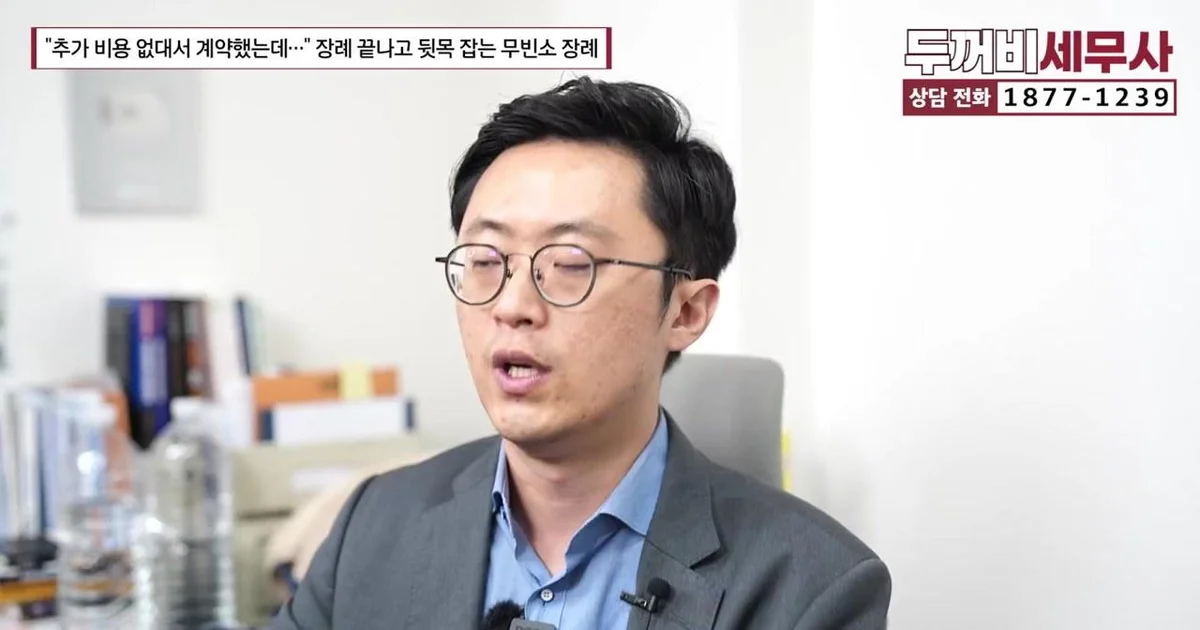
Recently, cases of choosing 'no-altar funerals' are increasing due to the decrease in family members and changes in social ritual methods. However, unlike advertisements promoting low prices, there are frequent cases where unexpected additional costs occur on-site, leaving bereaved families bewildered, which calls for caution.
'Option Sales' Hidden Behind Low-Price Advertisements... Why Do Costs Inflate?
According to a video from the Finance with Toad Tax Accountant YouTube channel, when choosing a no-altar funeral, the ultra-low-price advertisements presented by companies often show a large difference from the actual final payment amount. The video pointed out situations where a no-altar funeral promoted at a price in the 800,000 won range or below 1 million won skyrockets to the 5 million won range on-site as various options are added.
Three main reasons are cited for this cost increase. First, the advertised price is often limited only to 'basic services.' While companies lure bereaved families with low prices, essential items such as mortuary usage fees, encoffinment fees, crematorium costs, and hearse vehicle costs are often charged separately during the actual funeral. The video explained, "Considering minimum labor costs and basic supplies, even for a no-altar funeral, the final amount reaches the 2.5 million to 3 million won level." In particular, if a death occurs at home and the body must be transported, additional transportation processing costs of about 700,000 won may occur.
Second is the decision-making structure of the bereaved family. Unlike general funerals, no-altar funerals have simplified procedures, meaning a small number of bereaved family members must consult with a funeral director and decide everything within a short time. It was pointed out as a problem that it is difficult for bereaved families to scrutinize costs amidst unfamiliar funeral terminology and urgent situations. In a general funeral, a chief mourner stays in the altar room, and various people such as relatives participate in decision-making, creating a structure where they can check each other; however, in a no-altar funeral, only a few family members must judge, placing them in a vulnerable environment where they have no choice but to say, "Please proceed for now" on-site.
Third is the psychological factor. The guilt of 'not treating the deceased with enough respect because an altar was not set up' encourages the selection of options. When a company suggests upgrading to expensive burial shrouds or urns, saying, "Since it is their last journey, shouldn't we show proper respect?", bereaved families find themselves unable to refuse and accept it. The video analyzed this as a phenomenon of "'adding-on disease' where, because they didn't set up an altar, profits are good, so they make people choose good urns because they reduced the altar, in order to relieve their guilt."
"Request a Total Estimate"... How to Avoid Funeral Cost Bombs
The video presented countermeasures that bereaved families must practice to prevent unnecessary expenditures during the funeral process. The most core method is to request a 'quote based on the final total amount' from the company.
Simply asking "How much is a no-altar funeral?" is dangerous. This is because companies are highly likely to guide only the basic package price. The video advised, "You must ask them to write down all expected total cost items until the actual funeral is completed, from body transport to moving to the crematorium and then to the burial site." Specifically, one must check ▲mortuary usage fees (based on how many days) ▲crematorium costs ▲hearse vehicle basic distance and additional charges (including night/holiday surcharges) ▲and the grade of burial shrouds and coffins.
In particular, it is important to confirm "whether the configuration allows the funeral to proceed even without additional selections." This is because there are cases where the essential funeral procedures cannot be carried out with only the cheap basic options. It is safer to confirm such details through methods that leave a record, such as text messages, KakaoTalk, or email, rather than verbal contracts. The video emphasized, "You must ask for a breakdown to confirm when, who, and what was said."
Need to Distinguish Between Funeral Service and Funeral Hall Costs
One of the things many bereaved families confuse is the relationship between funeral services (sangjo) and funeral hall costs. According to the video, even if one is subscribed to a funeral service company, it does not mean that all costs to be paid to the funeral hall (altar usage fees, meal costs, etc.) are included. Therefore, when calculating costs, one must manage them by distinguishing between ▲costs paid to the funeral service company ▲costs paid to the funeral hall ▲and costs paid to external institutions (crematoriums, etc.).
Additionally, the video emphasized the need to be wary of disputes among family members caused by funeral cost issues. If expensive options are chosen spontaneously on-site, conflicts may arise with other family members later regarding the burden of costs. The video advised, "There are many cases where siblings fight, asking 'Who chose this?'," and suggested making rational choices that fit the family's situation rather than being swayed by the eyes of others. The presenter added, "The best method is to have conversations with parents about funeral methods in advance while they are alive," and noted that if parents requested "to keep it frugal" during their lifetime, respecting that wish is a way of practicing filial piety.



0Comments
Comments are currently disabled.