
"GTX will reshape the metropolitan real estate market"... Professor Kim Kyung-min says accessibility to business districts determines the housing market
Professor Kim Kyung-min of Seoul National University explains how the introduction of the GTX will shift the real estate market's focus from spatial distance to temporal distance. He highlights the importance of accessibility to major business districts and the role of circular subway lines in determining housing prices.
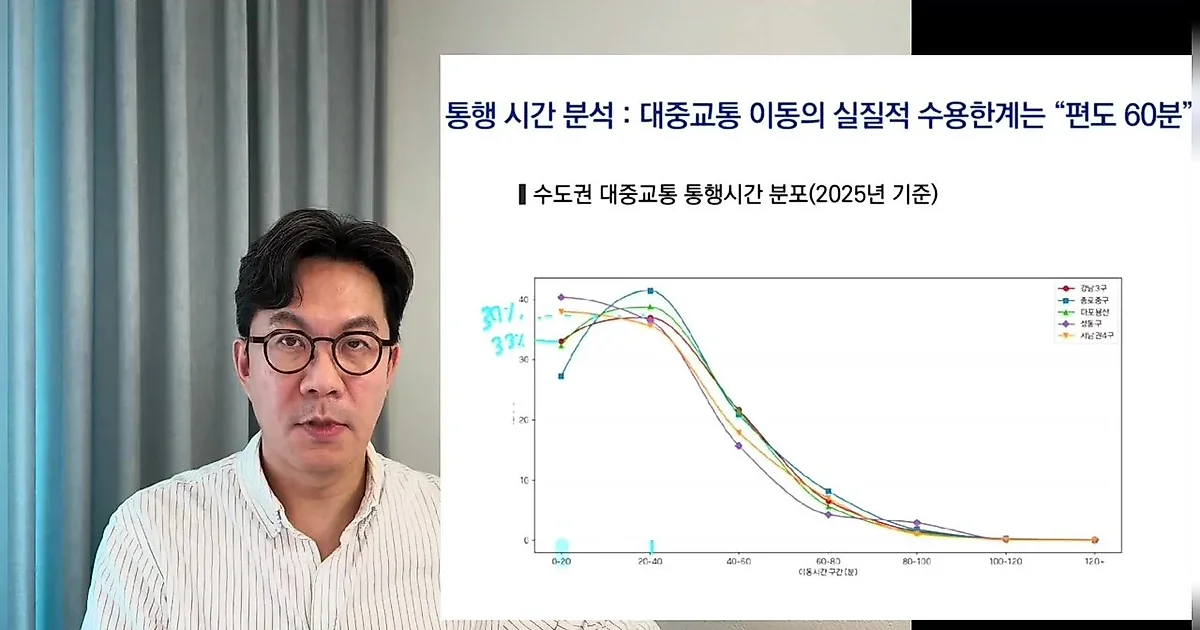
With the emergence of the GTX, the landscape of the metropolitan real estate market is being reshaped. In a recently released video, Professor Kim Kyung-min of Seoul National University stated that people will feel the market changes at the time the GTX lines are completed, and presented three key perspectives for understanding the future real estate market.
The core of the GTX era: a shift from 'spatial distance' to 'temporal distance'
Predicting that the GTX will completely change the metropolitan real estate market, Professor Kim Kyung-min identified three axes to read this change: ▲Thinking beyond the Seoul administrative district (the importance of temporal distance over spatial distance) ▲The location of high-wage jobs (such as the semiconductor belt) ▲The influence of these changes on the housing market. Professor Kim explained that rather than simply predicting the price fluctuations of specific areas, it is important to understand how the spatial market changes at the level of a "Mega-region" known as the "Greater Metropolitan Area."
The correlation between accessibility to business districts and housing rents
He mentioned the "relationship between the distance to business districts and housing rents" as a fundamental principle of urban and real estate economics. Professor Kim explained that assuming all households have the same income, households living close to the Central Business District (CBD) pay higher housing rents but spend less on transportation, whereas households living far from business districts pay relatively lower rents but spend more on transportation. In other words, accessibility from business districts is a key factor determining housing market prices.
In the case of Seoul, he analyzed that business districts have expanded beyond the once single CBD to YBD (Yeouido), GBD (Gangnam), and recently, new business districts have formed in Guro·Gasan (IT·Tech), Jamsil, Seongsu (Social Venture·Fashion), and Sangam·Magok (Media·Large Corporations). Professor Kim noted that these new business districts are mainly formed along the Subway Line 2 loop line, explaining that the housing market is being reorganized according to this Line 2 line and accessibility to business districts.
The importance of loop lines: Seoul Line 2 and Tokyo's Yamanote Line
Professor Kim emphasized the powerful role played by Seoul's Line 2 loop line, explaining it with the example of Tokyo, Japan. He explained the correlation between loop lines, business districts, and high-priced residential areas by pointing out that major business districts such as Marunouchi, Shinjuku, Shibuya, and Minato are concentrated inside the Yamanote Line, which is Tokyo's core loop line, and that the areas forming the highest housing prices are also located within the Yamanote Line.



0Comments
Comments are currently disabled.