
"Is the Korean Economy Communicating Honestly with the Market?"... Polarization and Lack of Systems are Key Challenges
Economic expert Dr. Gwak Su-jong points out that South Korea must address structural issues and market opacity…
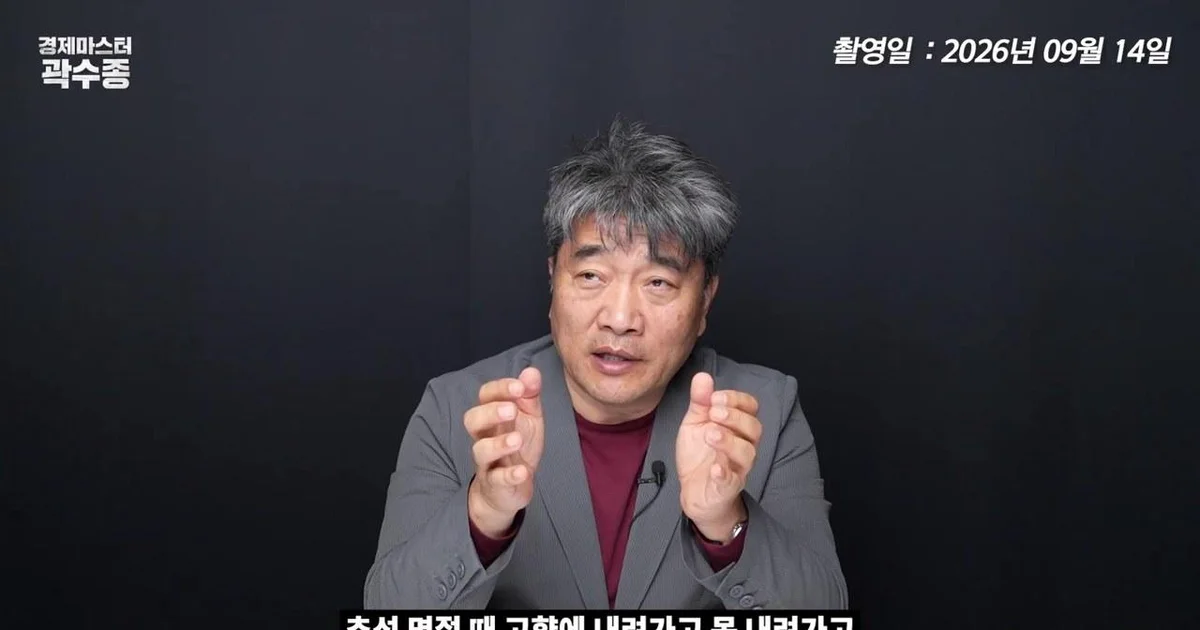
Points have been raised that the structural problems facing the South Korean economy and the opacity of the market system must be resolved. Economic expert Dr. Gwak Su-jong identified solving the problem of polarization and honest communication with the market as key challenges for the sustainable growth of the South Korean economy.
Economic Polarization and Deepening Social Conflict... Concerns Over the Collapse of the Middle Class
Dr. Gwak Su-jong identified 'polarization' as one of the most urgent problems in the South Korean economy. He diagnosed the current situation in South Korean society as one where patterns of conflict between social classes are appearing seriously due to the concentration of economic power. In particular, he focused on the role of the middle class, which can be called the backbone of the South Korean economy.
According to the video, small and medium-sized enterprises, which account for 99% of the country's companies, are responsible for 88% of all employees, but economic benefits such as holiday bonuses are being concentrated in large corporations. Dr. Gwak emphasized that "the predecessor and successor of the South Korean national economy lie in the middle class," and analyzed that the social phenomenon where an individual's success or failure is judged by visible indicators—such as foreign cars, residence, or the type of vehicle used when going to one's hometown during holidays—is also a problem intertwined with economic polarization.
Dr. Gwak mentioned that the reason leaders are chosen by the people is to support the people's right to pursue happiness, and raised questions about whether the government is communicating honestly with the market. He expressed concern that instead of the national economy communicating honestly with the market, it might be operating in a way that hides numerous time bombs and delayed inspections for a certain period and then avoids taking responsibility.
Limits of Applying the American Economic Model to South Korea... "Wrong Market Economy"
Criticism regarding the systemic flaws of the South Korean economy was also raised. Dr. Gwak argued that while South Korea ostensibly advocates a US-style free market economy system, it is actually operating as a 'wrong market economy.' This is also connected to the phenomenon where predictions do not match when US macroeconomic indicators and interpretation mechanisms are applied directly to the South Korean market.
He cited the opacity of the South Korean market and the credibility issues of policy authorities as the causes of this discrepancy. Dr. Gwak stated, "There are no institutions or policy authorities in South Korea that possess as much credibility as in the United States," citing examples such as the independence issues of the Bank of Korea or the monopoly determination and unfair trade response capabilities of the Korea Fair Trade Commission. He explained that in contrast to the United States taking strong legal measures, such as spinning off AT&T through the Telecommunications Act in 1988 or investigating Microsoft's oligopolistic monopoly system, South Korea's system has limits in controlling the side effects of the market.
Dr. Gwak posed several questions to gauge the physical strength of the South Korean economy. He suggested that one must judge for themselves whether the semiconductor market is achieving record-breaking results, whether Hyundai Motor Company and Kia Motors are selling well, and whether the economic strength is robust enough to allow the exchange rate to fall below the 1,350 won level. He also added that it is necessary to contemplate, based on logical grounds, the direction of the Bank of Korea's interest rate decisions and whether the stock market can break past the 9,300 level again to head toward the 15,000 level by 2027.
Concentration of Capital Power Spills Over into Education... Must Ask Questions About Sustainable Growth
The analysis suggests that the concentration of economic power is spreading beyond mere market issues to society as a whole. Dr. Gwak mentioned that the phenomenon of the concentration of capital and economic power extends to the education sector, creating a ripple effect that determines the solidity or collapse of the educational system.
He presented questions that must be asked to judge the future direction of the South Korean economy. There is a need to contemplate how honestly the market is operating, whether leaders know that opposing market principles is wrong, and how to achieve sustainable growth beyond mere survival. Dr. Gwak explained that individuals must be able to provide their own answers to these questions, and that the majority decision on the results of those answers represents the South Korean economy.

0Comments
Comments are currently disabled.