
"2027 Leading Stocks Will Be Power and Physical AI"... The Backflow of the South Korean Economy Driven by Semiconductors
Economic expert Kim Kwang-seok explains how AI is creating a "backflow of money" that reshapes the global economy, positioning South Korea as a key player through semiconductor exports. He predicts that the economic leadership will shift from HBM and DRAM in 2026 to power infrastructure and physical AI in 2027.
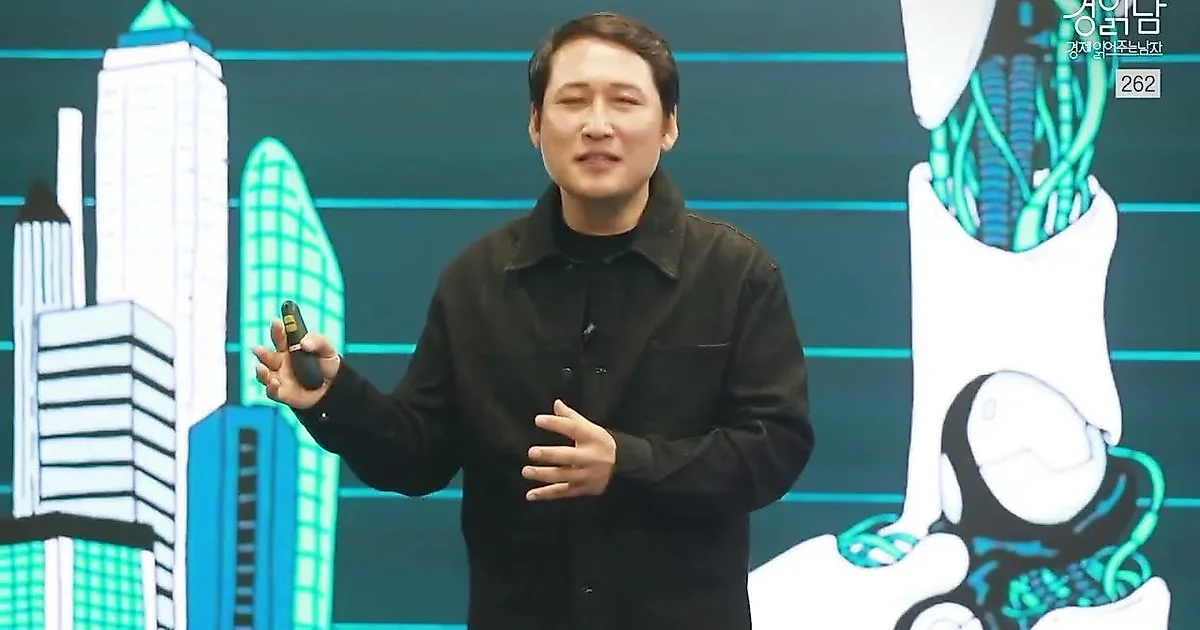
A phenomenon known as the 'backflow of money' is appearing, where AI (Artificial Intelligence) technology is changing the flow of the global economy. The analysis suggests that even amidst downward pressure caused by low growth trends and wars in the Middle East, AI is acting as a powerful upward pressure, reshaping the economic structure.
The Economic Backflow Created by the AI Value Chain and South Korea's Semiconductor Exports
In a recently released video, economic expert Professor Kim Kwang-seok explained that AI is causing a productivity revolution comparable to the introduction of the wheel, the steam engine, electricity, and the internet in the past. In particular, AI is inducing a 'backflow of money' where capital is concentrated into specific industries, appearing as a phenomenon where funds are surging into the AI value chain.
The AI value chain consists of AI models from hyperscaler companies, and the power, telecommunications, and AI infrastructure (data centers) that support them. Professor Kim analyzed that out of approximately 200 countries worldwide, only about 10 countries—including semiconductor design (United States), materials (Japan), equipment (Netherlands), production (Taiwan), and South Korea—are participating in this core value chain. He explained that thanks to this structure, despite the impact on energy-importing countries caused by wars in the Middle East, 'AI enabling goods' exporters like South Korea, which exports semiconductors, are facing strong growth opportunities.
In fact, changes are being detected in the growth path of the South Korean economy. Contrary to existing concerns that South Korea would find it difficult to avoid supply chain shocks from Middle East wars due to its high dependence on oil and the Middle East, Professor Kim mentioned that growth rate forecasts are being upwardly adjusted thanks to the strong semiconductor exports. South Korea's semiconductor export share has risen from around 9% in 2011 to 38.7% as of the first half of this year, becoming a key driver leading the transition to high growth in the South Korean economy.
Leading Stocks Shifting from HBM/DRAM in 2026 to Power Infrastructure in 2027
Regarding the future shift in economic leadership, he focused on technical bottlenecks. While the market up to 2025 was focused on the shortage of GPU (Graphics Processing Unit) supply, he analyzed that the leading stocks in the first half of 2026 will shift to HBM (High Bandwidth Memory) and DRAM, with Samsung Electronics and SK hynix showing steep upward trends.
The key variable for late 2026 and 2027 is expected to be 'power.' While data centers are surging worldwide, it is observed that power infrastructure will become a new bottleneck (shortage) because the supply and demand of sufficient power to operate them is not smooth. Professor Kim explained that the reason the Trump administration in the United States picks LNG, petrochemicals, and power plants as investment priorities is that power supply is an essential prerequisite for securing AI competitiveness.
The Emergence of a New Value Chain: Physical AI and the Robot/Automotive Sectors
The expansion of the AI economy is expected to extend beyond service models and infrastructure into new domains. Professor Kim presented 'Physical AI' as the next value chain for the global economy in 2027. While the existing value chain moved with the trio of services, models, and infrastructure, he predicted that a new flow centered on 'products,' including the robot and automotive sectors, will emerge in the future.
Ultimately, the economic structure led by AI is expected to evolve beyond a simple software revolution into a form that combines with physical products, determining the leadership of the economy.


0Comments
Comments are currently disabled.