
Industries with High AI Exposure See Sharp Decline in Youth Employment; Unemployment Among Highly Educated Also Rises
The rapid spread of Artificial Intelligence (AI) is causing significant changes in the youth labor market, particularly in sectors where AI has a high potential to replace human tasks. This shift is leading to increased unemployment among highly educated youth and a growing preference for experienced workers over new hires.
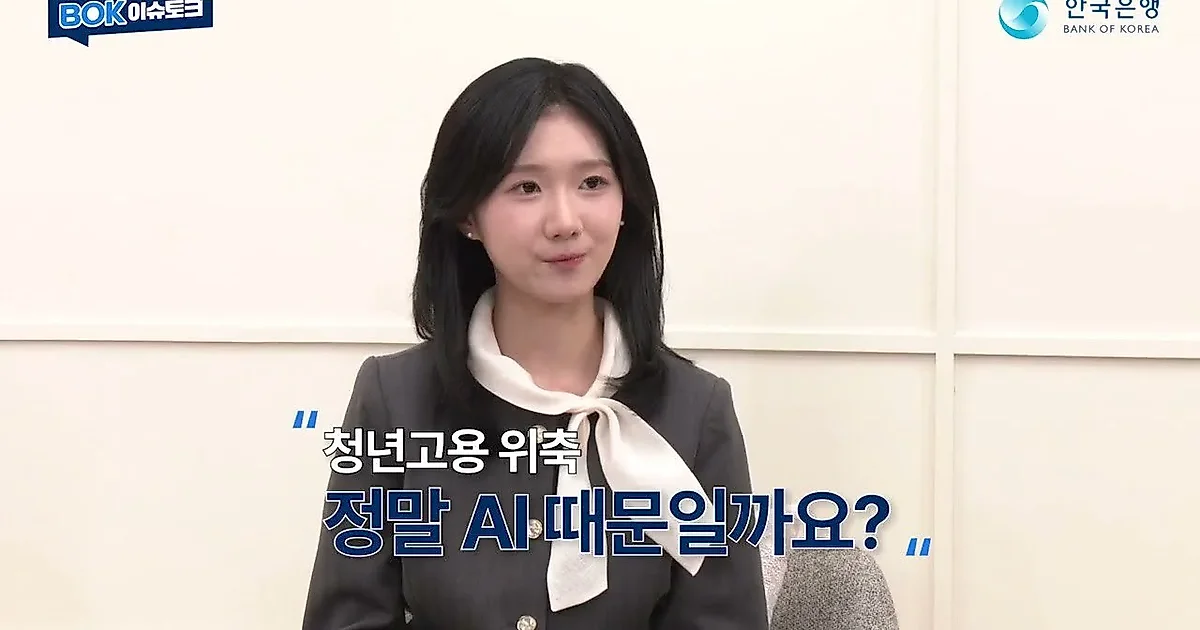
It has been revealed that the rapid spread of Artificial Intelligence (AI) technology is causing practical changes in the youth employment market. In particular, it was confirmed that youth employment tends to decrease in industries where the possibility of AI replacing tasks is high.
Industries with High AI Exposure Linked to Shrinking Youth Employment and Rising Unemployment Among the Highly Educated
According to the Bank of Korea YouTube channel 'BOK Issue Talk', a phenomenon was observed where youth employment decreases in industries with high 'AI exposure'—those where AI has a high possibility of replacing human tasks. On the other hand, employment for those in their 50s showed a trend of actually increasing. This is analyzed to be because tasks such as data analysis and document writing, which the youth primarily perform, are easy for AI to replace, whereas personnel management and key decision-making tasks handled by experienced workers in their 50s are difficult to replace with AI.
Of particular note is the employment situation of highly educated youth. In the past, a higher level of education was advantageous for employment, but since the introduction of AI, a reversal phenomenon has occurred where the unemployment rate of highly educated youth appears higher than that of less educated youth. This is because the cognitive tasks (such as text and number processing) primarily performed by highly educated youth are directly linked to high AI exposure. Additionally, it was found that the proportion of youth employed in industries with high AI exposure leaving the labor market has increased compared to the past.
Shrinking Youth Employment: Complex Factors Such as 'Preference for Experienced Workers' and 'Remote Work' Act Alongside AI
However, an analysis has also been raised that it is difficult to conclude that the recent shrinkage in youth employment is solely due to the influence of AI technology. According to the video, three major factors besides the spread of AI are affecting youth employment.
First is the 'normalization of over-hiring' phenomenon, where youth employees centered on digital industries, which had temporarily increased due to the spread of non-face-to-face activities during the COVID-19 pandemic, are returning to normal during the process of social normalization. Second is the strengthening tendency of companies to frequently hire experienced workers who can be immediately deployed as needed, rather than hiring and training new employees on a large scale. Third is the spread of remote work. As remote work increases, opportunities for 'informal learning,' where senior employees teach junior employees by their side, decrease; from a company's perspective, this becomes a factor in avoiding recruitment because the burden of the cost of training juniors increases.
AI Should Be Used for 'Augmentation' Instead of 'Automation'... Government Support for Education Investment Needed
To mitigate the negative impact of AI on youth employment, suggestions were made that a shift in the way AI is utilized is necessary. The Bank of Korea confirmed that if AI is used in an 'automation' method that completely replaces human tasks, youth employment decreases sharply, but if it is used in an 'augmentation' method that complements human abilities, a distinct pattern of employment decrease does not appear.
In the long term, to secure skilled experienced workers, companies must build a 'career ladder' where young people can accumulate experience. To this end, a structure is needed that includes tasks requiring human experience and judgment in junior roles, allowing them to collaborate with experienced workers. The video emphasized that the government should go beyond simply providing recruitment subsidies to companies and should subsidize the costs incurred by companies in training junior personnel. Additionally, it added that while tax benefits are currently concentrated on AI facility investment, policy review is needed to balance tax benefits, such as recognizing education costs for talent cultivation as investment.


0Comments
Comments are currently disabled.