
"Protect Income Rather Than Assets"... Kim Gyeong-pil's Advice to a Couple in Their 50s with a 60% Savings Rate Worried About Retirement
A couple in their 50s with a 60% savings rate expressed concerns regarding managing their children's seed money and disposing of real estate assets. Money trainer Kim Gyeong-pil advised them to prioritize securing cash flow for retirement over increasing asset value.

A couple in their 50s with a savings rate reaching 60% expressed concerns regarding the management of their children's seed money and the disposal of real estate assets. Money trainer Kim Gyeong-pil advised them that securing cash flow to prepare for life after retirement should take priority over the increase in asset value.
1.1 Billion Won in Real Estate Assets and a High Savings Rate, but Uncertain Retirement
According to a story from a subscriber of the YouTube channel 'Teacher Pil TV - Kim Gyeong-pil's Money Training', a four-person household consisting of a 55-year-old husband and a 51-year-old wife living in Gyeonggi Province has a combined monthly income of 13.8 million won. This is the sum of the husband's monthly salary of 5.8 million won and the wife's self-employment income of 8 million won (which fluctuates). The couple's monthly savings amount to 8.35 million won, saving 60% of their total income. Their real estate assets include an apartment in Guri, Gyeonggi Province (purchase price 900 million won, loan 78 million won) and an apartment in Seongbuk-dong, Seoul (purchase price 700 million won, jeonse 390 million won), totaling approximately 1.13 billion won in net assets. In addition, they hold financial assets such as a retirement pension of 150 million won.
The storyteller expressed difficulties regarding how to manage the seed money for their two children after they entered university, concerns about moving residence due to rising house prices in Seoul, and which of the two houses they own should be sold first. In particular, the children currently hold lump sums of 80 million won and 30 million won each, combining parental support with money they saved themselves.
"If You Sell the House, It All Goes to Taxes"... Real Estate Disposal Strategy for Multi-homeowners
Regarding the issue of house disposal raised by the storyteller, money trainer Kim Gyeong-pil analyzed that selling a house in the current situation is not an option. This is because there is a high possibility of heavy capital gains taxation in a situation where they own two houses. Kim pointed out that even if capital gains occur, there may be no real profit when considering transaction costs and holding taxes, explaining that they should wait for a period when heavy taxation is suspended. Furthermore, he suggested that moving to Seoul away from the area where the wife's business is located carries the risk of giving up the business, which is a source of income, so they should consider the distance from the business location even if they move.
Children's Economic Independence and Building Cash Flow Through 5:5 Asset Allocation
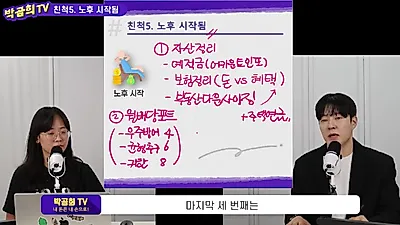
Kim presented three methods of classification for retirement preparation. First is the 'classification of expenses,' in which he urged clear management of business sales and expenses. Second is the 'classification of ownership,' in which he emphasized that they must cut the umbilical cord of economic support to their children and make them independent so they can manage money themselves. The last is the 'classification of purpose.' This means that current income and assets must be converted for the purpose of retirement preparation.
In particular, considering that they are about 5 to 10 years away from retirement, he proposed a strategy of allocating assets into 50% safe assets and 50% risky assets. Kim emphasized the importance of building a cash flow pipeline using the National Pension, retirement pension, and financial assets, stating, "Rather than worrying about where to buy assets, you should focus on how to generate the monthly living expenses of 5 to 6 million won needed after retirement."


0Comments
Comments are currently disabled.