
"Supply Chain Control Over Efficiency"... Changing Global Trade Order and South Korea's Response Strategy
The global trade order is shifting from efficiency to security and supply chain control, leading to a resurgence of industrial policies and the rise of regional agreements. Jeong Cheol, president of the Korean Association of International Trade, analyzes these changes and suggests South Korea must participate in various trade agreements to secure its economic interests.
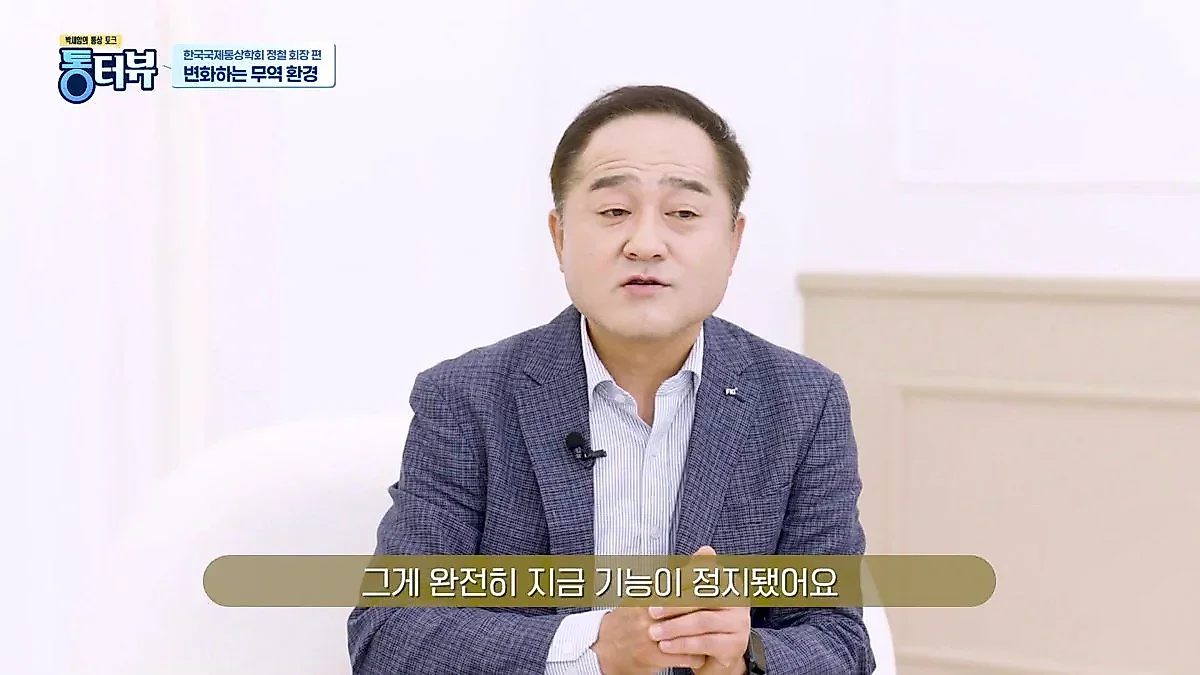
The global trade order is undergoing a rapid reorganization, shifting from the efficiency-centered focus of the past to a focus on security and supply chain control. As the intensification of US-China competition and geopolitical conflicts emerge as core economic variables, the central axis of negotiations between nations is also trending toward tariffs, subsidies, and supply chain regulations.
Beyond Cost Reduction to Securing Core Technologies and Supply Chains... The Return of Industrial Policy
Jeong Cheol, president of the Korean Association of International Trade, recently diagnosed that the global economy and global trade order are changing rapidly. While past trade policies prioritized cost reduction and efficiency as the highest values, he analyzed that we have entered an era where securing core technologies and controlling stable supply chains is more important. In particular, after experiencing cracks in global supply chains through the COVID-19 pandemic, security has established itself as a core economic issue.
These changes are leading to the revival of industrial policies that were discarded in the past. Jeong explained that moving beyond manufacturing-centered Industrial Policy 1.0 and ICT-centered 2.0, it is now time for 'Industrial Policy 3.0' suitable for the AI era. In fact, according to the IMF, in the year 2023 alone, more than 2,500 industrial policy measures were implemented worldwide, showing that countries are intervening in markets to protect their own economies and security.
The Diminishing Role of the WTO and the 'Sun Hidden by Clouds'... Changing Trade Platforms
The status of the World Trade Organization (WTO), which has served as a public good for world trade, is also shaking. The WTO has created a free trade environment by lowering tariff and non-tariff barriers and through the principle of non-discrimination (MFN), but its functions have recently weakened. In particular, as the Appellate Body, the higher instance for dispute settlement, is effectively suspended, the system to finally resolve disputes even when they occur has collapsed.
Jeong compared the current situation to a state where 'the sun exists but is hidden by clouds.' He explained that while the basic norms of the WTO are still operating and a significant portion of world trade is still conducted under the WTO system, there are limits to creating new rules due to differences in interests among member states and the difficulty of the 'Single Undertaking' (the principle that the entire agreement is considered agreed upon only when agreement is reached in all areas).
Digital Economy and Critical Mineral Security... New Trade Agreements to Watch
The trade environment that our companies and the government must watch in the future is expanding beyond goods trade to data and resource security. Jeong emphasized the importance of RCEP (Regional Comprehensive Economic Partnership), a regional trade agreement, and the CPTPP (Comprehensive and Progressive Agreement for Trans-Pacific Partnership), which is under consideration for joining. These agreements play a role in filling the vacuum left by the WTO and providing regional norms and platforms.
In particular, with the rise of the digital economy, the 'Digital Economy Partnership Agreement (DEPA)', which deals with electronic documents, data movement, and digital payments, and the 'Minerals Security Partnership (MSP)', which aims for the stable management of critical minerals, are expected to become the core of new trade negotiations. Jeong suggested that South Korea must create conditions to expand markets and manage supply chains stably by participating in all possible agreements.
Source: original video (YouTube)

0Comments
Comments are currently disabled.