
"A feeling of limbs being torn" Kang So-yeon performs posture correction to overcome ankle and hip instability
Kang So-yeon has begun intensive posture correction training to address physical imbalances, including ankle instability and hip misalignment. Working with an expert former physical therapist, she performed a step-by-step program ranging from myofascial release to core strengthening.
Kang So-yeon, who enjoys exercising, has entered intensive posture correction training to correct physical imbalances. To resolve the ankle instability and hip imbalance identified in a previous video, she proceeded with a step-by-step exercise program ranging from myofascial release to core strengthening alongside an expert who is a former physical therapist.
Myofascial release starting from the soles and thoracic spine stretching
Prior to the full-scale strength training, a myofascial release process to alleviate physical tension was conducted first. Following the expert's guidance, the process involved using a foam roller to release the fascia extending from the ends of the soles to the calves, thighs, and hips. By releasing the ends of the soles, the fascia in the back of the calves, thighs, hips, and even the occipital fascia of the head can be loosened, increasing flexibility. In particular, a method was introduced where one rubs with a foam roller to find areas where the fascia is tangled and formed like a band, then stops at the most painful point to apply strong pressure for 10 seconds. According to the expert, even if one does not exercise, the soles and calves can become stiff due to postures such as sitting.
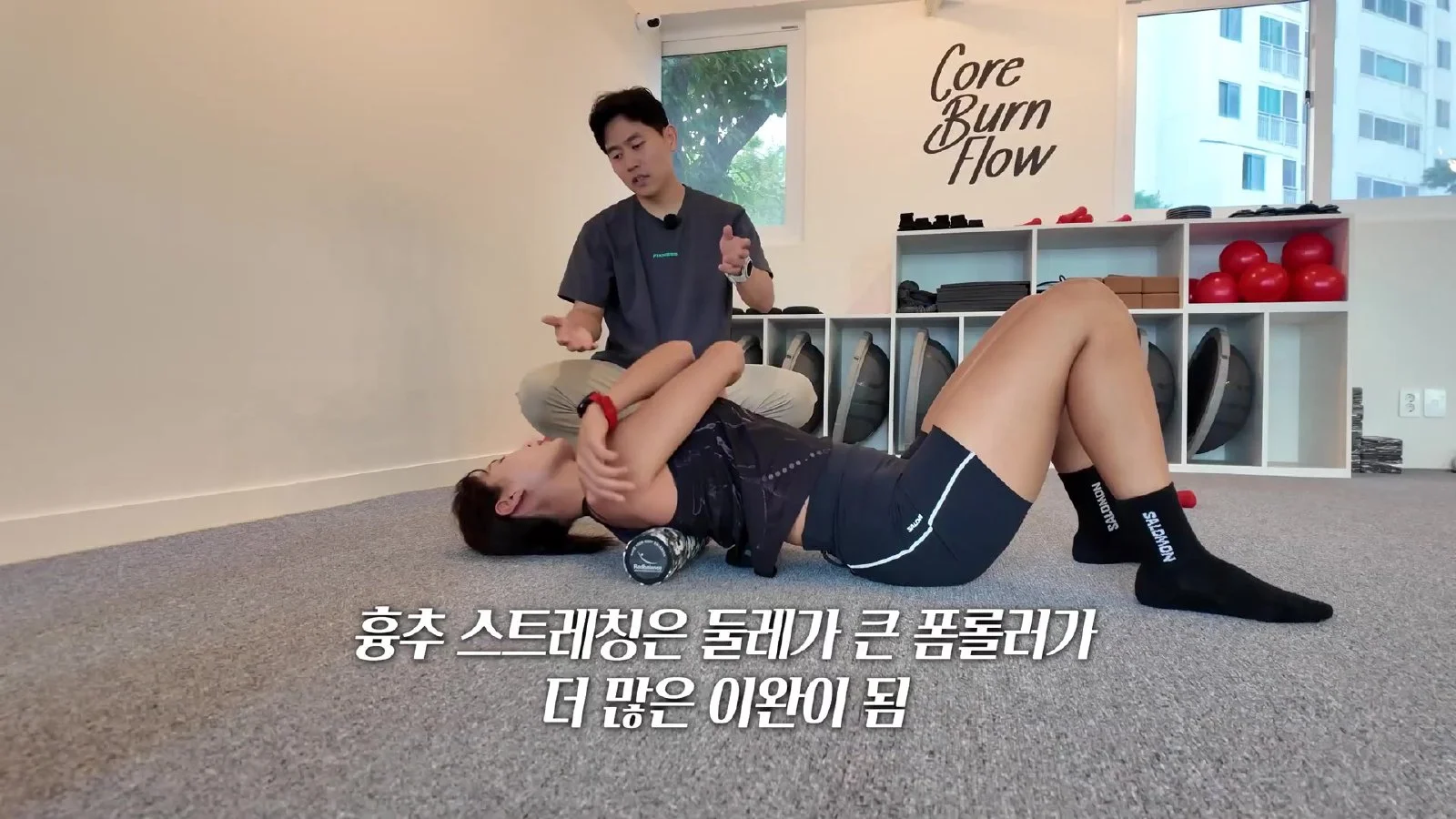
In the following thoracic spine stretching, a movement to open the chest was performed by lying down with a foam roller placed near the shoulder blades. This movement helps correct turtle neck or hunched back, applying the principle that the neck becomes comfortable only when the thoracic spine is opened. Kang So-yeon performed the chest-opening movement using the foam roller and confirmed that it is an essential movement for people with turtle neck or hunched back symptoms. While performing the movement, she showed efforts to secure the range of motion despite feeling pain, and it was recommended to perform thoracic spine stretching for less than 10 minutes before going to bed.
Core exercises 'McGill's Big 3' for protecting the waist
To secure physical stability, the 'Big 3' exercises proposed by the authority on core exercise, McGill, followed. The purpose of these exercises is to effectively activate core muscles while protecting the spine. The first step, the side plank, was used to check lateral stability. Caution is required as raising the elbows too high can put strain on the shoulders, and Kang So-yeon performed training to hold the position for 10 seconds while controlling this.
In the second step, the curl-up movement, a ball was used to maintain pelvic neutrality. Rather than trying to come up too high, the focus was placed on feeling the tension in the upper abdominal line, and a precaution was delivered to stop the movement if neck pain is felt. In the final 'bird-dog' movement, training was conducted to balance by extending the arms and legs diagonally from a quadruped position. This movement uses muscles close to the spine to maintain balance, and the key was to maintain neutrality so that the pelvis does not shift. Kang So-yeon focused her abdominal and gluteal strength to maintain the horizontal level of the spine while extending her arms and legs far.
Pelvic correction and back muscle strengthening to resolve imbalance
The subsequent training directly targeted the difference in leg length and pelvic imbalance shown in the previous video. To resolve the state where one side of the pelvis is raised and the other is lowered, movements to adjust the height of the pelvis were performed. In the following lunge movement, coordination between the lower body and core was increased through a movement that rotates the torso while sitting. Additionally, physical control ability was tested through jump movements mainly performed by figure skaters to develop full-body coordination.
Finally, band exercises were conducted for round shoulder correction and back muscle strengthening. The movement of pulling the shoulder blades together using a band focused on expanding the rib cage and increasing the stability of the shoulder joints. Kang So-yeon repeated the movement of pulling the band to stimulate the area near the shoulder blades, confirming it as a necessary exercise for people with narrow rib cages. This aimed to strengthen the back muscles in relation to preventing conditions such as frozen shoulder, where the shoulder joint adheres.
Source: original video (YouTube)



0Comments
Comments are currently disabled.