
Leading Index Cyclical Fluctuation Turns Downward After July Peak... "Stock Weight Should Be Reduced to Around 20%"
As the leading index, which indicates future economic trends, enters a downward phase, experts suggest a conservative asset allocation strategy, including reducing stock holdings to around 20%.
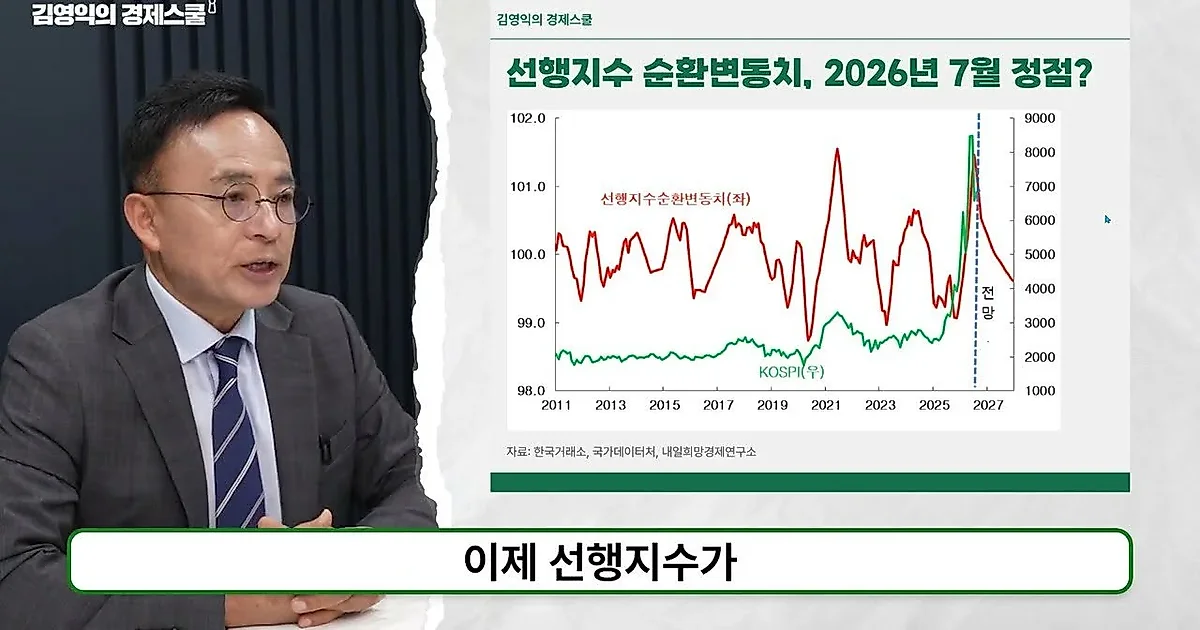
As the leading index, which shows the future flow of our economy, enters a downward phase, an analysis has emerged suggesting that a conservative asset allocation strategy, such as reducing the weight of stocks, is necessary. Since signals of an economic slowdown have been confirmed through the recently released industrial activity trends, the view is that one should prepare for falling market interest rates and stock price corrections.
Leading Index Peaked in July... General Slump in Production, Facility Investment, etc.
Professor Kim Young-ik explained the changes in the economic flow by analyzing the August industrial activity trends recently released by Statistics Korea through the 'Kim Young-ik's Economics School' YouTube channel. According to the presenter, the leading index cyclical fluctuation, which shows the direction of the economy in advance, was seen to have peaked in July and turned downward in August. Unlike the previous trend of raising economic growth forecasts, the analysis suggests that there is a high possibility that forecasts will be adjusted downward following this data.
Looking at the actual August industrial activity trends, major indicators such as production, consumption, and facility investment all showed a general slump, decreasing. Production decreased by 1.3% compared to the previous month, mainly due to the impact of decreased mining and manufacturing production. In particular, automobile production plummeted by 24.8% compared to the previous month due to the effects of vacations and strikes. Facility investment also increased downward pressure on the economic slowdown, decreasing by 9.5% compared to the previous month. Sales of durable goods also appeared to have decreased by 45% due to the slump in automobile sales.
While the coincident index cyclical fluctuation, which represents the current state of the economy, is still rising in an expansion phase, attention must be paid to the fact that the gap with the leading index is narrowing. This means that the discrepancy with the real economy is decreasing due to the adjustment of financial variables, suggesting the possibility that the economy will enter a contraction phase in the future.
News Sentiment Index and Yield Spread Narrowing... "Recommend Stock Weight Around 20%"
Regarding the future direction of the leading index, a downward outlook was presented based on the news sentiment index and the long-term/short-term interest rate spread. The presenter explained that the news sentiment index leads the leading index by about two months and shows a high correlation coefficient (0.74), and that the news sentiment index, which recently peaked and is now falling, foreshadows the future decline of the leading index. Additionally, the long-term/short-term interest rate spread, which is the difference between the 10-year and 1-year treasury yields, also shows a high correlation (0.7) with the leading index and continues to narrow, leading to the prediction that the leading index will continue its downward phase until next year.
As an asset allocation strategy following these changes in economic flow, a reduction in stock weight was proposed. The presenter advised, "When the leading index cyclical fluctuation is rising, it is good to increase the weight of stocks to more than 60% among financial assets, but when it is falling, it would be good to reduce the stock weight to around 20%." The explanation is that as the leading index has entered a phase of declining for at least one year or more, the KOSPI is also highly likely to show a correction where the peak gradually lowers.
On the other hand, a positive outlook was presented regarding bonds. This is because market interest rates are highly likely to gradually fall due to the economic slowdown. The presenter added, "In a phase where the leading index is falling, an appropriate strategy is to buy short-term bonds or, if there are surplus funds, long-term bonds, rather than highly volatile stocks."
Rising US Credit Spreads and Caution Regarding Political Uncertainty
Not only the domestic market but also financial risk factors in the United States were cited as major checkpoints. While the US 10-year treasury yield recently exceeded 5.2%, recording its highest level since March 2022, the fact that high-yield bond spreads, which indicate credit risk in the US, are rising rapidly was pointed out as a risk factor. This means that the risk level in the US financial market is increasing.
Furthermore, the 'Trump Uncertainty Index', an indicator that combines economic and political uncertainty, has risen to its highest level since the appearance of former President Trump, which is also a subject of caution. The presenter urged continuous monitoring of US financial and credit risks, stating, "In a situation where US credit risk is rising and the leading index has turned to a downward trend, if US stock prices undergo a significant correction from the middle of the fourth quarter, domestic stock prices will inevitably be affected."



0Comments
Comments are currently disabled.