
South Koreans report economic hardship despite projected $40,000 per capita income
While South Korea's export-driven growth is pushing per capita income toward the $40,000 mark, a massive gap exists between these macroeconomic indicators and the stagnant reality of consumer spending and employment.
The economy of South Korea is enjoying an unprecedented boom in terms of indicators. With exports projected to exceed $1 trillion, per capita national income (such as GNI and GDI) is also on the verge of entering the $40,000 era. However, contrary to these brilliant statistical figures, the voices of citizens on the ground are close to a scream, stating that life is "harder than during the IMF era." A massive gap exists between the rapid growth of economic indicators and the stagnation of the grassroots economy.
$40,000 driven by semiconductors: Statistical illusion and polarization
According to an analysis presented by Professor Lee Hyun-hoon's Economic Forum, the driving force of the recent South Korean economy is undoubtedly exports. This year's exports are expected to surge by nearly 40–50% from last year's level of $700 billion, exceeding $1 trillion. The video projected that current export performance could even surpass $1.1 trillion. This export boom is driving the economic growth rate and serves as the core engine enabling the entry into the $40,000 per capita national income era, as announced by the Ministry of Finance and Economy. The Ministry of Finance and Economy projected that per capita national income would exceed $40,000 this year, offering a bold outlook that it would rise to $49,000 next year and $52,000 the year after. When converted to a four-person household, a per capita national income of $40,000 represents a massive annual income of approximately 300 million won (52 million won × 4 people).
However, a serious "statistical illusion" is hidden within this figure. Professor Lee pointed out that per capita income is an average value that encompasses all age groups and households. In a situation where the income levels of the majority of citizens do not reach this average, the rise in the average value created by the explosive growth of specific industries does not deliver actual warmth to individual lives. In particular, this growth is largely due to the increase in export value following the rise in semiconductor prices, which boosted real GDP by 18.8%. According to Bank of Korea data for the third quarter, real GDP grew by 3.4% compared to the same period last year, but real Gross Domestic Income (GDI) surged by 18.8% compared to the same period last year. This is a result of the average price of export goods rising significantly due to the increase in semiconductor prices, revealing a structural limitation where the profits of exporting companies do not flow to households.
In fact, looking at demand-side indicators, the polarization of the economy is distinct. According to Bank of Korea data for the third quarter, while real GDP grew by 3.4% compared to the same period last year, private consumption decreased by 0.2% compared to the previous quarter and grew by only 1.1% compared to the same period last year. Consumption, which accounts for 50% of GDP, has stagnated. Conversely, manufacturing, including semiconductors, led growth with a 7.0% increase compared to the same period last year. In contrast, the service industry grew by 0.2% compared to the previous quarter and 2.4% compared to the same period last year, but wholesale, retail, accommodation, and food services showed sluggishness, decreasing by 0.4% compared to the previous quarter. While exports and facility investment are hot, consumption and the service industry—the measures of the grassroots economy—are cold, intensifying "K-shaped" polarization.
Jobs decrease despite manufacturing growth; employment cliff for youth
The fact that the fruits of growth are not leading to jobs is also a major reason for the worsening perceived economic conditions. Although the real GDP growth rate in the manufacturing sector was as high as 7%, the number of manufacturing employees actually decreased by 30,000 compared to the previous year. The construction industry also reflected a stagnation in the labor market, with 45,000 fewer employees. Despite companies increasing facility investment in high-tech industries such as semiconductors, a pattern of "jobless growth" is appearing, where this does not lead to large-scale job creation.
The employment situation for the youth is particularly severe. The employment rate for the youth aged 15 to 29 fell to 44% compared to the same period last year, and the unemployment rate rose by 0.6 percentage points compared to the previous year to 5.4%. Professor Lee pointed out that the currently announced unemployment rate is a "false figure" that does not reflect the actual pain felt by young people. This is because young people who cannot find desired jobs after graduating from university and make a living through part-time jobs are classified as "employed" in statistics. Professor Lee analyzed that the real unemployment rate perceived by young people would be more than 2 to 3 times higher than the statistical figure of 5.4%.
The business environment for the self-employed is also on a downward trend. In contrast to the high GDP growth rate, the performance of the service industry, including wholesale, retail, accommodation, and food services, is sluggish. In particular, indicators representing the perceived economic conditions of the self-employed, such as those operating convenience stores or restaurants, recorded negative growth compared to the previous quarter. According to the October consumer trend survey, the index for those who feel their current living conditions are good was 93, falling below the baseline of 100. Furthermore, the outlook for future economic conditions (97), the outlook for employment opportunities (86), and the judgment of current economic conditions (82) all remained below 100, showing that the perceived economic sentiment of the public is frozen. The warmth of the export boom is unable to flow into local commercial districts and remains trapped in an industrial structure centered on large corporations. Indeed, the October Business Survey Index (BSI) for small and medium-sized enterprises supported the difficulties of companies, showing 83.3 for manufacturing and 81.3 for non-manufacturing.
Caution against confusing short-term rebounds with long-term downward trends
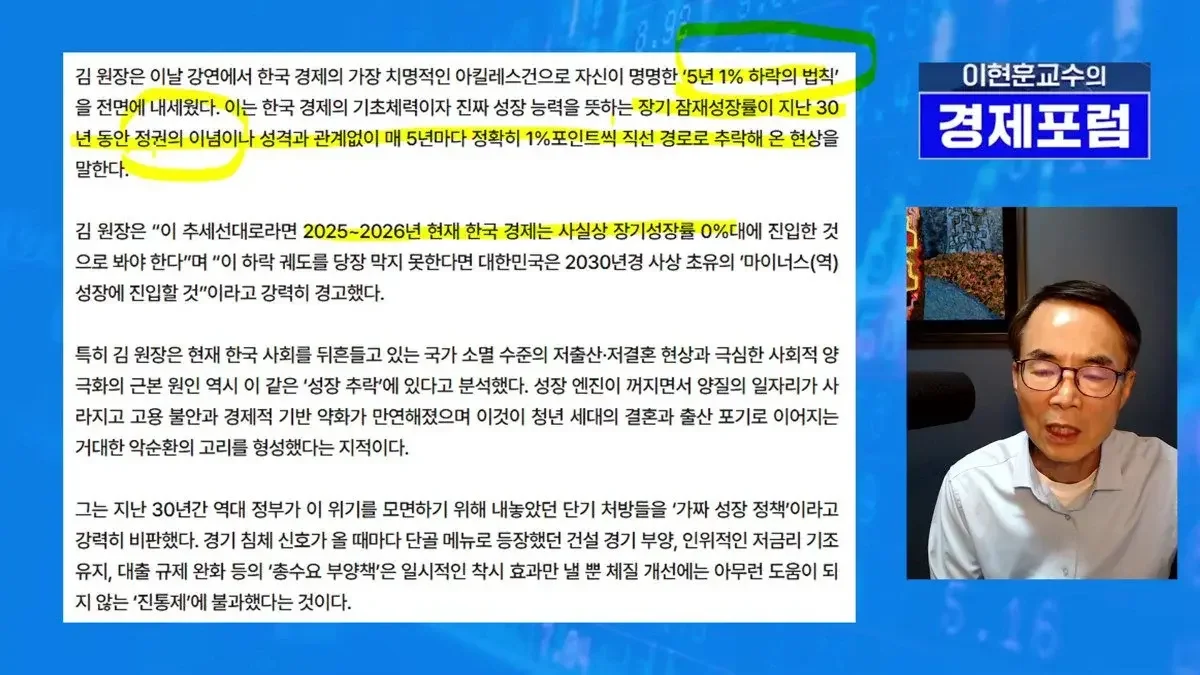
The current high growth does not mean an improvement in the fundamental structure of the South Korean economy. Professor Lee explained the current economic situation by distinguishing between a "short-term cyclical rebound" and a "long-term downward trend in the growth rate." The analysis suggests that the GDP growth rate has temporarily jumped due to the semiconductor boom, but the fundamental potential growth rate of the South Korean economy has not returned to an upward trajectory.
The potential growth rate of the South Korean economy has been steadily declining due to population aging and declining productivity. It is pointed out that while semiconductor exports are temporarily defending this trend, they are insufficient to reverse the structural low-growth trend. Ultimately, rather than being complacent with the current boom in indicators, the urgent task remains to create a sustainable growth structure where the fruits of growth can be distributed evenly to households, small and medium-sized enterprises, and the self-employed.
Source: original video (YouTube)



0Comments
Comments are currently disabled.