
South Korea weighs strategic risks of $50 billion Alaska LNG project
South Korea is weighing the strategic value of the Alaska LNG project against significant economic uncertainties, while Japan has already begun systematic analysis of the venture.
South Korea is facing a strategic dilemma over a $50 billion Alaska LNG project as Japan begins systematic analysis of the venture. While the United States seeks to use the project to counter China and Russia in the Arctic, South Korea maintains a cautious stance, stating it will only proceed if commercial rationality is confirmed.
Attention is focusing on South Korea's response to the Alaska LNG (liquefied natural gas) development project being promoted by the United States. The situation involves a clash between "economic uncertainty"—driven by massive initial investment costs and construction risks in the Arctic—and "strategic value" regarding the ROK-US alliance and energy security. In contrast to Japan, which has already commenced systematic analysis, South Korea faces the challenge of a lack of accumulated expertise due to shifts in policy.
Alaska falls into the resource curse amid political interests
The Alaska LNG project extends beyond a simple natural gas extraction venture. For the United States, the project serves as a strategic outpost to resolve Alaska's energy crisis while countering the expansion of China and Russia in the Arctic Ocean. The geopolitical value of Alaska has increased as China strengthens its Arctic exploration activities by constructing a large number of icebreakers.
However, the internal situation in Alaska is difficult. The gas fields in the Anchorage area, where 70% of the population of 700,000 resides, are nearly exhausted after 50 years of extraction. Alaska is experiencing a "resource curse," where industries flourish when energy prices are low but the industrial foundation shakes when resources are depleted or prices surge. In practice, Alaska residents use specialized LNG tank trucks to transport gas over 600km through snowy roads to supply the shortage. The costs incurred in this process are double the price of gas imported by South Korea, and the burden of heating costs is extreme. While small-scale LNG production and supply facilities using gas fields on the northern coast are currently operating in central Alaska, they are insufficient to solve the high-cost problem.
This economic deficit is spilling over into political issues. As resident dissatisfaction over rising energy costs grows in Alaska, a Republican Party stronghold, the U.S. political establishment is gaining momentum to strongly push the project to defend the Senate and the governorship. Notably, because the United States Senate assigns two senators per state regardless of population, Alaska, with its 700,000 residents, remains a key political unit with two senators. While claims recently surfaced that South Korea had agreed to bear the entire $50 billion project cost, the South Korean government moved to suppress these claims, stating they "have not agreed to such a thing" and maintaining a cautious stance that they will proceed only if commercial rationality is confirmed. A fact sheet from both countries on October 1 contained common-sense details stating that South Korea would proceed after review if commercial rationality is confirmed.
"Negotiation needed rather than unconditional acceptance"... South Korea's strategic options
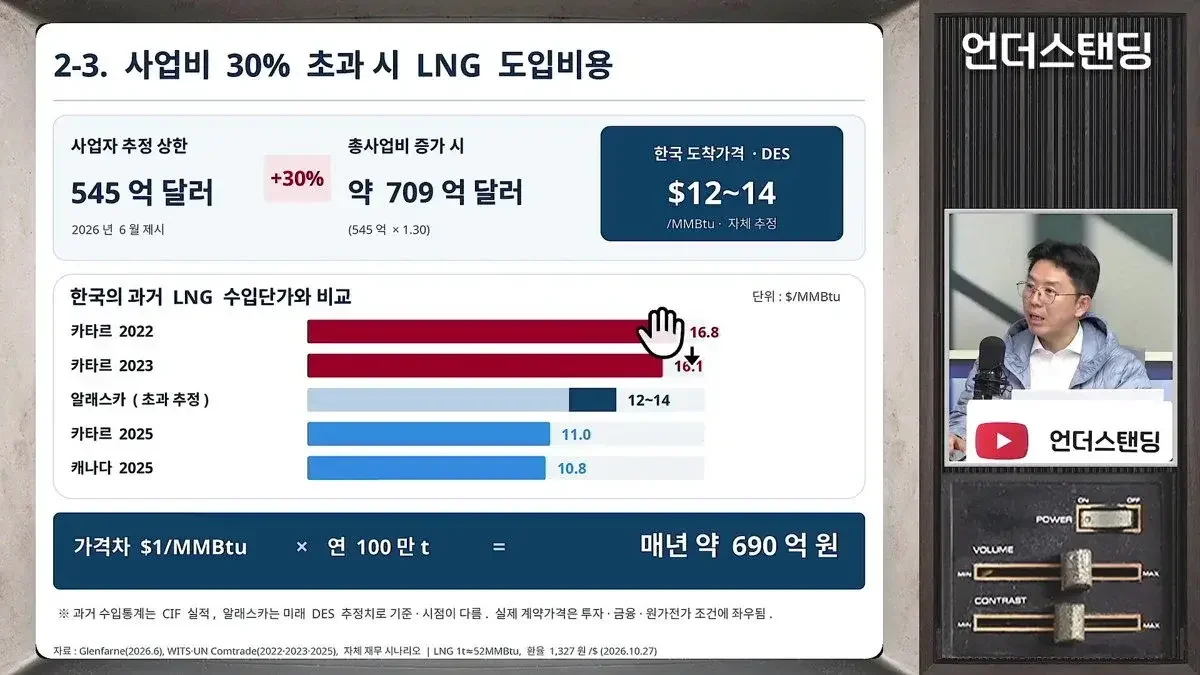
Kwon Hyo-jae, CEO of COR Energy Insight, pointed out via Understanding that "a dichotomous approach of choosing between unconditional participation or rejection is dangerous." While construction risks in the Arctic permafrost and uncertainties regarding future LNG demand exist in terms of economic feasibility, the analysis suggests that Alaska LNG could be a valid supply source considering international LNG price volatility and instability in major maritime routes such as the Middle East. It is explained that even if project costs increase, it is difficult to conclude the project is unconditionally uneconomical when considering long-term import prices and supply stability.
Kwon suggested specific negotiation strategies for South Korea, such as long-term contracts through "setting purchase volumes and price ceilings" in addition to the "equity acquisition" method. In other words, instead of directly bearing massive construction costs and taking on the risk, a flexible approach is possible by establishing mechanisms to secure stable volumes while preventing price surges. This aligns with the legal safeguard in South Korea where investment is only possible once "commercial rationality" is confirmed. If commercial rationality is lacking, institutional mechanisms are in place requiring reporting to the National Assembly of the Republic of Korea and approval from standing committees.
In particular, he emphasized the "paranoid preparedness" that served as a driver for South Korea's past economic growth. Referencing a management philosophy of managing risks by preparing for the future in double or triple layers, he advised that massive projects like Alaska LNG must undergo sufficient deliberation and thorough risk review. He warned that if the project is delayed without sufficient review and U.S. energy policy changes or security and tariff-related pressures intensify in the future, South Korea could instead receive an unexpected "bomb bill." Kwon emphasized, "If we delay this project and fail to respond to U.S. demands, resulting in an unexpected bill being sent, only we will suffer the loss."
Japan's systematic analysis vs. South Korea's policy discontinuity
The difference in overseas resource development capabilities between South Korea and Japan is cited as a painful point in this matter. Japan is systematically reviewing overseas energy projects based on long-accumulated experience and professional personnel. It is evaluated that Japanese companies have already entered a practical preparation stage, such as deploying professional personnel to analyze the actual costs and profitability of the Alaska LNG project. The video mentioned that Japan has already built many LNG fronts and is having related companies analyze the actual value of the project.
On the other hand, South Korea's limitation is pointed out as its inability to maintain consistency in resource development strategies due to changes in administration and policy. It is noted that the country struggles to establish long-term national energy strategies and exert negotiating power because expertise has not been accumulated. Currently, the scope of participation in this project is being discussed not only for South Korea but also for Japan, Taiwan, and Thailand. Ultimately, the Alaska LNG project is expected to be a major watershed for South Korea, moving beyond a simple energy import issue to a test of national energy security strategy and negotiation capabilities.
Source: original video (YouTube)



0Comments
Comments are currently disabled.