
AI reverse engineering agents spark speed wars in software and gaming
The emergence of REA, Reverse Engineering Agents, is transforming the software and gaming sectors by allowing AI to rapidly replicate competitor functions, shifting the industry focus from feature innovation to organizational speed.
The emergence of Reverse Engineering Agents (REA) is triggering a "speed war" in the software and gaming industries by allowing competitors to rapidly clone functionalities. While current products like the 'Craft' series mimic Adobe and Microsoft tools at a 50-point level, the technology is expected to shift competition from feature design to organizational speed.
The development of "Reverse Engineering Agents" (REA)—AI agents that analyze finished software to reverse-engineer its design structure and replicate it—is becoming a major topic among developers. As AI agents take over processes that previously required humans to manually analyze using various tools, an era of "speed wars" is opening where competitors can rapidly clone functionalities.
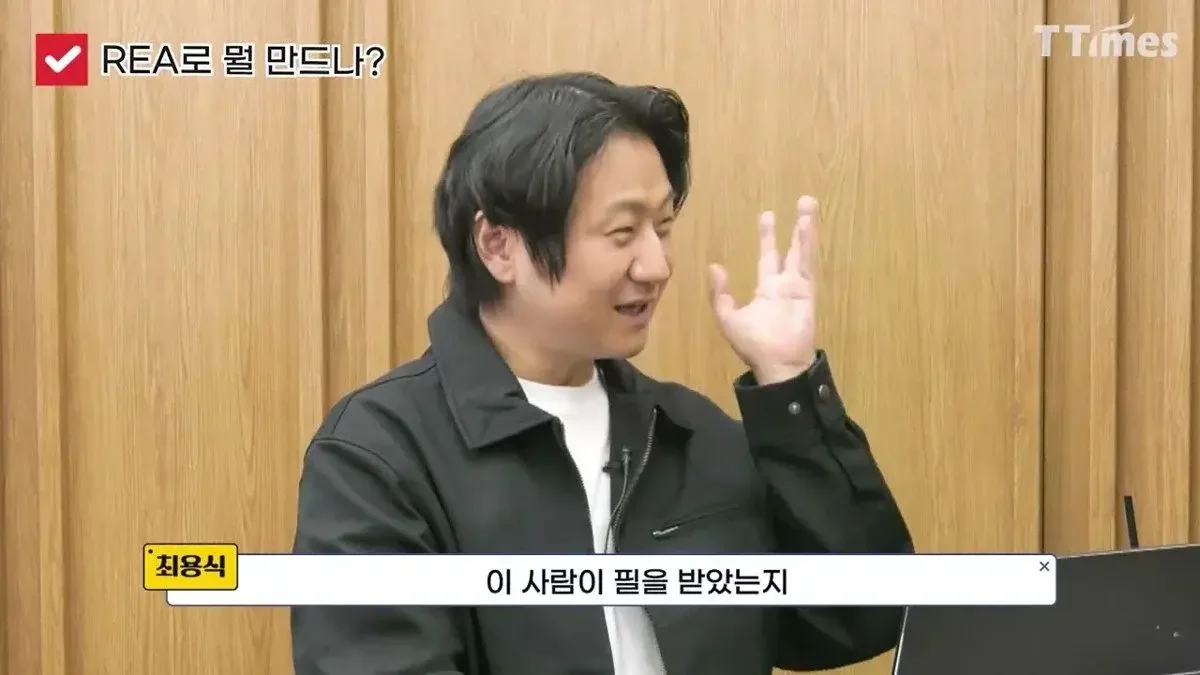
A discussion reported by T Times TV covered everything from the concept of REA to the disruptive changes it is expected to bring to the software (SW) and gaming industries. Sim Jae-seok, CEO of Byline Network, and Choi Yong-sik, CEO of Edged, predicted that REA will go beyond mere technical advancement to fundamentally change how companies survive.
"Like discovering a famous restaurant's secret sauce"... The power of REA combined with Vibe Coding
Reverse engineering is the process of analyzing a finished product to derive the original source code or mechanisms used to create it. While this was a technique companies already used to analyze competitors' products, the landscape has changed entirely with the integration of AI agents.
CEO Sim Jae-seok explained the difference between REA and the recent "Vibe Coding" trend using a food analogy. If Vibe Coding is like asking "AI, please make me some kimchi stew," REA is like demanding, "I want to make kimchi stew exactly like a specific famous restaurant, so please infer that restaurant's recipe and secret sauce." The structure is such that once REA finds the secret mechanism of the restaurant, Vibe Coding completes the actual cooking (coding) based on that recipe. Sim added, "It is like using REA to study the secret sauce to make a broth, and then using Vibe Coding to boil the kimchi stew based on that recipe."
CEO Choi Yong-sik explained, "AI agents directly coordinate tools to understand how software works and then write new source code based on that. Previously, humans had to analyze using tools one by one, but now, instead of the AI agent using tools to extract source code, it writes new source code based on the derived mechanisms." He diagnosed that "the amount of work humans have to do in this process has decreased significantly, making reverse engineering very easy."
'Craft' series clones Adobe and MS functions; clones spreading in the gaming industry
The impact of REA is already manifesting in the release of actual products. In the developer community, the heat is intense, with the star count for 'KitoB', an open-source project related to REA, exceeding 290,000. Developers are not just looking at the code but are taking actual action based on it. The impact is growing as it combines the primary motivators for developers: "immersion in a specific product" and "nostalgia."
A representative example is the 'Craft' series, which mimics Adobe's product lineup. Developer Braden Thomas, formerly of Square, reverse-engineered Adobe products to present 'PhotoCraft' as a Photoshop alternative, 'VectorCraft' for Illustrator, and 'FilmCraft' for premium use. Similarly, 'WordCraft' (mimicking Microsoft (MS) Office), 'GridCraft' (an Excel alternative), and 'DeckCraft' (a PowerPoint alternative) are results created in a short period through reverse engineering. The industry was shocked to see products pouring out in just one to two weeks.
Technical progress continues, such as Perplexity, one of the Large Language Models (LLM), incorporating 'Resolve Engineer' via its AI agent commands. Additionally, processes of cloning Photopea or the audio editing program Audacity are being shared via video. Sim noted that the topic is gaining traction by sending the message that "reverse engineering is stronger and more effective than open source."
Changes in the gaming industry are also intense. While past work mainly focused on "cultural heritage restoration" tasks, such as restoring old games where server support has ended, even recent popular games are now targets. Representative cases include reverse-engineering the Xbox exclusive 'Fable II' for PC, and a video of 'Cloud of Duty', suspected to be a clone of 'Call of Duty', which was taken down following a complaint from the developer. A browser version of the famous game 'Fallout' was also taken down at the request of the developer.
"The competition for features is over"... Lowered entry barriers and corporate speed wars
The emergence of REA is expected to fundamentally change the rules of competition in the software industry. Sim Jae-seok warned, "It will become difficult for software companies to compete based on the features themselves. The fact that entry barriers are lowering paradoxically means competition will become much more intense, and survival will be harder than in the past." He predicted that competition between companies will shift from designing new features to an "organizational speed competition" of how quickly they can follow and recreate a competitor's functions.
At the current level, some evaluate that products made by REA are at a "mimicry" level, implementing only about 50% of the original's functions. Braden Thomas also notes that his products are at a "50-point level" and provides notices regarding compatibility. However, the key is "cost." If the original provides a 100-point feature for 10,000 won, but a company using REA provides a 50-point feature for 1,000 won, users can migrate quickly. In particular, "installed software" that lacks cloud integration, such as communicating with a server for license authentication, is much easier to apply reverse engineering to than SaaS (Software as a Service), making its impact inevitable.
Choi Yong-sik suggested both the potential risks and possibilities of REA, stating, "Right now, it is at a level where amateurs do it in their spare time, but if large-scale companies or genius developers jump in in earnest, products that surpass the originals could emerge."
Source: original video (YouTube)


0Comments
Comments are currently disabled.