
Investors urged to shift toward bonds as economic slowdown signals emerge
Professor Kim Young-ik advises increasing bond investments in anticipation of falling interest rates as leading economic indicators signal a downturn.
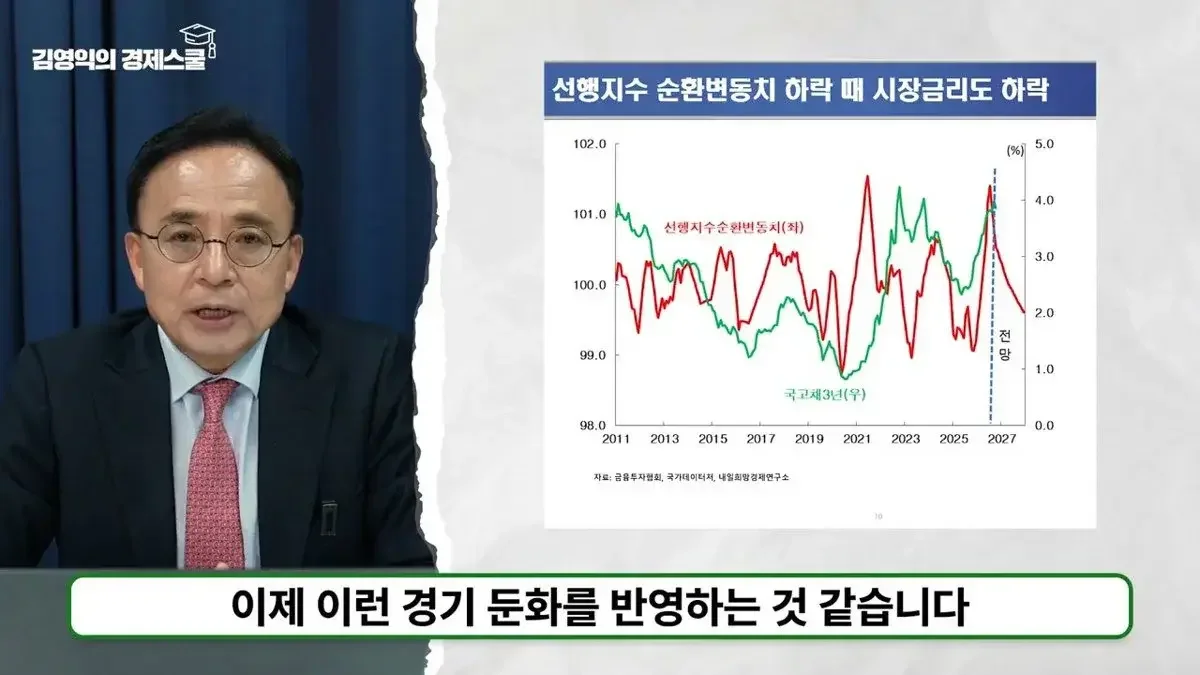
Professor Kim Young-ik recommended increasing bond investments on the 5th, noting that the leading index cyclical change value peaked last July and is now declining. He warned that both stock prices and apartment prices could undergo a significant correction next year as the KOSPI growth rate has already turned.
Professor Kim Young-ik, an expert in analyzing asset market trends, has called for a shift in asset allocation strategies, pointing to signals of an economic slowdown. While the inflation rate is decelerating, he analyzed that the leading economic index has passed its peak and is trending downward, suggesting that investors should increase their weight in bond investments to prepare for falling interest rates.
During an appearance on "Kim Young-ik's Economics School" on the 5th, Professor Kim analyzed recent inflation indicators and economic trends to forecast the future direction of the asset market. Analyzing average growth rates from 2000 to 2025, Kim noted that the returns on all assets—including deposits (3.3%), 10-year treasury bonds (3.9%), apartments (4.6%), KOSPI (8.0%), and gold (10.8%)—were higher than the consumer inflation rate (2.5%). "The fact that all asset prices were higher than the inflation rate means that, ultimately, one should not hold only cash," he emphasized, adding, "The issue is the problem of asset allocation: which assets to hold, when, and how much."
Falling leading index and interest rate cut forecasts... "Bond investment should be actively considered"
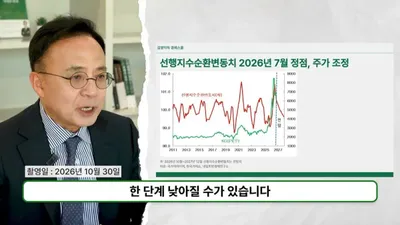
Kim identified the "leading index cyclical change value" as the key indicator for judging the current economic situation. "The leading index cyclical change value peaked last July and is now declining," he said. "This means that consumption and investment will slow down with a time lag, and reflecting the economic slowdown, the yields on 10-year and 30-year treasury bonds are highly likely to fall."
Accordingly, Kim suggested actively considering bond investments in line with the medium-to-long-term trend of falling interest rates. He advised tailoring strategies based on the nature of the investment funds. He explained that if funds are managed for the purpose of buying stocks in the first half of next year, bonds with 6 months to 1 year until maturity are suitable, whereas for surplus funds, purchasing long-term treasury bonds with 10-year or 30-year maturities may be advantageous.
Indeed, such changes are being captured in recent fund flows. "Until the first half of this year, a large amount of money flowed into equity funds due to the rise in the stock market, but since entering the second half, the inflow has stagnated as the market underwent a correction," Kim analyzed. "On the other hand, bond funds have recently been on an increasing trend. Smart money is moving to the bond market rather than the stock market recently."
Impact of KOSPI decline on real estate... "Possibility of apartment price correction next year"
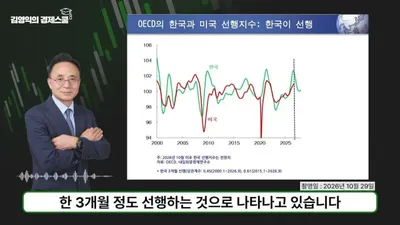
Regarding the debate over the real estate market, he approached it from the perspective of the "cycle" between assets. Amid intense debate over rising house prices and increased transactions in some areas recently, Kim presented a correlation between the KOSPI index and apartment prices. He explained, "A cycle is observed where the KOSPI leads Gangnam apartment prices, and Gangnam apartments, in turn, lead apartment prices nationwide."
Kim forecasted, "The direction of the KOSPI growth rate has already turned, and the growth rate of Gangnam apartments is also slowing down. Considering this cycle, it is highly likely that not only stock prices but also apartment prices will undergo a significant correction next year."
He maintained a cautious stance regarding inflation and monetary policy. The consumer inflation rate for October was 2.8% compared to the same month last year, showing a decelerating trend compared to August (3.1%) and September (2.9%). Kim analyzed, "Rising oil prices may act as a factor for inflation through the first half of next year, but in the second half of next year, the contraction in demand due to the economic slowdown will act as a factor for price stability." He predicted that while the Bank of Korea is highly likely to implement a final interest rate hike at the November monetary policy decision meeting to stabilize prices, there is a high possibility that it will lower the base interest rate again in the second half of next year following the economic slowdown.
Source: original video (YouTube)

0Comments
Comments are currently disabled.