
Kim Young-ik warns of economic slowdown as leading indicators peak in July
Professor Kim Young-ik warns that while current economic indicators in South Korea and the United States appear robust, leading indicators have already begun to decline, signaling a potential slowdown in growth as early as late this year or next year.
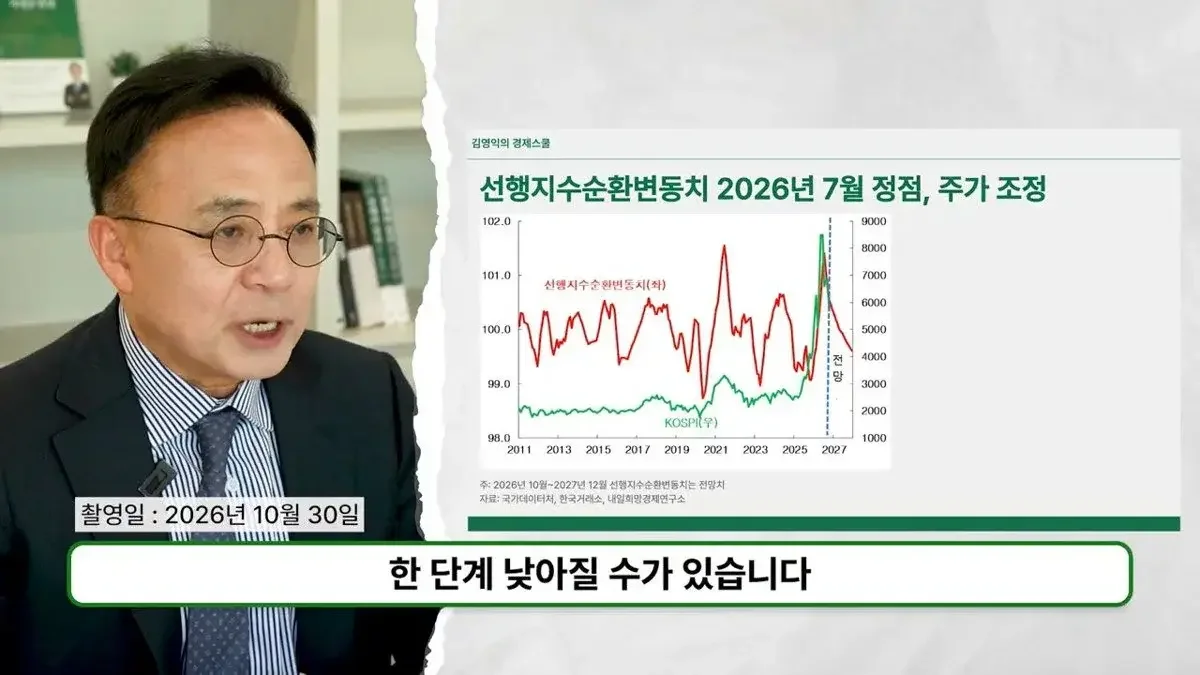
Professor Kim Young-ik warned that South Korea and the United States could face slowing growth as early as the latter part of the fourth quarter this year or next year, noting that leading indicators peaked in July. While South Korea's third-quarter growth reached 1.0%, Kim predicted the U.S. growth rate could drop to 1.4% next year.
While current economic indicators in South Korea and the United States are very robust, leading indicators that predict future economic trends have already turned downward. Rather than being complacent with the current boom shown in the indicators, it is a time when asset management strategies prepared for an upcoming economic slowdown are necessary.
According to the recent economic diagnosis provided by Professor Kim Young-ik, South Korea's third-quarter real GDP growth rate recorded 1.0% compared to the previous quarter, exceeding the market expectation of 0.7%. The United States also maintained a good economic state, with its third-quarter growth rate rising to 3.4%. However, Kim emphasized that "what is important is not now, but the future," noting that leading indicators, which signal the direction of the economy, have already changed course.
Leading indicators peaked in July, signaling slowdown hidden behind 'economic expansion'
The South Korean economy is currently in an "economic expansion" phase, with the coincident indicator cyclical change increasing rapidly as production, consumption, and investment all increased in September. However, Kim noted that the leading indicator cyclical change, a precursor to economic activity, has been slightly declining through August and September after peaking in July. "The leading indicator peaked in July and is now declining," Kim said, forecasting that "there is a high possibility that growth rates in the United States and South Korea will slow down as early as the latter part of the fourth quarter this year or next year."
In particular, Kim utilizes the "difference between the leading indicator cyclical change and the coincident indicator cyclical change" as a risk management metric. Since stock prices are reflected in leading indicators, a sharp drop in stock prices causes the leading indicator to fall and the coincident indicator to rise, thereby narrowing the gap between the two. The recent phenomenon of this gap narrowing due to falling stock prices suggests that downward pressure is acting as the gap between the real economy and stock prices closes.
Additionally, the fact that the yield spread between long-term and short-term interest rates (the difference between 10-year and 1-year yields) has recently narrowed sharply, along with the increasing decline in the news sentiment index, were presented as evidence supporting the further decline of the leading indicator. "When the leading indicator rises, you should increase your stock weight, and when it falls, you should decrease it," Kim advised, adding, "For investors who already have a high weight in stocks, it is good to use this opportunity to reduce that weight."
U.S. consumption slowdown and falling real wages... downward pressure on next year's growth
The United States economy is also currently recording a high growth rate of 3.4% driven by the strength of consumption and facility investment, but growth is expected to slow significantly next year. Kim predicted that consumption, which accounts for 69% of the U.S. economy, will fall below its trend next year. He cited low savings rates, a decrease in real wages due to inflation rising faster than wage growth, increased household interest burdens, and the negative wealth effect following stock price adjustments as the causes.
He expected the U.S. economic growth rate this year to be 2.4%, but warned it could drop to a level of 1.4%, which is lower than the market consensus of 2.2%. His analysis suggests that if consumption decreases, corporate sales and profits will decline, which could ultimately lead to a vicious cycle of slowing employment. Accordingly, he forecasted that the Fed, while deliberating between the two goals of price stability and maximum employment, is highly likely to shift toward interest rate cuts in the latter half of next year or at the end of the first half of next year.
South Korea is also expected to follow a similar trend. Kim predicted that the consumer inflation rate in October would slow down to around 2.6%. As demand shrinks, South Korea's inflation rate (both headline and core inflation) is expected to approach the 2% range in the second half of next year, and he analyzed that the Bank of Korea is likely to show an interest rate cutting stance, similar to the United States.
Slowing semiconductor momentum and increasing market volatility
A macroeconomic diagnosis was also provided regarding the recent trends in semiconductor stocks that have shaken the domestic stock market. Despite optimistic outlooks for semiconductor companies such as Samsung Electronics and SK hynix, the reason stock prices have been sluggish lies in the "slowing of macroeconomic momentum." Kim explained, "The growth trend of semiconductor exports is slowing down compared to the previous month or the same month of the previous year," and noted, "The momentum where Samsung Electronics' stock price moves in a similar direction to semiconductor export amounts has weakened."
The analysis suggests that external factors, such as the AI coupling debate and the increase in semiconductor production in China, are acting as downward pressure on semiconductor stock prices. "Stock prices are smart. If something good happens, stock prices rise, and if something bad happens, stock prices fall," he pointed out, noting that the market is already reflecting uncertainties regardless of the optimistic outlooks of companies.
Future market trends are expected to depend on the results of the U.S. midterm elections. Kim added, "Volatility may expand until before the election, but after the election, a short-term rebound may appear as uncertainty is resolved," though he cautioned, "This is highly likely to be a temporary rebound during a downward process rather than a trend-based rise."
Source: original video (YouTube)

0Comments
Comments are currently disabled.