
Three-step principle for building wealth through income and investment
According to a review of Sahil Bloom's "The 5 Types of Wealth" shared by The Man Who Explains the Economy (Kim Kwang-seok TV), building financial wealth requires a three-pillar strategy of income generation, expense management, and long-term investment.
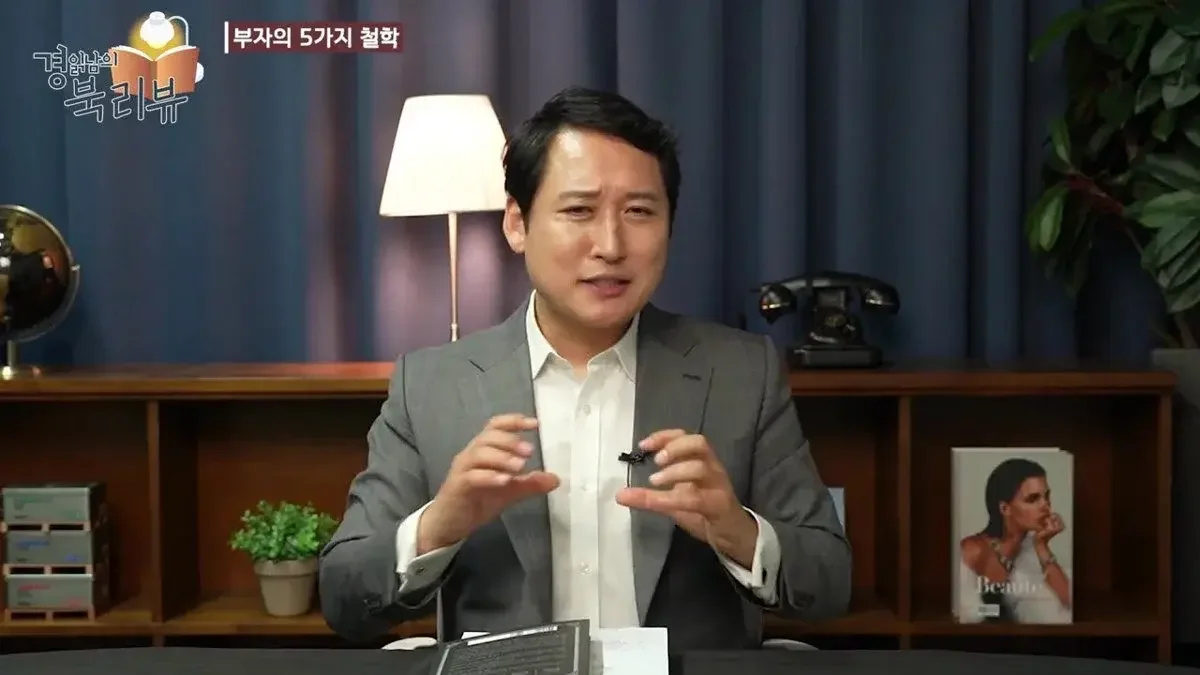
Professor Kim Kwang-seok suggests that building financial wealth requires maximizing the gap between income and expenses to create seed money for long-term investment. He advised that people in their 20s should prioritize building market-recognized capabilities over money management to improve their future income engines.
In a capitalist society, the choice not to invest is not merely a decision to forgo returns, but one that can lead to self-imposed poverty by failing to keep pace with the increasing value of assets. According to a review of Sahil Bloom's book "The 5 Types of Wealth" presented by The Man Who Explains the Economy (Kim Kwang-seok TV), achieving financial wealth requires the organic integration of three pillars: income generation, expense management, and long-term investment.
The 'gap' between income and expenses is the cornerstone of wealth
The core of the process for building financial wealth lies in maximizing the gap between income and expenses. Citing the book, Professor Kim Kwang-seok emphasized that the difference between income and expenditure is the most important tool for achieving economic freedom. A larger gap increases the "seed money," which serves as the foundation for investment assets that can benefit from the effects of compound interest. In other words, the gap between income and expenses becomes the cornerstone for building financial wealth.
The specific three-step process for achieving financial wealth is as follows. The first step is "income generation." One must build a "income engine" that grows steadily and stably through a primary job, side hustles, and passive income pipelines. This requires the process of creating skills that are recognized by the market and strategically deploying them to convert them into income. The second step is "expense management." One must maintain control to ensure monthly expenditures remain clearly lower than income levels, specifically guarding against the failure of "expectation management," where spending increases alongside rising income. This must be supported by concrete control, such as creating and adhering to a budget. The final step is "long-term investment," which involves managing the surplus funds created through these steps efficiently and over the long term so that compound interest can occur.
For those in their 20s, focus on 'capability building' rather than 'money management'
Professor Kim Kwang-seok offered a distinct perspective on the attitude young people should adopt during the income generation stage. He expressed regret that many young people are preoccupied with investment techniques, such as "how to buy stocks," rather than acquiring capabilities that are recognized by the market. He noted that while he is often asked by young people, "How can I build capabilities that are recognized by the market?", the dominant questions he encounters in the field are actually "How do I invest?"
He advised, "Since young people in their 20s are structurally in the process of building capabilities, they can temporarily set aside concerns about how to manage their money." This is because the days of a person in their 20s are not just a single day, but time that determines their entire life. Therefore, during this period, the priority should be investing all available time into building differentiated skills and areas of expertise to improve the performance of the "income engine." Professor Kim added that building such capabilities is not too late even if started after the age of thirty, and that they should currently focus on creating irreplaceable talents like Son Heung-min or Yuna Kim. His philosophy is that studying economics is different from studying money; therefore, rather than becoming a slave to money, young people should focus on understanding economic flows and learning what to prepare in response to changes in the world.
Maximize the index of 'time' through the magic of compound interest
In the stage of growing the secured seed money, the principle of "long-term investment" is absolute. The book defines compound interest as "the return rate raised to the power of time." Here, the exponent is "time." Therefore, the key variable to control and utilize to maximize the effect of compound interest is "time." One must understand the cyclical structure of compound interest, where money produces money, and that money in turn produces more money.
Professor Kim recommended maintaining a long-term perspective rather than focusing on short-term trading (the act of buying and selling), stating, "I have never seen anyone who aimed for long-term investment actually lose money." He suggested that while short-term investors may see profits or losses, the results for long-term investors differ when they adhere to their principles. However, he advised that while investing in a way that realizes profits upon reaching a target return rate may be appropriate, one should avoid investing simply to become a trader.
The phrase that the best time to start investing was 20 years ago, and the second best time is today, serves as a reminder of the value of time. Ultimately, the standard path toward financial wealth is to create a gap with a solid income engine, secure seed money through strict expense control, and then entrust it to the flow of compound interest over a long period of time.
Source: original video (YouTube)
0Comments
Comments are currently disabled.