
Kim Young-ik warns of economic slowdown despite optimistic growth forecasts
Professor Kim Young-ik warns that despite optimistic growth forecasts from the KDI, narrowing yield spreads and falling leading indicators signal an impending economic slowdown.
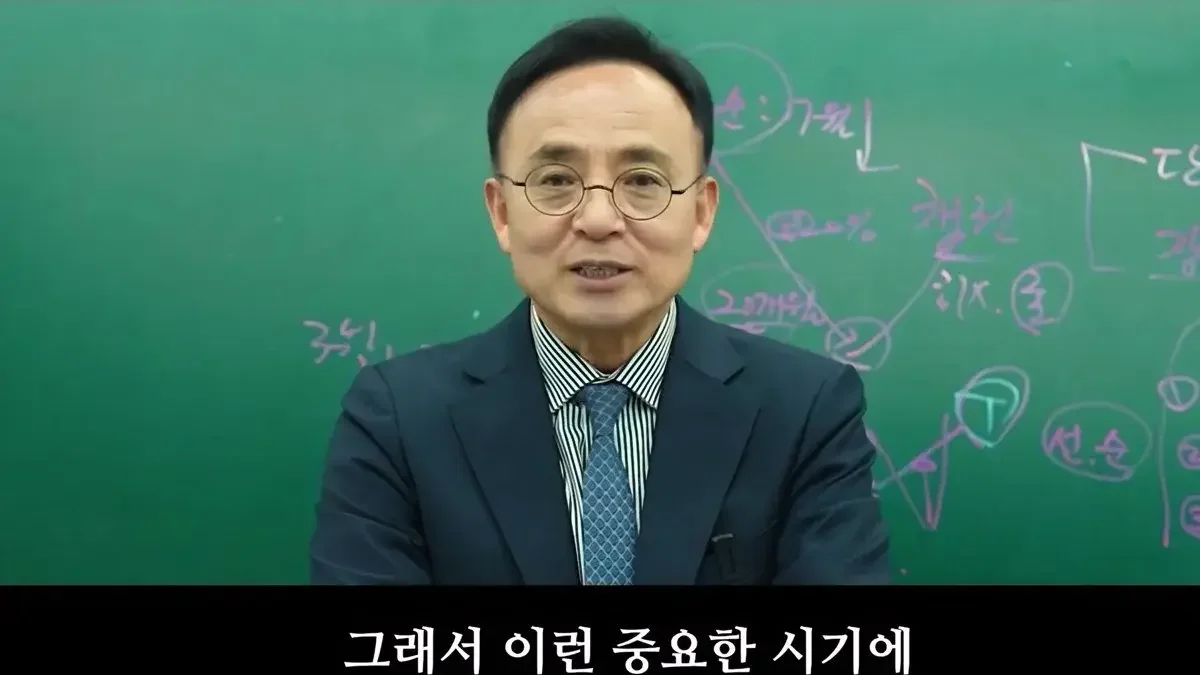
Professor Kim Young-ik warned on the 20th that narrowing yield spreads and falling leading indicators signal a potential economic downturn, despite the KDI's upward revision of growth forecasts to 3.8% this year and 3.9% next year.
Despite optimistic upward revisions in economic growth forecasts, real signals of an economic slowdown are being detected in various areas. While major research institutions are setting high economic growth rates for next year, market leading indicators and interest rate spreads strongly suggest the possibility of a future economic downturn.
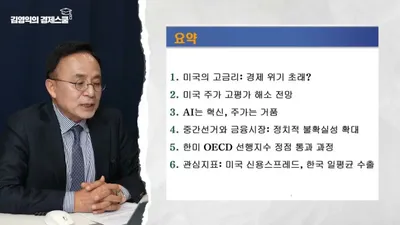
Analyzing recent economic indicators and financial market trends through "Kim Young-ik's Economics School" on the 20th, Professor Kim Young-ik defined 2027 as an era of uncertainty where "survival and leaps" coexist. Regarding the KDI's upward revision of economic growth forecasts to 3.8% this year and 3.9% next year, Kim diagnosed that "while the outlook suggests robust increases in consumption, investment, and exports thanks to AI investment and semiconductor exports, it is far from market expectations."
Narrowing yield spreads and falling leading indicators signal impending slowdown
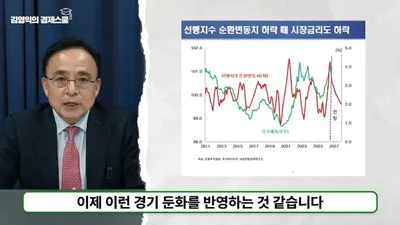
Contrary to the optimistic KDI outlook, Kim analyzed that core market indicators point toward an economic downturn. "The cyclical component of the leading index entered a downward phase after peaking this past July," he explained, adding, "This means all economic indicators, including consumption, investment, and exports, could slow down in the future."
In particular, he noted the rapid narrowing of the long-term and short-term interest rate spread. The yield spread is an indicator that precedes GDP growth by approximately one to two quarters. "The recent rapid narrowing of the long-term and short-term interest rate spread is a powerful warning that economic growth will fall in the future," Kim said. He analyzed that both the bond and stock markets are already reflecting the possibility that next year's economic growth could drop significantly.
He maintained a conservative view on the stock market. With the KOSPI having fallen below the 5,000 level, he warned that if the AI bubble theory originating from the United States persists, it could lead to a decrease in domestic semiconductor demand. "It appears difficult for the average daily export amount to exceed the level seen this past September ($5.63 billion) through next year," he projected, noting, "The KOSPI will undergo adjustments around the 5,000 level for the time being, and there is a possibility of a further decline next year as US AI capital expenditure decreases." He added that the trend of average daily semiconductor export amounts should be monitored through export statistics to be released in November and December.
AI bubble theory and overvaluation relative to money supply... "Focus on bond investment weight"
Regarding the AI industry in the US market, he emphasized the separation of technological prowess and capital. Mentioning that major indices fell despite the successful Nasdaq listing of Entropy, he pointed out, "The success of Entropy does not guarantee the profitability of the entire AI industry." Entropy listed on December 19 at $83 per share and rose 17.1% to a closing price of $97.2 on its first day, recording a market capitalization of $1.5 trillion, but Kim noted, "Even though September sales increased 13 times compared to the previous year, net losses still exceed $100 billion, so we must watch whether it can generate profits in the future."
"Looking at past cases, bubbles often formed due to expectations for technology and then collapsed," he said, pointing out, "The current S&P 500 index is overvalued by about 40% relative to the money supply (M2)." His logic is that if the supply of the stock market increases while it is overvalued relative to the money supply, stock indices have no choice but to fall. He also cited the trend of the credit spread—the difference between high-yield and government bond yields—as an indicator to watch, as it may suggest that financing for AI companies could become difficult.
On the other hand, he emphasized investment opportunities in bonds following the downward trend in interest rates. "Market interest rates have been falling after peaking this past September, and long-term rates, in particular, are falling, reflecting the economic slowdown," Kim said. He advised, "Since market interest rates tend to precede the Bank of Korea's base rate decisions, one should pay active interest to bond investment starting from the second half of this year with the possibility of future rate cuts in mind." His analysis is that there is a high possibility of interest rate cuts in the second half of next year as the inflation rate approaches 2% due to shrinking demand.
"Do not be defeated by the flow of the times"... Emphasizing macro-perspective asset allocation
Regarding exchange rates, while the KRW-USD exchange rate has recently been stabilizing at low levels, he left open the possibility of a short-term rebound. "Dollar inflows from current account surpluses and strong exports are supporting the value of the won, but considering the rise in the Dollar Index, it will be difficult for the exchange rate to fall further," he said. "In the short term, there will be a period of adjustment moving in the opposite direction of the Dollar Index, so the exchange rate may rebound slightly." However, he predicted that a trend of US dollar weakness and won appreciation would continue in the medium to long term, potentially entering the 1,200 won range as early as the end of this year or the first half of next year.
Kim identified a "macro perspective" as the attitude individual investors should adopt amidst the changing economic environment. "It is more important to read the flow of the macroeconomy rather than being buried in micro details," he emphasized. "If you fail to read the flow of the times, you can lose all your assets, but if you ride the flow well, you can increase individual wealth and grow companies." He stressed the importance of grasping macro flows with the expression, "If you are defeated by an individual, you may lose some assets, but if you are defeated by the times, you can lose all your assets."
Finally, he urged, "One must establish an asset allocation strategy by adjusting the proportions of stocks, bonds, and cash while checking the leading indicators and the long-term and short-term interest rate spread."
Source: original video (YouTube)
0Comments
Comments are currently disabled.