
Kim Young-ik warns of US stock market correction amid AI bubble burst
Professor Kim Young-ik predicts a significant correction in US stock prices next year as the AI investment bubble begins to deflate. He advises reducing equity holdings to approximately 20% to prepare for a potential economic slowdown.

Professor Kim Young-ik warned that the US stock market could face a significant correction next year as the AI investment bubble bursts. With the Buffett Indicator exceeding 190%, Kim estimated the S&P 500 remains overvalued by approximately 20% compared to its fair value.
Asset allocation strategies are facing an emergency as global financial market uncertainty grows following the US midterm elections. Analysis suggests a conservative approach is necessary to prepare for a future economic slowdown, as debates over the overvaluation of the US stock market coincide with the bursting of the AI (artificial intelligence) investment bubble.
Through the YouTube channel "Kim Young-ik's Economics School," Professor Kim Young-ik analyzed recent plunges in the US stock market and volatility in the KOSPI, diagnosing the current market situation as a "process where overvalued stock prices are being resolved." Kim explained that the victory of the Democratic Party in the elections is not the direct cause of the stock price decline; rather, the accumulated AI bubble and overvalued valuations are using the midterm elections as a catalyst for correction.
Buffett Indicator exceeds 190%... Overvaluation higher than the 2000 IT bubble
Kim warned that the current level of overvaluation in the US stock market is more severe than during the dot-com bubble. When combining major indicators such as the "Buffett Indicator"—which divides US stock market capitalization by nominal GDP—along with PER (price-to-earnings ratio) and Tobin's Q, current valuations are approximately 190% higher than the long-term average. This figure is higher than the levels seen during the 2000 IT bubble.
In fact, the dividend yield of the S&P 500 has recently been at the 1.1% level, significantly lower than its long-term average of 4.4%. This indicates that the stock prices in the denominator are excessively high. Based on a nominal GDP growth rate of 6.5% for this year, Kim estimated the fair value of the S&P 500 to be 6,255. However, considering the recent index level is around 7,353, the calculation shows it remains overvalued by approximately 20%.
"As the AI bubble bursts next year, there is a high possibility that US economic growth will decrease significantly," Kim predicted. "When forecasting next year's nominal GDP growth at 3.6%, the fair value could drop to the 6,658 level, which is even lower than now." He added that US stock prices are currently in the process of finding their proper place.
Shrinking AI investment and widening credit spreads... Signs of economic recession detected
Optimism regarding the AI industry is also a cause for caution. Kim cited historical examples where excessive stock market optimism eventually led to bubble bursts and capital destruction, despite the automotive industry in the 1920s and the internet industry in the 1990s innovating productivity. He reminded that the Dow Jones Industrial Average fell by about 90% from its peak when the 1920s automotive bubble burst in the 1930s, and the Nasdaq plummeted by about 80% from its peak during the 2000 internet bubble burst. He argued that the current AI revolution, regardless of its technological value, could undergo a bubble-bursting process in the stock market.
In particular, he emphasized that major institutions such as the IMF and BIS are warning about potential investment contraction and financing issues for AI companies. The BIS recently released a report stating that high interest rates in the US could reduce investment funds for AI companies, making the US economy difficult. As the high-interest-rate stance is maintained, credit issues for AI companies are emerging, which could ultimately lead to delays in data center investment and a decrease in semiconductor demand. The recent sharp declines in the stock prices of Samsung Electronics and SK hynix are interpreted as results of the market preemptively reflecting these concerns. Analysis suggests that as the US Democratic Party controls both the House and the Senate, political uncertainty is increasing, and if regulations on Texas data centers, for example, are strengthened, increased costs and project delays could worsen the profitability of AI companies.
The narrowing of the "yield spread" and movements in "credit spreads" were also identified as signs of economic recession. "The yield spread between long-term and short-term rates has been narrowing rapidly recently, which suggests that the economic slowdown could arrive larger and faster than expected," Kim analyzed. "The fact that the credit spread—the difference between US high-yield bond yields and Treasury yields—is hitting a bottom and rising also shows that credit issues in the US economy could become serious." He also mentioned the possibility of the credit spread exceeding its long-term average of 5.2%, warning that this could indicate serious credit problems in the US economy.
KOSPI enters undervalued phase... "Reduce equity weight to 20%"
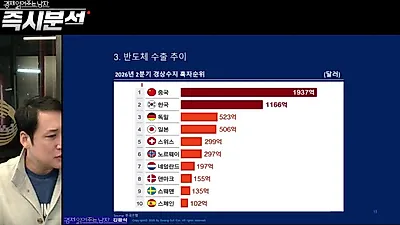
Regarding the domestic stock market, the KOSPI, Kim judged that it has entered an "undervalued zone." He analyzed the fair level of the KOSPI based on import and export statistics to be announced on November 10. If the average daily export amount for this month is expected to be $4.73 billion, the fair KOSPI index level would be 5,318. Since the KOSPI is currently formed lower than this, he viewed the possibility of further short-term plunges as low. Notably, the correlation coefficient between the KOSPI and the average daily export amount reaches 0.91, and he explained that there is room for the KOSPI to rebound by the end of December following the forecast that the average daily export amount will increase to $4.99 billion in December.
However, he clarified that being undervalued does not mean an immediate transition to a bull market. This is because Korea's leading index already peaked in July and has entered a downward phase. Since the US leading index tends to lag behind Korea by about three months, Kim's analysis suggests that the US likely peaked in October as well. "When the leading index falls, all economic indicators inevitably slow down," he forecasted. "As export growth and consumption growth slow down from November, overall economic growth and corporate profits will decrease next year."
In conclusion, Kim strongly recommended a change in asset allocation. "From the second half of this year, it is good to lower the equity weight to around 20%," he advised. "For surplus funds currently held in short-term bonds, a strategy of holding a significant weight in long-term bonds will be effective." He also predicted that the adjustment of US stock prices will continue until the first half of next year, which will also have a negative impact on the Korean market.
Source: original video (YouTube)


0Comments
Comments are currently disabled.