
US Considers Cutting 40,000 Troops... Controversy Over 'Retaliatory Measures' Against Spain, Italy, and Germany
The United States is considering a significant reduction of its military presence in Europe…
As the United States considers a plan to significantly reduce its military forces stationed in Europe, changes in the international situation surrounding this move are being predicted. In particular, as discussions regarding the reduction focus on specific European countries that refused to support US operational activities, analyses are emerging that this measure may not be a simple strategic redeployment but rather a 'retaliatory measure.'
Targets for US Military Reduction are Spain, Italy, and Germany... Suspicions of 'Retaliation' Raised
According to a video from Park Jong-hoon's Knowledge Remedy, a plan to reduce between a minimum of 25,000 and a maximum of 40,000 out of the 80,000 US troops currently stationed in Europe is being considered. This means withdrawing nearly half of the total force. The noteworthy point is the countries targeted for reduction. The video identified Spain, Italy, and Germany as the countries where reduction discussions are concentrated.
These countries are those that have recently expressed refusal or critical attitudes toward US requests for support in Middle East operations. Italy did not permit the landing of US bombers at Naval Air Station Sigonella in Sicily, which the US intended to use for refueling and maintenance for attacks in the Middle East. At the time, Italian Prime Minister Meloni had shown a friendly relationship by emphasizing her closeness with President Trump, but the Italian government drew a clear line, stating, "We only authorized the base for peaceful purposes and have no intention of participating in the war against Iran."
Spain was even firmer than Italy. On March 2, the US requested the use of the Rota-Moron bases, which are strategic points at the entrance of the Atlantic Ocean, but Spain refused, stating they could never allow it if it were to be used for operations against Iran. In response, President Trump threatened to completely halt trade with Spain on March 3, but no follow-up measures, such as actual tariff policies, appeared. Ultimately, Spain moved 15 Air Force planes that were at the US military base to other European countries such as the United Kingdom, Germany, Romania, and Croatia. Germany also took a confrontational stance as its Chancellor criticized the US attack on Iran, but was forced to allow the use of the military base.
The video mentions that although the Trump administration applied strong pressure to Spain, it failed to take substantial measures, analyzing that this decision to reduce US troops could have a kind of retaliatory nature against countries that did not follow US demands. In particular, the final announcement date for the US troop reduction is scheduled for November 6, which is set after the US midterm elections in November. This appears to be a strategic timing adjustment for the election, considering that the decision to reduce US troops could face backlash from conservatives within the United States.
NATO is a Two-Way Base for Maintaining US Hegemony... The Role of Europe
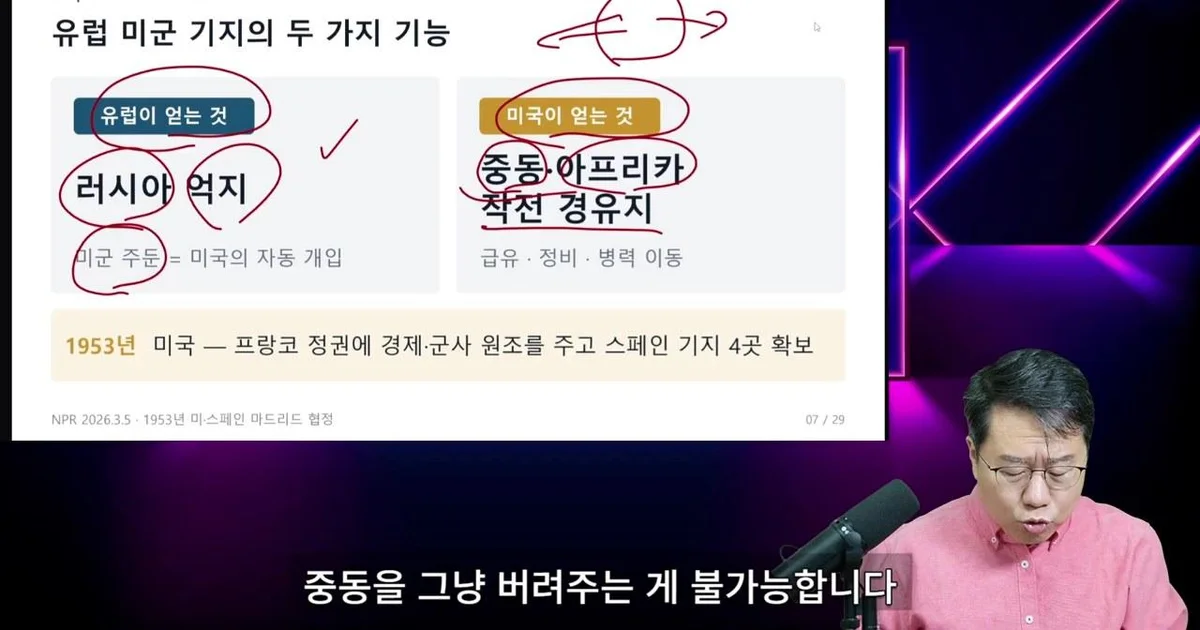
Contrary to the view that the US military presence is solely for European security, European bases are also strategically very important to the United States. Citing remarks from US Secretary of State Rubio, the video emphasizes that "The reason NATO is good for the United States is that in case of an emergency, the US can use European bases as it pleases." Secretary Rubio is a key figure within the Republican Party, to the extent that he is mentioned as a potential next presidential candidate, and he directly mentioned that NATO serves as a military base for the United States.
The United States has essentially utilized military bases in Europe to conduct operations in the Middle East and Africa, and to maintain global hegemony to check China. In particular, to maintain the petrodollar system in the Middle East, the US cannot give up its influence in that region, and the foundation supporting this is the US military bases in Europe. The past case in 1953, where the US secured four bases by providing economic and military aid to the Franco regime in Spain, which was a dictatorship, shows how powerful means the US has mobilized to secure European bases. Recently, the strategic value of the Moron base in Spain has been so high that expansion plans are being discussed, such as adding 9 parking spots for B-52 bombers and 10 refueling facilities.
Meanwhile, Italy's attitude is complex. While Italy refused to cooperate with the US in the war against Iran, it is faithfully performing its NATO missions. A recent case where Italy urgently deployed two Eurofighter Typhoons to shoot down a suspicious drone that appeared in Lithuanian airspace supports this. In other words, Italy opposes specific US operations but is active in NATO security missions, such as checking Russia.
Prospects for the Acceleration of 'European Autonomous Defense' Caused by US Troop Reduction
A prospect was also presented that the pressure from the US to reduce troops will instead act as a catalyst to accelerate Europe's 'autonomous defense.' The video explains the response methods of European countries by comparing the case in 1966 when French President de Gaulle notified the withdrawal of US troops and the case of West Germany in 1967.
While France, which had the power to protect itself in the past, was able to expel US troops after the success of its nuclear tests in the 1960s, West Germany, which had high economic and military dependence, succumbed to US pressure and allowed US troops to remain. At that time, after being threatened by the US while demanding that dollars be exchanged for gold, the Governor of the Central Bank of West Germany sent a letter to the Chair of the Federal Reserve on March 30, 1967, conceding that they would no longer exchange dollars for gold and thus maintaining the US military presence.
However, the analysis suggests that the current situation in Europe is different. The video reported that as Europe observes the US not actively intervening in the security of allies such as Saudi Arabia, skepticism that 'the United States cannot be trusted' is spreading within Europe. The fact that the US response was lukewarm even when Saudi Arabia was attacked by the Houthis is stimulating the will for European autonomous defense.
In conclusion, if the reduction of US troops becomes a reality, Europe is expected to strengthen its autonomous defense capabilities at a faster pace for its survival. The video predicted that despite its economic weakening, Europe possesses solid basic scientific capabilities, and thus within the next 10 to 15 years, Europe will possess independent defense capabilities to refuse US demands. In the long term, Europe's power to resist US hegemony demands will grow, which will be a change contrasting with the past trend where the US maintained hegemony by obstructing the securing of independent defense capabilities in Europe.


0Comments
Comments are currently disabled.