
Comprehensive Real Estate Holding Tax for Jointly Owned Property by Spouses: Which is Better, 'Individual Payment' or 'Single-Household One-Home Special Exception'?
As the application period for Comprehensive Real Estate Holding Tax special exceptions approaches…
Ahead of the Comprehensive Real Estate Holding Tax (comprehensive real estate holding tax) special exception application period, which takes place from mid to late September every year, owners of jointly owned residential properties stand at a crossroads in choosing how to reduce their tax burden. During this special exception application period, which runs from September 16 to September 30, applicants can request to be treated as a single-household one-home owner for their jointly owned property.
Major Schedules Related to Comprehensive Real Estate Holding Tax and 4 Special Exception Application Items
The major schedules related to the comprehensive real estate holding tax are divided into three parts. First, June 1 of every year is the taxation standard date for the comprehensive real estate holding tax, and the person who owns the house as of this date bears the tax obligation. Subsequently, from September 16 to September 30 is the period when various special exceptions are applied for, and finally, December 15 is the deadline for reporting and paying the comprehensive real estate holding tax. The presenter of the video explained that the principle is that the owner as of June 1 pays the tax, and mentioned that if the balance settlement date for selling a house is set to the end of May, the comprehensive real estate holding tax obligation does not arise because they are not the owner as of June 1.
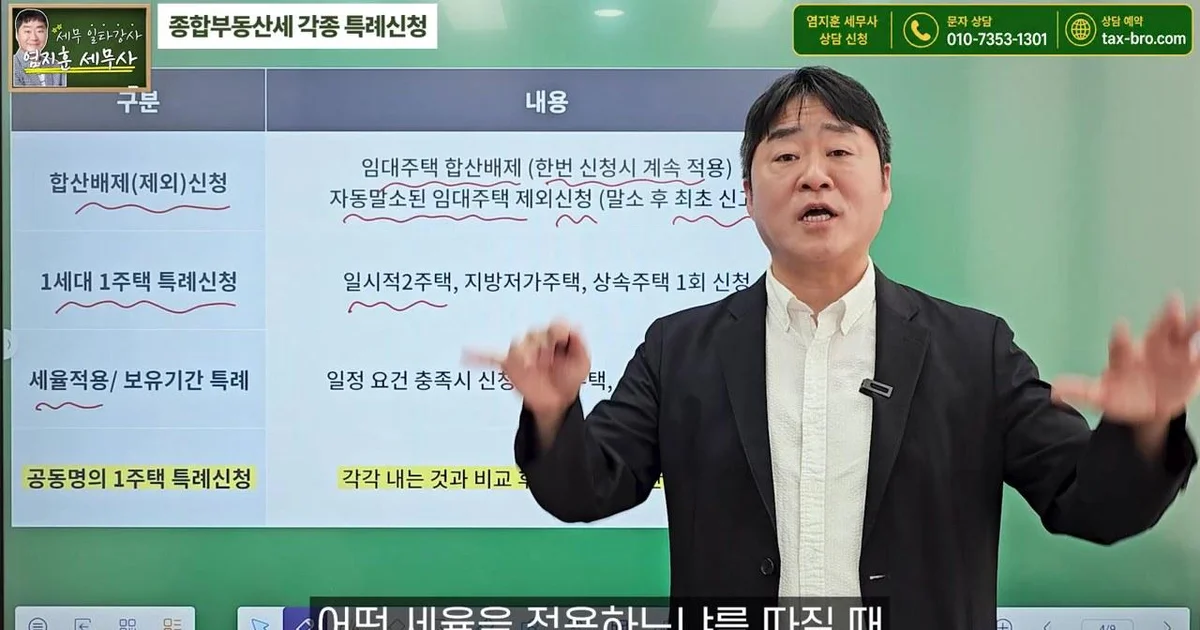
There are four main items covered during the September special exception application period. The first is the 'Exclusion from Aggregation Application' related to rental housing. This is a procedure to exclude rental housing that meets certain requirements from the calculation of the comprehensive real estate holding tax, and for rental housing that has been automatically canceled, a re-application may be necessary. Second is the 'Single-Household One-Home Special Exception Application.' This is a procedure for temporary two-home owners, owners of low-priced local housing, owners of inherited houses, etc., to apply to receive the deduction benefits granted as a single-household one-home owner. Third is the special exception for tax rate application and holding period, which is an application to be excluded from the number of houses when applying tax rates based on the tax base. Finally, there is the 'Spouse Jointly Owned One-Home Special Exception Application,' which is the core of this video.
Joint Ownership by Spouses: Why Applying for the Special Exception Is Not Always Advantageous
If a married couple jointly owns a house 50:50, they can choose whether to let each spouse pay the tax individually or to apply for the special exception to be considered a single-household one-home owner and concentrate the tax credit on one person. Citing National Tax Service data, the video explained the criteria for a favorable choice based on the officially announced price. Generally, in cases where there is no tax credit, it is advantageous for each spouse to pay individually regardless of the officially announced price. This is because if they apply as a single-household one-home owner, the deduction amount is 1.2 billion won (as of 2026), but if they pay individually under joint ownership, they can receive a total deduction of 1.8 billion won, with 900 million won per person.
The judgment changes when tax credit rates are applied. According to the video, in the range where the officially announced price is approximately 2.55 billion won or less, it may be advantageous for each spouse to pay individually even if the tax credit rate is high. On the other hand, as the officially announced price rises and the tax credit rate reaches a certain level (e.g., 80%), it becomes more advantageous to apply for the single-household one-home special exception. The presenter used an example where the officially announced price is 1.8 billion won, explaining that in this case, if each spouse receives a 900 million won deduction, no tax is generated, so there is no need to apply for the special exception.
Verification of Actual Tax Amount Comparison through Hometax Simulation
In the video, the actual cases were verified using the 'Comprehensive Real Estate Holding Tax Simple Tax Calculation' function of Hometax. For the first case, a situation with an officially announced price of 2.05 billion won and a holding period of 15 years at age 70 was set. In this case, even though a tax credit for elderly and long-term holding of 1.64 million won is applied, the tax amount when each spouse pays individually (approximately 492,000 won) was found to be slightly more advantageous than the tax amount when applying for the special exception (approximately 492,480 won). In other words, in this case, staying as is is advantageous.
The second case is when the officially announced price is 2.5 billion won. After setting the tax credit rate to 80% and calculating, it was confirmed that, unlike the previous case, applying for the special exception is more advantageous than joint payment by the couple. The presenter advised that detailed judgment criteria can be found by referring to National Tax Service press releases, and recommended making the optimal choice suited to one's own situation through the Hometax simulation.

0Comments
Comments are currently disabled.