
"An Era Where Saving Makes You Poor"... Two Betrayals That Flipped the 40-Year Rule of Wealth
The fundamental formula for wealth accumulation maintained over the last 40 years is being shaken as the era of low interest rates and quantitative easing gives way to a new economic reality. Analysis suggests that artificial interest rate cuts and currency devaluation have created a structural problem where diligent savers lose asset value, while the recent rebound in interest rates marks a "second betrayal" that changes the rules of money.
The formula for asset formation that has been maintained for the past 40 years is being fundamentally shaken. Following the 'first betrayal,' where the value of currency declined due to a continuous low-interest-rate trend, an analysis has emerged stating that the 'second betrayal' has begun, where the rules of money are changing as interest rates recently rebound. According to this analysis provided by Park Jong-hoon's Knowledge Remedy, a structural problem has occurred where those who diligently accumulated assets through savings instead experienced a decline in asset value due to continuous artificial interest rate cuts and quantitative easing.
The 'Asset Illusion' Caused by Interest Rate Cuts and the Corruption of Currency Value
In the past, in 1980, the highest interest rate for savings in Korea reached 41.6%. At that time, even through bank deposits alone, one could enjoy returns exceeding the average return of Warren Buffett, which was 19.9%. However, as of 2020, the average interest rate for bank deposits in Korea fell to 2.9%. As a result of lowering interest rates under the pretext of economic stimulus during every economic crisis, depositors have been placed in a situation where they cannot protect their asset value, effectively acting as a subsidy to investors.
In this process, an 'illusion caused by the decline in currency value' appeared, where asset prices soared. Taking Eunma Apartment as an example, the price which was 700 million won in 2005 soared to 3.13 billion won in 2016, appearing to have risen 4.5 times in terms of Korean won. However, when converted to dollars, it is only a 3.4-fold increase, and when converted to gold, an apartment that required 48kg of gold in 2005 can now be purchased with only 18kg of gold, meaning the real value has fallen by 63%. In other words, the analysis suggests that asset prices did not rise, but rather it is a phenomenon that appeared as the value of the Korean won corrupted.
The Gap in Returns by Asset Type Created by Quantitative Easing... Nasdaq 16x vs KOSPI 5x
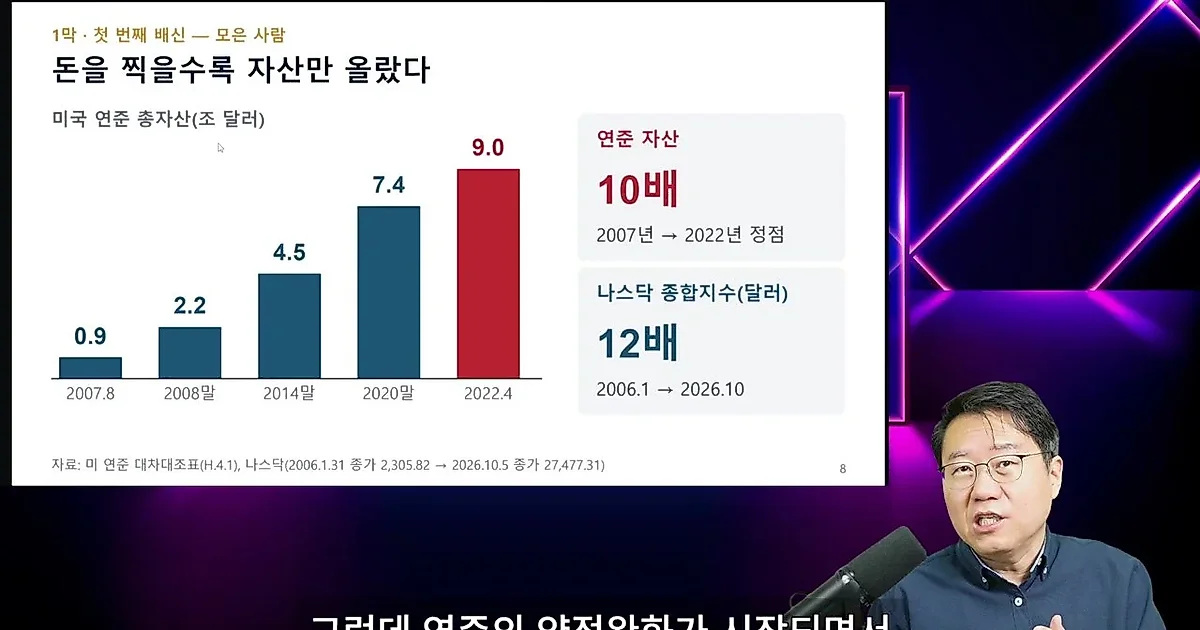
The quantitative easing implemented by the Fed through the 2008 global financial crisis and the 2020 pandemic intensified the polarization of returns between assets. The Fed's assets, which were around 900 billion dollars in 2007, increased to 9 trillion dollars in April 2022. This is a scale of printing about 10 times more money compared to just before the financial crisis. During this period, the Nasdaq index rose 12 times in dollar terms, and 16 times when converted to Korean won, and gold prices also rose about 10 times in terms of Korean won.
On the other hand, Korea's KOSPI only rose 5 times during the same period. In the case of apartments in Gangnam-gu, the average based on the Ministry of Land, Infrastructure and Transport's actual transaction price rose 2.7 times. While it is also because Gangnam apartments were already forming high price ranges, it is because the massive liquidity supplied by the Fed concentrated on the most 'smart assets,' causing a stark gap in growth rates by asset type. An analysis followed that the background of KOSPI investors having lower returns than apartment holders was the characteristic of Korean stock investors repeatedly engaging in frequent trading, with an average holding period of only 5 days.
2026, the Counterattack of Money and the Changing Rules of Wealth
If the rule for the last 40 years was 'asset price increases through low interest rates and quantitative easing,' that rule is now changing completely. The interest rate hikes that began in 2022 mean that the price of money has begun its counterattack, and 2026 is pointed out as the time when this change will become full-scale. The interest rates that were artificially lowered have passed a threshold, and the value of money has begun to move again.
In the future, methods such as simply borrowing money to increase assets or relying on savings as in the past may become dangerous. As the rules of money change, the way to accumulate assets and build wealth must also fundamentally change, and an era has arrived where it is important to have the eye to identify real wealth and escape from the illusion of fake money.
Source: original video (YouTube)



0Comments
Comments are currently disabled.