
Asset gap reaches 190 times as AI drives economic polarization
Professor Kim Kwang-seok explains how the divergence between expansionary fiscal policy and contractionary monetary policy can act as a strategic division of roles, while warning that the AI-driven economy could widen the asset gap between the top and bottom 20% to 190 times.

Professor Kim Kwang-seok warned that while AI acts as a new growth engine, the asset gap between the top and bottom 20% has widened to 190 times. This polarization occurs as capital concentrates in AI-related industries, even as the government faces a transition to a fiscal surplus for the first time in nine years.
A phase of "out-of-sync" policies is continuing, where government fiscal policy maintains an expansionary stance while monetary policy moves toward contraction.
In a dialogue with Jose Ilbo reported by The Man Who Explains the Economy (Kim Kwang-seok TV), Professor Kim Kwang-seok projected that the government budget will show an increase in the mid-10% range in 2027, comparing the current policy stance to a "technician's out-of-sync" movement. Professor Kim noted that as the government secures a massive excess tax revenue of 150 trillion won, it is facing a transition to a fiscal surplus for the first time in nine years. He explained that from the perspective of fiscal authorities, they have no choice but to actively invest this excess tax revenue into future growth engines, such as nurturing future industries or cultivating talent. He stated that rather than the total amount of fiscal expenditure, it is time to ask questions about which specific fields the budget is being intensively allocated to.
'Strategic Division of Roles' Between Fiscal Expansion and Monetary Contraction
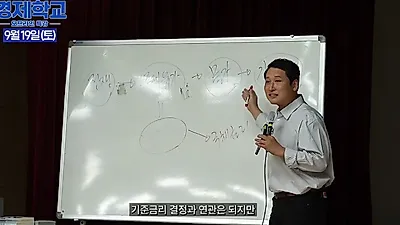
In particular, Professor Kim interpreted the phenomenon of the Bank of Korea's contractionary stance coinciding with the government's expansionary fiscal policy as a "strategic division of roles." He explained that while the monetary authority strives for price stability, the fiscal authority contemplates growth, comparing it to turning on a boiler to maintain an appropriate temperature during a cold winter. His analysis suggests that if the contraction of monetary policy offsets the expansionary effects of fiscal policy to promote price stability, this may be a sophisticated response rather than a simple policy error.
Professor Kim described this policy combination as a "technician's out-of-sync" movement, stating that if the Bank of Korea works for price stability while the government contemplates growth, it could be a "good" out-of-sync. He diagnosed that while detailed policy supplements—such as repaying government debt or lowering government bond yields through bond purchases—may be necessary, the broad framework is a phase where expansionary fiscal policy and contractionary monetary policy each perform their respective purposes.
AI-Driven Real Economy Growth and 'Choke Point Tech' Strategy
Professor Kim defined the 2027 economy with the keyword "countercurrent." This means that AI can act as a new growth engine that goes against the main current of the economy, which consists of debt, war, and low growth. He diagnosed that the Korean economy is driving the real economy by maintaining a super-gap in the semiconductor field, which is the core of the AI value chain. In particular, he analyzed that record-breaking current account and trade surpluses, along with strong corporate performance, are the driving forces propelling the Korean economy.
He emphasized that Korea must adopt a "Choke Point Tech" strategy to continue sustainable growth. Just as Korea currently holds a monopolistic grip on the HBM (High Bandwidth Memory) market, it must secure core technologies that make the global AI industry unable to operate without Korea. Professor Kim suggested that beyond HBM, Korea should select fields where it can perform best—such as the space industry, robotics, or the era of Physical AI—and proceed with intensive R&D and talent cultivation. He added that Korea must continue to challenge the non-memory semiconductor field rather than settling for memory semiconductors to secure a future "necklace."
Income Gap of 9 Times vs. Asset Gap of 190 Times: "Diligence Without Preparation is Dangerous"
Behind this growth lies the dark shadow of extreme polarization. Professor Kim warned of the imbalance in asset values occurring as capital concentrates in the AI industry. This is because, in a situation where the global economic growth rate is at the 3% level, the phenomenon of capital flocking to companies with certain performances—such as those seeing earnings surge 14 times compared to the same period last year—is accelerating.
Citing recent analyses, he pointed out that while the income gap has widened by about 9 times, the gap in asset value between the bottom 20% and the top 20% has widened by as much as 190 times. In a structure where capital flows toward AI-related materials, parts, and equipment companies, he warned that unprepared individuals could choose a path of becoming poor while working diligently.
Professor Kim said that in an era of changing economic paradigms, proper asset management and decision-making are as important as efforts to increase earned income. He also emphasized that the government must consider policy responses to resolve the extremely widening structure of asset polarization, moving beyond providing transfer income for income redistribution. He explained that following the wheel in the 1700s, electricity in the 1800s, and the internet in the 1900s, the 2000s is the era when AI is introduced, and the AI we face now is merely in the early stages of moving beyond generative and reasoning AI toward Agentic AI and Physical AI.
Source: original video (YouTube)


0Comments
Comments are currently disabled.