
Jack Dorsey's Block Experiments with 'Managerless Organization'... AI to Handle Information Transfer and Coordination
Block, the financial company led by Twitter co-founder Jack Dorsey…
Block, the financial company led by Twitter co-founder Jack Dorsey, has embarked on a radical experiment to redesign its organizational structure around artificial intelligence (AI). The company is showing moves to drastically reduce organizational hierarchy, recently laying off 4,000 employees, which accounts for 40% of its total workforce. While the number of employees grew from 5,477 in 2020 to 11,372 in 2024, this layoff essentially clears out most of the personnel added over the past few years. According to a T Times TV video, this layoff is analyzed as a strategic decision to fundamentally change the way the organization operates by introducing AI agents, rather than being due to deteriorating management. Jack Dorsey emphasized, "This is not a decision we made because we are in trouble. Our business is doing very well." In fact, as of 2025, Block's total profit increased by approximately 17% compared to the previous year, and in particular, the total profit of the Cash App division, a personal remittance service, is sailing smoothly with a 33% increase.
"Hierarchy is due to cognitive limits"... AI replaces the role of middle managers
The paper 'From Hierarchy to Intelligence', jointly presented by Jack Dorsey and the former head of Sequoia Capital, Roelof Botha, contains the theoretical background for this experiment. The paper finds the reason why hierarchies existed, from ancient Roman legions to modern large corporations, in human 'cognitive limits.' It explains that organizational hierarchies were inevitable because the scale at which one person could effectively control and manage information was limited to a maximum of 8 people.
However, the video argues that with the emergence of digital intelligence such as AI, the necessity for such hierarchies has disappeared. This is because AI agents can take over the core tasks of middle managers: 'information transfer and coordination.' The vision is that if AI takes on the roles of reporting from bottom to top, distributing instructions from the top to subordinate organizations, and coordinating schedules, the existing complex management layers can be removed. Jack Dorsey plans to reduce the current management layers, which are up to 5 levels, to 2 to 3 levels by 2026 and sequentially eliminate personnel whose sole purpose is management. He imagined a structure where 6,000 employees all report directly to him, claiming that if AI agents organize information in the middle, he could control everyone alone without a central manager.
The market reacted immediately to this experiment. Immediately after the announcement, Block's stock price surged by more than 20%. This is interpreted as a result reflecting not only the expectation of increased profits due to labor cost savings but also the expectation for the AI-centered organizational experiment itself being pursued by Jack Dorsey. Jack Dorsey's goal is clear: to quadruple the total profit generated per employee from the current level of $500,000 to over $2 million through the introduction of AI agents.
AI-centered organizational model consisting of 4 layers... 'Company World Model' is the core
Jack Dorsey defined the components of the organization into four layers. The lowest level, 'Basic Capabilities,' refers to the fundamental functions of financial services such as payments, loans, and banking. These act like 'Lego pieces' that make up the services of the fintech company Block. Above that sits the 'World Model.' The World Model is further divided into two: the 'Company World Model,' which learns the decision-making and progress within the organization, and the 'Customer World Model,' which learns customer data to predict financial status.
In particular, Jack Dorsey emphasizes the construction of the 'Company World Model.' Due to the nature of Block, which defaults to remote work, all meetings and decisions are left as text data, and the AI learns this in real-time to grasp the current state of the company. The Customer World Model learns from millions of daily transaction data to predict customer revenue inflection points or times of fund shortages. Based on this, the third layer, the 'Intelligence Layer,' proposes necessary financial products to customers, and forms contact points with customers through the app, the final 'Interface' layer. Jack Dorsey explained the interface stage as "just a delivery window," emphasizing that the real value lies in the preceding stages. The video metaphorically described it as: "If the existing hierarchical structure was like a 'game of telephone' where information is lost, an AI-centered organization is like a state where everyone is looking at a real-time map."
"Humans work at the edges"... Three changing roles of humans
As AI distributes information and operates at the center of the organization, the role of humans is redefined into three types. First is the 'Individual Contributor,' who develops financial functions or designs models. Instead of waiting for a manager's instructions as in the past, they perform practical work by making their own judgments based on the contextual information provided by the 'World Model' of the AI. Since all information is open, they can make decisions in their own domain without waiting for instructions.
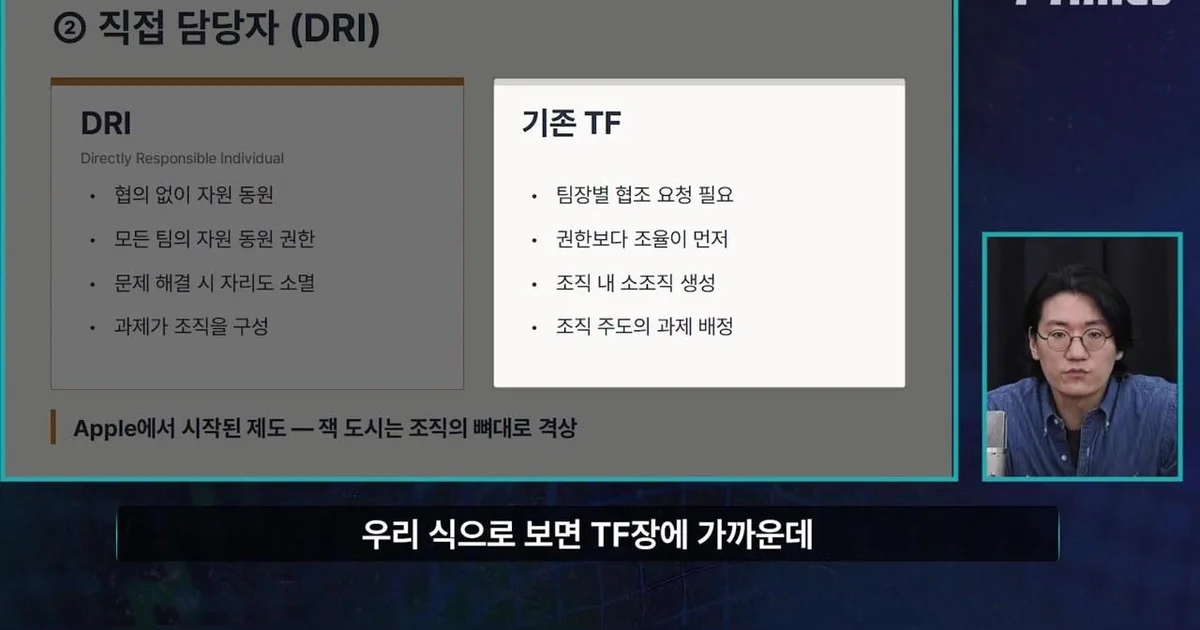
Second is the 'Temporary Lead,' who mobilizes resources from multiple teams to solve specific problems. Unlike typical TF (Task Force) leaders, they have the authority to immediately pull in resources without needing to ask for cooperation from other team leaders, and they return to their original roles once the problem is solved. In other words, it is a structure where 'tasks' create the organization, rather than the organization creating the tasks. Third is the 'Player Coach.' Unlike existing managers, they must perform practical work, such as writing code or designing, alongside their management duties. Their main role is not reporting or coordination, but investing in the growth of members.
Ultimately, the future Jack Dorsey is drawing is "a structure where AI and systems make judgments, and humans work at the edges." It means humans will focus on intuition, ethical judgment, and building trust with customers and colleagues, which AI cannot replace. However, the video specifies that this experiment is still at the stage of a completed blueprint. While the Customer World Model based on transaction data and the proprietary AI agent 'Goose' are operational, the 'Company World Model,' which is the core of the organization, is still under construction. Additionally, criticisms are being raised that the layoffs were an excuse to reduce personnel, along with economic concerns that AI operating costs could exceed labor cost savings. In fact, according to one study, there is an analysis that the operating costs incurred when replacing call center work with AI could offset the labor cost savings. Unlike the difficulties faced by Zappos's Holacracy or GitHub's managerless organization due to information disconnection, whether Jack Dorsey can solve this problem with the technology of AI is the key to this experiment.
0Comments
Comments are currently disabled.