
"Jeonse Could Disappear" – President's Decisive Answer... Signaling Changes in Real Estate Policy
The President expressed a strong will to stabilize the real estate market and reform the Jeonse system during a press conference.
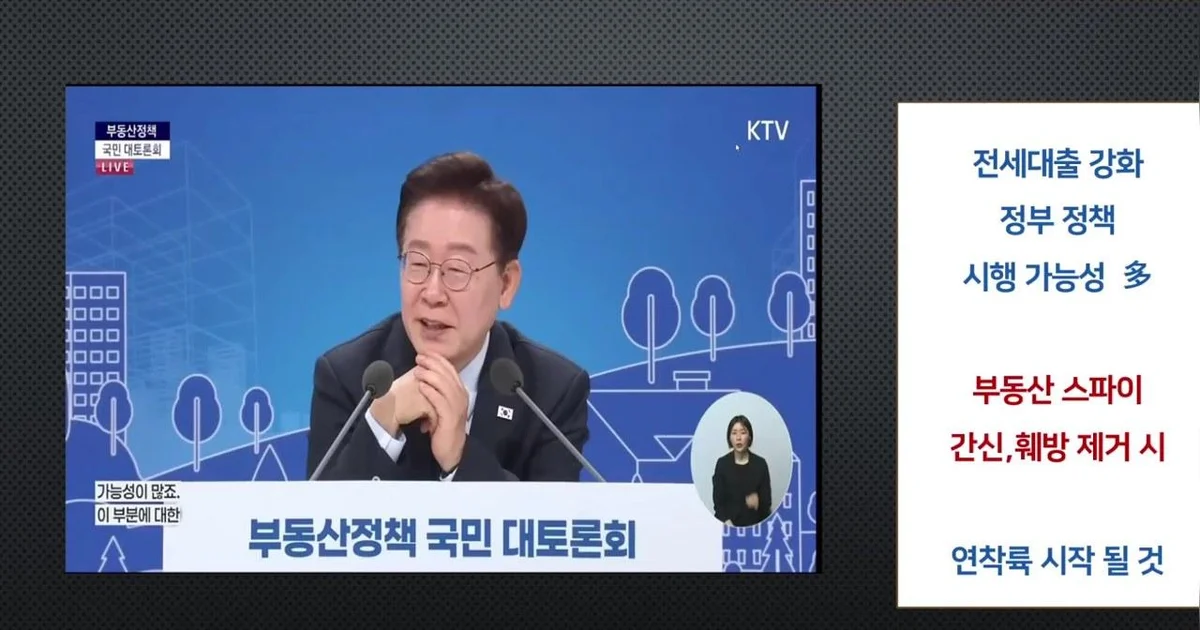
Through a press conference, the President expressed a strong will regarding real estate market stabilization and the reform of the Jeonse system. As the upward trend in housing prices in Seoul and the Seoul Capital Area continues recently, the government has sent a signal that it will focus all its efforts on market stabilization by reaffirming the direction of real estate policy.
"Jeonse is a system that could disappear"... Suggesting strengthening of Jeonse loan regulations
According to a video from Han Mundo TV_Real Estate Channel, a presenter analyzed that the President reacted sensitively regarding the Jeonse system during the press conference, suggesting policy changes. The video reported a situation where, in response to a reporter mentioning the Jeonse system as a "system that should disappear," the President reacted sternly, refuting by saying, "I said it would disappear, when did I say it is a system that should disappear?" Regarding the President's reaction, which sharply cut off the meaningless question, the presenter explained that this is a part showing the President has a clear awareness of the Jeonse system.
The presenter analyzed that the President clearly recognizes the problems of the Jeonse system. In particular, it was pointed out that Jeonse loans acted as one of the major causes of the surge in housing prices. The analysis suggests that past policies, which supported Jeonse deposits reaching nearly 100% of house prices, ultimately became factors that induced Jeonse fraud and propped up house prices. The presenter noted that the President has a definite awareness regarding the strengthening of Jeonse loans.
Based on the President's perception that "Jeonse loans are a major cause of maintaining house prices, so one must be cautious in expanding them," the presenter suggested specific policy directions. It was predicted that it is highly likely that the "correct answer" will be to strictly limit general Jeonse loan regulations, except for cases with specific validity, such as married couples applying for their first-ever Jeonse loan. The presenter added that such a method could serve as an alternative to induce a soft landing for housing prices in South Korea and bring market stability.
Controversy over the expression 'Market Flattening'... Pointing out the lack of realistic perception among bureaucrats
In this press conference, the term 'market flattening' used by the government side became a subject of controversy. The presenter raised strong criticism regarding this expression, which came up during the President's mention of real estate market stabilization. The presenter pointed out that "in most areas of Seoul currently, sales prices, Jeonse prices, and monthly rent prices are rising together, causing the housing ladder for ordinary people to collapse," and noted that describing this situation as 'flattening' is inappropriate.
The presenter raised the possibility that the term 'flattening' might be a 'defensive word' used by Cheong Wa Dae bureaucrats to evade responsibility while ignoring market suffering. It was criticized that using the expression 'flattening,' which refers to the work of leveling ground, is inappropriate for the market, and that this reveals a lack of perception among bureaucrats who have failed to properly grasp the reality on the ground. In particular, the explanation was given that the phenomenon of prices rising in most areas of Seoul, excluding Gangnam, is closer to 'upward standardization' rather than 'flattening' that reduces the housing burden for ordinary people.
The presenter pointed out that such choice of terminology reflects a reality that is unaware of the pain of non-homeowning ordinary people and the youth. Despite the rising barriers to entry for ordinary people due to the surge in housing cost burdens and the lack of supply signals, there is concern that using the expression 'flattening' could become a means of political evasion using statistical illusions.
Rising house prices in Seoul and Seoul Capital Area and future policy direction
Currently, the real estate market is showing signs of change, such as the KB Real Estate Buyer Superiority Index turning, along with the rise in house prices centered in Seoul. The presenter mentioned the concentration phenomenon in Seoul and the Seoul Capital Area, as well as the lack of regional base. It was reported that the President showed the will to promote balanced national development through the rapid promotion of the relocation of the administrative capital and support for public enterprises, under the premise that Seoul cannot be ruined.
Regarding future policy direction, the President reaffirmed the will to stabilize the market by mobilizing all means, including regulation, supply, and taxation. In particular, tax reform is expected to have a major impact on the future market landscape. The President cited catching Jeonse/monthly rent prices and house prices as a preemptive response task and expressed confidence that the market will gradually stabilize.
The presenter predicted that the President will push forward policies while emphasizing the suppression of real estate speculation and market stability as top priorities. However, unlike the President's will, a warning was issued that a 'friction' problem may occur where bureaucrats fail to follow the President's will. Additionally, along with the suggestion that the experience of market experts should be actively utilized in policy control, it was added that the impact of future tax and supply-related measures on market stability should be closely monitored.
0Comments
Comments are currently disabled.