
"Preventing 670 Million Tons of Annual Water Leakage"... South Korean Water Pipe Technology Uses AI to Detect Even the Sound of Leaks
South Korea's water pipe management technology, which utilizes AI and IoT to detect underground leaks in real-time, is gaining global attention.
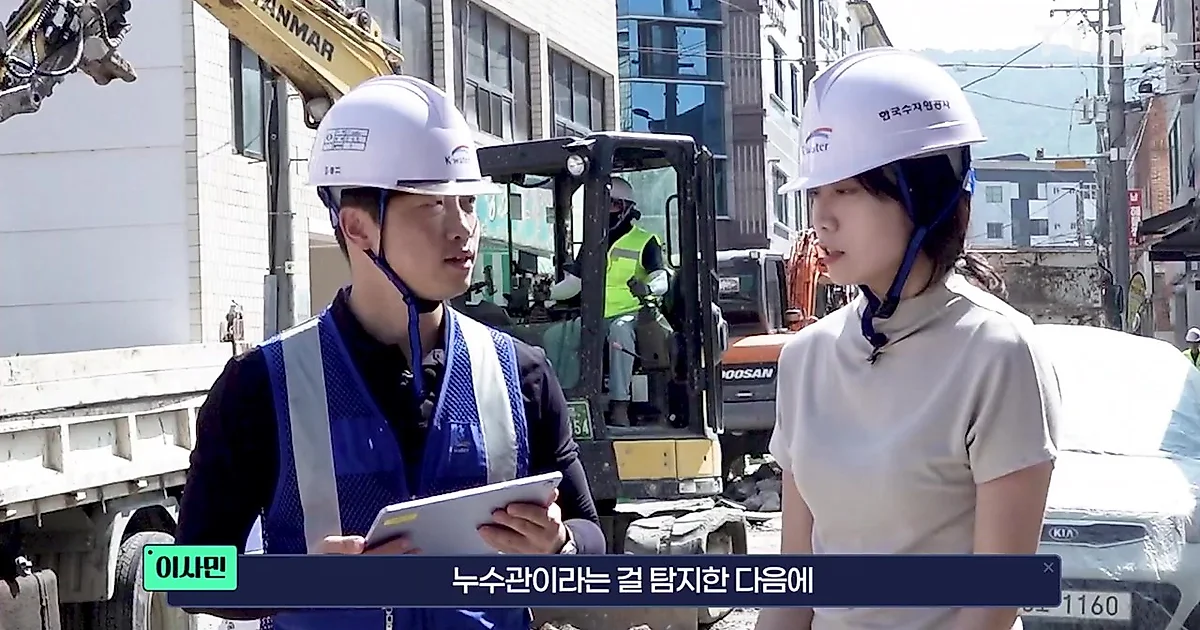
As approximately 40% of the water supply networks in local governments nationwide are identified as aging pipes installed more than 21 years ago, South Korea's water pipe management technology, which utilizes Artificial Intelligence (AI) and the Internet of Things (IoT) to detect underground leaks in real-time, is receiving global attention. According to a T Times TV video, K-water is solving the problem of water loss caused by aging pipes through SWNM, Smart Water Network Management technology that integrates AI and IoT.
670 Million Tons of Water Disappearing Annually..."Data Acquisition is the Core of AI"
Currently, the amount of water leakage caused by the aging of water supply pipes in South Korea reaches approximately 670 million tons annually, which translates to about 700 billion won in monetary terms. Water leaking underground can also cause ground subsidence and sinkholes. The video explains that by capturing only the groundwater leakage, one could secure a volume of water sufficient to build two to three dams.
The core of SWNM technology to solve these problems is 'data.' The video explains that the most important thing to run AI models is data acquisition, and that data must be properly collected through basic infrastructure to train AI algorithms and create flexible analysis models. To this end, the corporation has divided regions into large, medium, and small 'Blocks,' installed flow meters and pressure gauges, and established a system to measure the inflow and water pressure of each area in real-time. By combining inflow data with the water bill information of consumers, the revenue water ratio (the ratio of water actually used compared to the water sent from the water treatment plant) of a specific area can be accurately identified, allowing for optimal investment decisions such as network maintenance or pipe replacement.
AI Sensors Instead of Stethoscopes... Real-time Leak Sound Detection and Automatic Water Pressure Adjustment
In the past, employees had to listen to leak sounds directly using acoustic sticks every night or use surface leak detectors to find locations. However, the SWNM technology uses a method where IoT sensors collect leak sounds and transmit them to a server via wireless communication, after which the AI server learns this to immediately judge whether a leak exists. The video introduces an AI screen that visualizes leak sounds through specific frequencies, allowing even non-skilled personnel to quickly identify leak locations. In particular, these sensors were developed so that even general employees can conveniently check data by connecting surface acoustic data, which is difficult for humans to hear with their ears, to smartphone devices.
A technology similar to 'cruise control' in a car is also applied to water pressure management. Since higher water pressure leads to more leakage, 'active pressure reduction technology' is utilized to automatically adjust valves to maintain appropriate water pressure (above 1.5kg) by detecting pressure in real-time. This is a core technology that lowers the pressure when it rises and adjusts it again when it falls to supply stable water pressure to citizens. In the future, it is planned to expand into an 'AI pressure reduction' method with added AI functions.
From Field Safety with AI CCTV... "Expectations for Exporting to the Global Market"
AI technology is also being introduced for safety at water pipe replacement construction sites. By equipping mobile CCTVs installed at construction sites with AI functions, accidents are prevented by immediately sounding an alarm if a pedestrian falls or a worker approaches a dangerous area. The video stated that this technology, developed this year, is planned to be expanded to all construction sites starting next year, and it is expected that dangerous situations at sites can be prevented in advance through this.
Furthermore, AI technology is being integrated into 'trenchless replacement methods,' which insert new pipes while crushing existing pipes without digging the ground, and into endoscopic equipment that checks the internal condition of pipes. Once the 'AI endoscope reading technology' currently under development is completed, AI will be able to analyze the condition of the pipes and provide it in the form of a report without humans having to check the pipe condition one by one. The video predicted that these products could be sold to global businesses or the technology could be exported in the future.


0Comments
Comments are currently disabled.