
Ottogi Ramen completes response to EU packaging regulation (PPWR) through cross-functional collaboration
Ottogi Ramen has established a data-driven response system to comply with the European Union's Packaging and Packaging Waste Regulation (PPWR), which applies directly across all EU member states. The company has prepared technical documentation and declarations of conformity to meet upcoming regulatory requirements.
As the European Union's (EU) Packaging and Packaging Waste Regulation (PPWR) enters its full application stage, the response strategies of food companies preparing to export to Europe are drawing attention. Unlike the previous Directive system, the PPWR, which has transitioned to a Regulation system, is characterized by being applied directly and powerfully across the EU without the process of being transposed into the domestic laws of individual member states.
According to a webinar released by KOTRA TV, the Ottogi Ramen research institute has been monitoring regulatory trends and building a foundation for response since the PPWR came into effect in February 2020. Ottogi Ramen organized packaging information for products exported in 2025 and established a preliminary diagnosis and response system through supplier data collection and investigations of testing and analysis institutions. Based on this, the company finalized templates for the Declaration of Conformity (DOC) and Technical Documentation (TD) in May 2026, and completed the initial response by delivering relevant materials to customers after August 2026.
Establishment of a 'data-based' response system through a company-wide TFT
Ottogi Ramen's response process went beyond simple document preparation toward establishing a company-wide collaboration system. A Cross-functional TFT involving relevant departments such as Quality, Sales, and R&D was formed to set the direction of the response and establish a decision-making system. In particular, the scope of investigation was expanded to overseas analysis institutions to verify specific items, such as PFAS (per- and polyfluoroalkyl substances), which are difficult to analyze domestically.
The setting of response priorities was also carried out strategically. Rather than responding to all items simultaneously, the company prioritized items with high impact by considering export scale, packaging specifications, and regulatory risks. Subsequently, packaging information was organized by supplier to build a database. This database systematically contains packaging specifications, materials, weight, food contact status, as well as recyclability, recycled content, hazardous substance information, and supply chain evidence.
In particular, Ottogi Ramen applied conservative standards to minimize ambiguity in regulatory interpretation. The company prepared response materials by including auxiliary materials, such as paper ink used for printing expiration dates, within the scope of packaging materials. This measure was taken to preemptively block risks that could arise from differences in interpretation by regulatory authorities.
The core of Technical Documentation (TD) and Declaration of Conformity (DOC) is 'traceability'
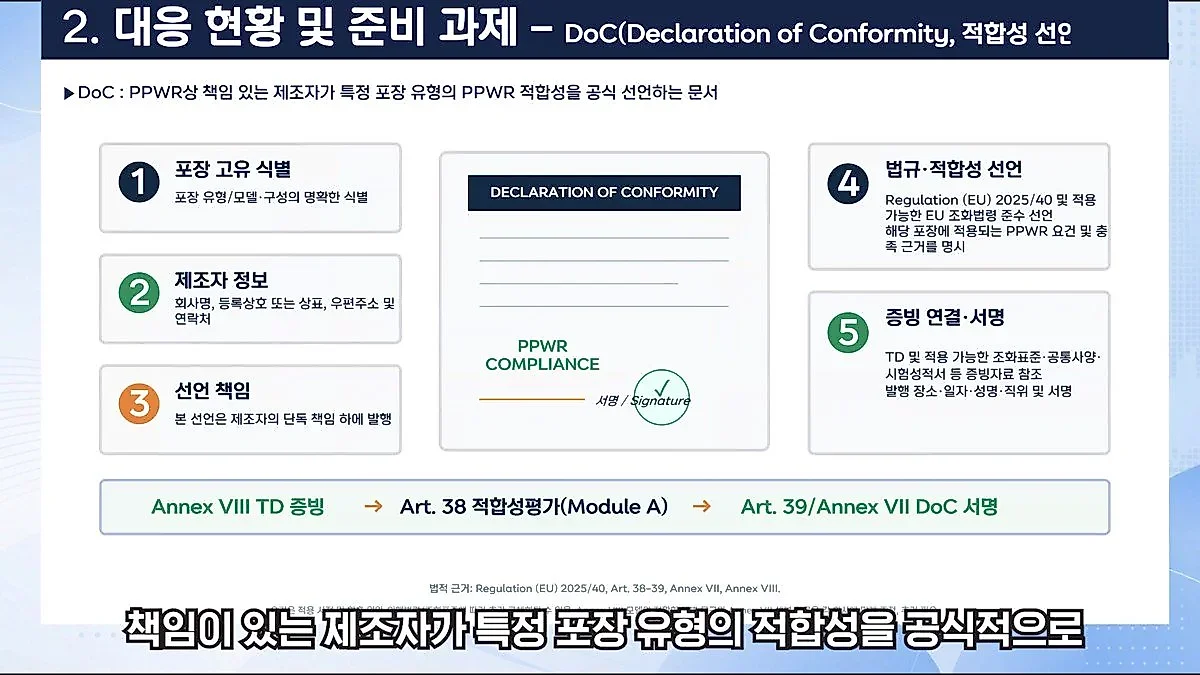
The Technical Documentation (TD) and Declaration of Conformity (DOC), which are the core outputs of the PPWR response, are defined not as simple documents for submission, but as an "evidence system" that supports the manufacturer's claims. Ottogi Ramen emphasized that the Technical Documentation must serve as a traceable and verifiable evidence system that supports the manufacturer's Declaration of Conformity.
The Technical Documentation (TD) must systematically record packaging descriptions, unit information, design and manufacturing data, grounds for application, test and analysis results, and supply chain evidence. All declarations regarding material composition, hazardous substance management, and recyclability stated in the Declaration of Conformity (DOC) must be linked to objective evidence (such as test reports, material specifications, and supplier declarations) within the Technical Documentation. In other words, the contents written in the DOC must be able to be proven in reverse through the TD.
According to the regulation, the Declaration of Conformity (DOC) must include the packaging identification number, manufacturer information, scope of responsibility, applicable laws, links to evidentiary materials, and signature information. This holds legal effect as a document in which the manufacturer officially confirms the conformity of the packaging material.
Need for a 'continuous management' system to prepare for 2030 core requirements
Ottogi Ramen defined the completion of the response in August 2026 not as an end, but as the "starting point for full-scale management." This is because the PPWR is structured such that detailed standards are continuously updated through delegated acts, implementing acts, and harmonized standards even after the regulation is finalized.
In fact, the major requirements of the PPWR are expected to be strengthened in stages. Between 2026 and 2028, detailed standards will be established step-by-step, and from 2030, core product requirements such as recyclability, recycled content, packaging minimization, limits on empty space ratios, and reuse and refill targets will be fully applied. Subsequently, recyclability requirements are expected to become even stricter in 2035.
Accordingly, if the composition of packaging materials, suppliers, recycled content, or testing methods change, the Technical Documentation (TD) and Declaration of Conformity (DOC) must be reviewed and revised immediately. An official from Ottogi Ramen explained that continuous document updates and management, including version control, are essential in accordance with the characteristics of packaging materials and regulatory changes.
Source: KOTRA TV (YouTube)



0Comments
Comments are currently disabled.