
Iraq Unpaid Receivables Risk of 565 billion won... 'Cash Recovery Structure' is more critical than contract size
Reports indicate that South Korean construction and defense companies face at least 565 billion won in unpaid receivables from Iraq…
While news of signing large-scale overseas contracts is commonly accepted as good news in the market, the actual contract amount does not directly translate into cash inflow for a company. As reports recently emerged that unpaid receivables owed to South Korean construction and defense companies in Iraq amount to at least 565 billion won, points are being raised that the possibility of payment recovery is more important than the scale of the order.
Proposing crude oil instead of cash... risks transferred to companies
According to a Trade King video, the Iraqi government is currently delaying payments for construction and supplies that should be paid to South Korean companies, citing difficulties in its financial situation. The Iraqi government is prioritizing internal expenditures such as civil servant salaries, defense spending, and national operating costs, maintaining the position that "there is no money to give to South Korean companies right now." In particular, concerns are growing as the Iraqi government is even discussing a plan to pay the amount in crude oil instead of cash.
The video analyzes that from a company's perspective, 10 billion won in cash and 10 billion won worth of crude oil have completely different values. What companies actually need is cash to pay employee salaries and material costs. If they receive crude oil instead of cash, companies face the inconvenience of having to transport and store it in South Korea and find a business partner to sell it to. Furthermore, the core risk is that companies must fully bear the risk of fluctuations in crude oil prices. In other words, if crude oil prices fall, companies may suffer the double hardship of a decrease in cash value.
The 'Order Cruelty' caused by war, dollar shortages, and political chaos
The reason why overseas contractors fail to receive payments even after normally fulfilling contracts is due to 'national risks' that companies cannot control. The video explains this through four major variables. First is war. When a war occurs, a nation prioritizes securing military equipment and food, so the priority for paying foreign companies is pushed back. Second is the shortage of dollars. Overseas transactions are usually conducted in dollars, and if the country's foreign exchange reserves are insufficient, they cannot make payments even if they have their own currency. Third is economic sanctions. If the remittance network (such as SWIFT) is blocked due to international sanctions, receiving payments becomes impossible regardless of the company's fault. The last is political chaos. If a regime or the responsible official changes, existing contracts may be reviewed, and payments may be indefinitely extended. These political variables are particularly fatal for countries that have not modernized their economic systems.
Looking at past cases, these risks have manifested in reality. During the Iraq construction boom in the 1970s and 80s, South Korean companies built large-scale infrastructure such as roads, power plants, housing, and hospitals, but later bore massive unpaid receivables while undergoing the Iran–Iraq War, the Gulf War, and international sanctions. For example, in the case of Hyundai Engineering & Construction, unpaid receivables from Iraq once reached 1.65 billion dollars (approximately 2 trillion won). Cases where they had to settle by reducing 80% of the claims through negotiations or by using a split recovery method to receive the remaining principal and interest over a long period show that a complex reality exists behind the news of orders. Even if it is reported in the news with a short phrase like 'recovery of unpaid receivables,' in reality, there are many cases where they wait for more than 10 years or receive a much smaller amount than the original amount they were supposed to receive.
5 'Overseas Order Checklists' for wise investors
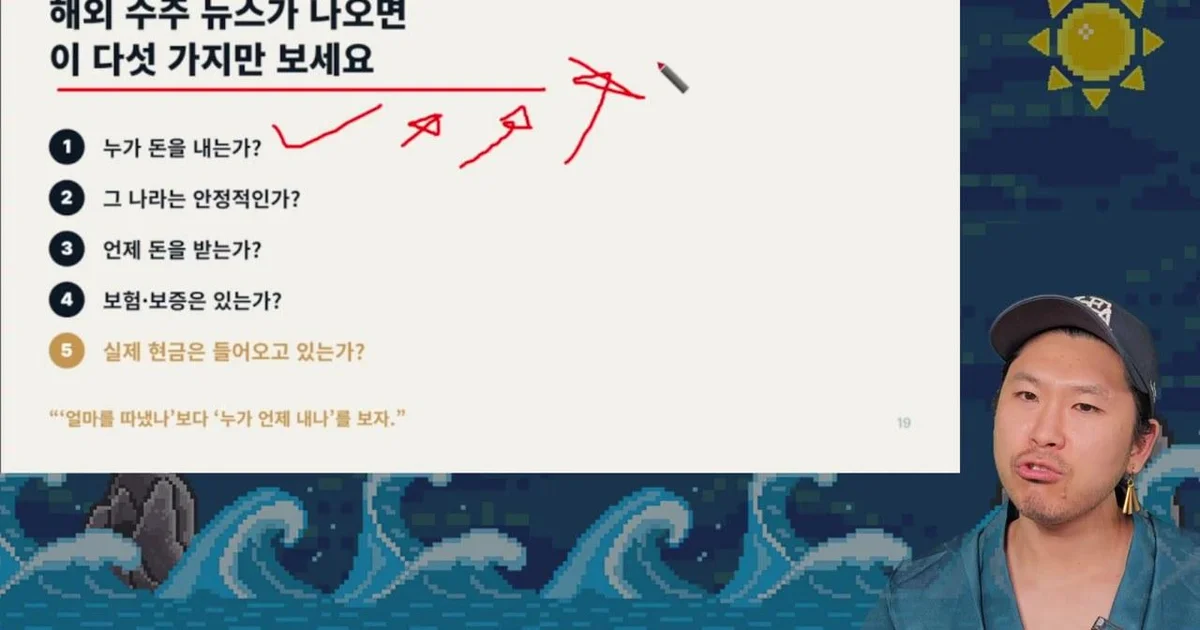
The video presents five criteria that investors must check when future overseas order disclosures are released. First, they must check 'who is paying the money.' The reliability varies depending on whether the payer is a government, a state-owned enterprise, or a private company, and the past payment history of that entity is also important. Second is 'national stability.' One must examine the possibility of war, the frequency of regime changes, the risk of economic sanctions, and dollar reserves. Third is the 'timing of payment.' It is necessary to check how the payment structure for down payments, intermediate payments, and final balances is designed.
Fourth is 'existence of insurance and guarantees.' If safety measures such as export insurance or bank guarantees are in place, the impact on the company in the worst-case scenario can be reduced. Finally, the most important indicator is 'whether actual cash flows in.' If the scale of orders grows but unpaid receivables continue to accumulate and cash does not flow in, this should be interpreted as a danger signal for corporate management. Conversely, even if the scale of orders is not large, a company that receives money on time and has steady cash inflow can be considered relatively strong. Ultimately, a company's value is determined not by the numbers on the contract, but by the cash that actually flows in.



0Comments
Comments are currently disabled.