
Daily Average Exports Plunge from $5.6 Billion to $4.7 Billion... KOSPI Adjustment Expected to Prolong
An analysis suggests that the recent decline in semiconductor stock prices, which has driven the Korean stock market this year, is preemptively reflecting changes in economic indicators. As data confirms that the export growth trend has begun to slow, the KOSPI is expected to continue its adjustment phase for the time being.
An analysis has emerged stating that the downward trend in semiconductor stock prices, which has driven the Korean stock market this year, is preemptively reflecting changes in economic indicators. As data confirms that the export growth trend has begun to slow, there is a forecast that the KOSPI will also likely continue its adjustment phase for the time being.
According to the analysis provided by Professor Kim Young-ik, the recent volatility in semiconductor stock prices is in line with the flow of export data, which is a key indicator of our economy. In particular, the correlation coefficient between the KOSPI index and the daily average export amount is very high, reaching 0.91. This means that export data is the most powerful leading indicator in predicting the direction of the KOSPI.
Reduction in Semiconductor Export Proportion and Decreasing Daily Average Export Amount
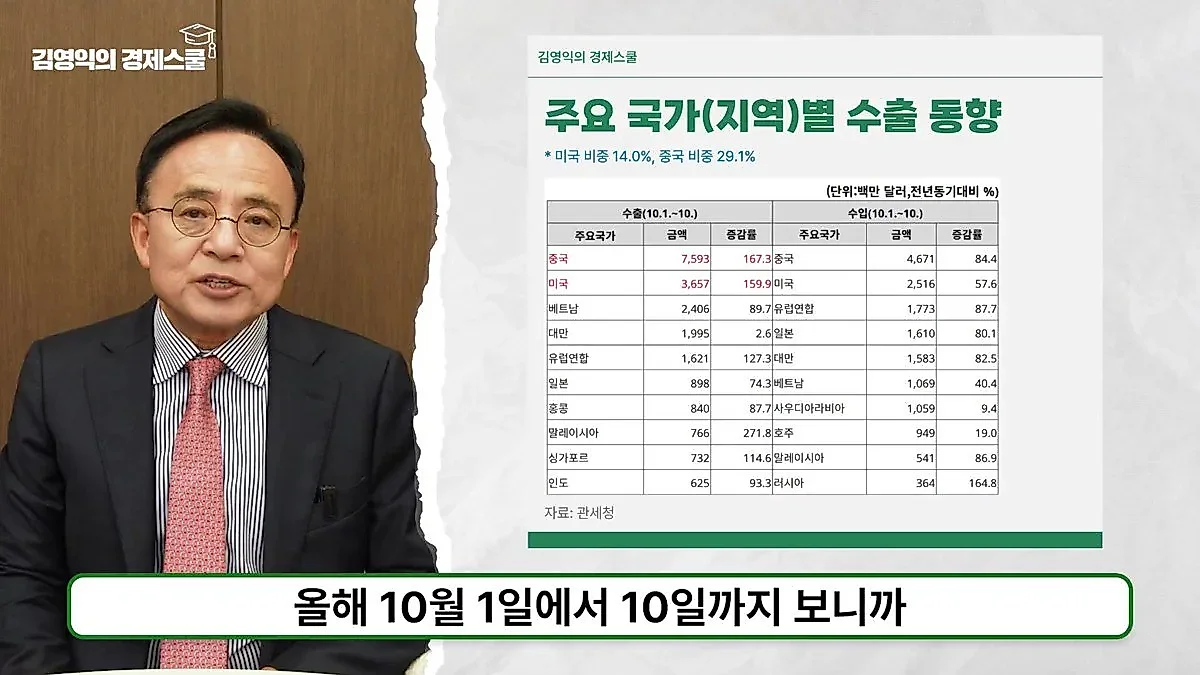
Looking at the export trends from October 1 to October 10 announced by the Korea Customs Service, the superficial export growth rate recorded a high figure, surging by 102% compared to the same period last year. However, this is an illusion caused by the base effect, as the number of working days this year was 5.51 days, which is two days more than last year when the number of working days was only 3.5 days due to the Chuseok holiday.
The daily average export amount, which shows the actual economic flow, recorded $4.75 billion. This is a noticeably decreased figure compared to the $5.63 billion in September. Professor Kim predicted that the daily average export amount for October, November, and December will not exceed the September level. In particular, he expected the decrease to be even larger in November than in October.
The flow of semiconductors, the mainstay item, is also showing signs of slowing down. The semiconductor export growth rate up to the 10th is 171% higher than the same period last year, but the daily average semiconductor export amount, considering the number of working days, only reached $2.22 billion. This is a significantly reduced figure compared to the $2.81 billion of last month. The proportion of semiconductors in total exports also showed a slowdown in growth, decreasing from 49.9% in September to 46.7% as of October 10.
Decline in G20 leading indicator and forecast of slowing export growth rate
Global economic indicators were presented as the basis for the forecast that the export growth trend will slow down. This is because the G20 leading indicator, which serves as a leading indicator for our exports, has been declining since peaking last March. While it showed a gradual decline through September, the decline is expected to become steeper from the fourth quarter through next year.
Changes were distinct in the export proportion by country. As of early October this year, the export proportion toward the United States decreased from an average of 18.6% from January to September to 14%, while the export proportion toward China increased significantly from 21.2% to 29.1%. This is the most important characteristic of our exports this year, showing that the proportion of China is expanding while the Chinese economy is not as bad as expected.
KOSPI Overvaluation Resolution Process... Possibility of Long-term Adjustment Phase
Regarding the direction of the KOSPI following the changes in indicators, Professor Kim presented the perspective of 'resolving overvaluation.' When the daily average export amount was $5.63 billion at the end of last September, the KOSPI index was in a state of being overvalued by about 8%. Professor Kim predicted the daily average export amount for December to be $5.36 billion and calculated the appropriate KOSPI index at the level of 6,028 accordingly.
Since the current KOSPI index is approaching an appropriate level, the stock price will not crash abruptly, but the market is highly likely to show an adjustment phase for a considerable period. Professor Kim analyzed that while the KOSPI moves around the 6,380 level, the index will be adjusted downward in line with the trend of decreasing daily average export amounts. In particular, considering that there was a tendency to underestimate average figures when the index fell in past cases, market volatility is expected to continue.
In conclusion, the current decline in semiconductor stock prices is interpreted as a process of preemptively reflecting changes in economic data, where both the export growth rate and the semiconductor export proportion are decreasing simultaneously. Professor Kim emphasized that this slowing trend must be continuously confirmed through the import and export trends to be announced by the end of this month on the 20th.
Source: original video (YouTube)



0Comments
Comments are currently disabled.