
K-industry sectors face volatility as stocks retreat from recent peaks
Key Korean industrial sectors, including defense, shipbuilding, and nuclear power, are experiencing significant corrections following a surge in order expectations during the first half of the year. Investors are facing uncertainty due to delayed orders, geopolitical risks, and project uncertainties.
Defense, shipbuilding, and nuclear power stocks are undergoing significant corrections following surges in the first half of the year. Hyundai Rotem has fallen more than 70% from its peak as investors face order gaps, delivery delays, and geopolitical risks.
Key "K-industry" sectors, including defense, shipbuilding, and nuclear power, are seeing deep concerns among investors as they undergo significant corrections from their recent peaks. These stocks, which surged in the first half of the year on expectations of new orders, have recently trended downward due to a combination of delayed orders, geopolitical risks, and project uncertainties.
According to an analysis by Kim Hyun, an investment product strategy manager at Woori Bank, major stocks related to defense, shipbuilding, and nuclear power generally formed their peaks around April and May before entering a recent downtrend. The defense sector saw particularly large declines, with Hyundai Rotem falling more than 70% from its peak. In the shipbuilding sector, Hanwha Ocean saw relatively high decline rates, while BHI in the nuclear sector also reflected market concerns with significant losses. Generally, these stocks have shown poor performance, with declines in the 50% to 60% range from their peaks.
Defense: 'Earnings Shock' Driven by Slowing Order Growth and Delivery Delays
The slump in the defense sector stems from a temporary slowdown in order growth and issues regarding delivery delays. Analysis suggests that an order vacuum has occurred as the expected environment for signing contracts became uncertain due to situations such as the Hormuz crisis in the Middle East. However, forecasts suggest that actual performance will remain robust, as Korea's order levels remain high compared to the first quarter of 2022. Additionally, exchange rate issues coupled with slower-than-expected growth have impacted stock prices.
Recent earnings volatility has dampened market sentiment. Hanwha Aerospace recorded an "earnings shock" due to a combination of delayed product deliveries and one-time costs resulting from a fire at its Daejeon site. In the video, Kim suggested a possibility for future earnings recovery, stating, "Delayed deliveries from the third quarter will be concentrated in the fourth quarter, and shipments of major items such as Chunmoo will increase."
Volatility stemming from global political situations also persists. Delays in government-to-government contracts with Poland or delays in implementation contracts with low-credit countries like Peru are common risks for export companies. There are also concerns regarding potential limits on defense budget increases following the results of the U.S. midterm elections. However, Kim analyzed that "excessive budget concerns are inappropriate because the U.S. needs to replenish its armories due to high missile consumption through the war with Iran." Furthermore, Kim forecasted that K-defense could still be an attractive alternative for countries seeking cost optimization amid Europe's fiscal crisis, and that a recovery period could emerge next year based on the market share increased since 2022.
Shipbuilding: 'Peak-out' Concerns for Merchant Ships and Delayed LNG/Special Vessel Momentum
The shipbuilding sector is facing a combination of "peak-out" concerns—the fear that merchant ship orders have already reached their zenith—and the delay of new growth drivers. While profitability is somewhat guaranteed through next year and the year after because docks are already filled with high-margin vessels, concerns have been raised that merchant ship demand may decrease after next year because this year's orders were fulfilled much faster than targeted.
Momentum related to North American LNG carriers and U.S. Navy special vessels (MAS Project), which are key to future growth, is also in a period of adjustment. Due to issues in the Strait of Hormuz, supply and demand volatility has occurred, with vessels intended to transport LNG from the Qatar region in the Middle East being unable to operate and entering the market as second-hand vessels. Additionally, the delay in investment decisions for North American LNG projects has temporarily weakened demand forecasts for 2028–2029. A further variable is the decline in newbuilding prices for LNG vessels, as China has secured aggressive orders on the condition of purchasing gas. In the special vessel field, the loss of the Canadian submarine project acted as a setback to momentum.
However, Kim maintained an optimistic long-term view. She emphasized that investment in LNG infrastructure will eventually expand due to increased energy demand from the expansion of AI data centers in the U.S., and that expected demand for 2030–2031 is actually rising even more sharply. She also diagnosed that special vessel momentum is highly likely to revive, citing the case where Philly Shipyard was selected on October 29 to build medium-sized landing ships for the U.S. Navy.
Nuclear Power: A 'Verification Stage' Between Expectations and Actual Projects
The nuclear power sector showed the strongest upward trend in the first half of the year due to AI power demand, but it is currently in a period of enduring the "time lag" that occurs as expectations transition into actual earnings and confirmed projects. While grand discourses such as the construction of large-scale nuclear plants exist, the stages of actual groundbreaking or project confirmation have not yet fully materialized. As the actualization of these projects lags behind the reflected expectations, a retreat in sentiment is occurring.
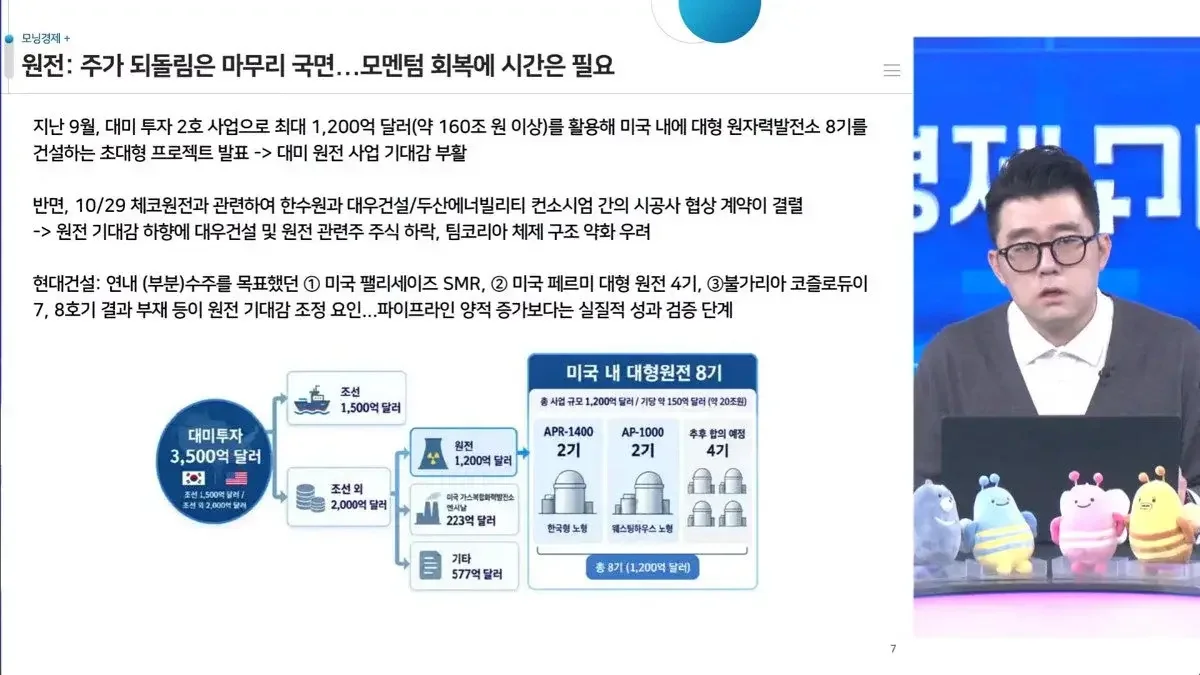
Recently, concerns regarding the profitability of the "Team Korea" system were highlighted by news that negotiations between the Korea Hydro & Nuclear Power consortium and the construction company (Daewoo Engineering & Construction) regarding the Czech nuclear power project had broken down. Furthermore, investor sentiment has been dampened because specific agreement timings for individual companies—such as the Palisades SMR in the U.S. pursued by Hyundai Engineering & Construction, the Fermi Unit 4 plant, and projects in Bulgaria and Kozloduy—have not emerged during the originally expected second half of this year or the fourth quarter.
Nevertheless, expectations for nuclear power exports to the U.S. remain. Within the investment plans for the U.S. announced this past September, 120 billion dollars out of 200 billion dollars were related to nuclear power, which aligns with the Trump administration's stance of confirming 10 large-scale nuclear power projects. In this process, the possibility of including two Korean-style nuclear plants (APR-1400) has been mentioned, and Westinghouse's moves to acquire equity are also factors reviving expectations for U.S. nuclear power business. Ultimately, the nuclear power sector is expected to rebuild momentum by passing through the "verification stage" where actual projects are confirmed and executed, moving beyond a simple increase in the order pipeline.
Source: original video (YouTube)



0Comments
Comments are currently disabled.