

The Flip Side of the AI Infrastructure Race: Once the Selection Process is Over, 'Skin-Clad Robots' Will Arrive
Professor Kim Kwang-seok analyzes the growing calls for "speed control" in the AI industry, suggesting it is actually a process of separating winners from losers based on capital strength. He predicts that after the current infrastructure race, the focus will shift toward Physical AI and the emergence of a "skin" market for robots and appliances.

"Craving Growth" Vietnam vs. "Exhausted" China... Two Faces of the Asian Economy Observed by Dr. Gwak Su-jong
Dr. Gwak Su-jong diagnoses the future of the South Korean economy based on his recent business trip through Vietnam, China, and Japan, observing the stark contrast between Vietnam's growth aspirations and China's structural economic crises.

Heatwaves drive up agricultural prices by 0.5%p... Climate risks could cause 45 trillion won in losses to the financial sector
The Bank of Korea warns that climate change is evolving from an environmental issue into a broad economic risk, potentially causing massive financial losses and "Green Swan" events. Analysis shows that proactive climate policies could prevent nearly 18.8 trillion won in cumulative losses compared to inaction.

Revenue is not profit... Basic tax knowledge easy for novice business owners and N-jobbers to miss
The article provides essential tax guidance for new entrepreneurs and multi-job holders (N-jobbers), covering business registration, taxation types, income classification, and the impact of side income on health insurance.

"Even with 3 million won a month, there is no answer"... The vicious cycle of reckless youth investment and parental bankruptcy
A structural sense of despair is driving young people toward high-risk investments as saving alone makes it impossible to afford housing in Seoul, often leading to the eventual bankruptcy of their parents. Lawyer Park Ki-tae explains how the loss of entry-level jobs due to AI and the burden of debt create a cycle where parents must liquidate real estate to cover their children's legal or financial failures.

KOSPI Plummets 8.8% in 4 Days... 'Psychological Fear' Spreads Ahead of End of Treasury Stock Buybacks
The South Korean stock market has experienced a sharp decline, with the KOSPI falling 8.8% in just four days. Five key reasons, including rapid interest rate hikes and massive foreign capital outflows, are analyzed as the drivers behind this market collapse.

Startup subsidies may be included in business income... Proof of expenditure is key to tax saving
Startup subsidies provided by the state or local governments may be treated as business income, making the management of expenditure proof essential for tax reduction.

Tax Reduction for Young Entrepreneurs up to 100% Depending on Region... Business Registration Procedures Also Simplified
The 'Tax Reduction for Young Entrepreneurs' system and the 'Business Registration and Operating Notification in One Step' service are being implemented to support young entrepreneurs facing unstable early-stage revenue. The tax benefits are determined by the representative's age, industry, and startup location.

S&P500 Profit Growth Expected to Accelerate... AI Investment Sustainability is the Key Variable
The S&P500 index is expected to break past historical patterns and show a steep upward curve in profit growth. The key factor determining future market volatility will be whether the increased capital expenditure (CAPEX) of companies leading AI investment translates into actual corporate profit growth.

The 'Gravity' of High Treasury Yields... A Process of Separating the Wheat from the Chaff in Asset Markets Begins
High US Treasury yields are exerting downward pressure on asset markets, acting like "gravity," while simultaneously forcing a survival-of-the-fittest process among companies. This analysis explores how rising yields lead to a "crowding-out effect" and how high-performing companies can still thrive despite the economic pressure.
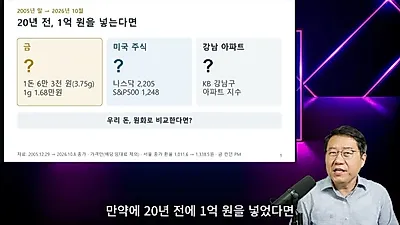
"Money increased 8 times, but gold only 1.4 times"... The paradox of 'gold' that protects asset value
While the Fed's assets have surged eightfold over the last 20 years, the amount of gold held by humanity has only increased by about 1.4 times. This analysis explores how gold serves as a crucial hedge against currency devaluation and compares the returns of various assets over the past two decades.

Companies Accumulate Cash Instead of Borrowing... The Paradox of 'Capital Surplus' Driving Interest Rates Down
Professor Kim Young-ik analyzes how the shift of corporations from capital borrowers to capital surplus entities is changing the financial landscape and likely leading to long-term interest rate declines. He also notes the record-high stock holdings in South Korean household financial assets and compares the current situation to Japan's experience in the 1990s.

Semiconductor Technology Gap and the Collapse of the Middle Class: Diagnosing the Structural Crisis of the Korean Economy
Economics Master Gwak Su-jong warns that the weakening middle class and the rapid technological advancement of Chinese semiconductor companies pose a structural threat to South Korea's economic sustainability over the next 5 to 10 years. He also discusses the complexities of interest rate policies, China's strategic economic moves, and the potential slowdown in the AI industry.

"Supply Chain Control Over Efficiency"... Changing Global Trade Order and South Korea's Response Strategy
The global trade order is shifting from efficiency to security and supply chain control, leading to a resurgence of industrial policies and the rise of regional agreements. Jeong Cheol, president of the Korean Association of International Trade, analyzes these changes and suggests South Korea must participate in various trade agreements to secure its economic interests.

Why Amazon Blocked the AI Agent 'Muse', a Seismic Shift in the Commerce Market
As AI agent technology advances, the revenue models and customer touchpoints of existing e-commerce giants are being fundamentally shaken. According to an analysis by Kang Jung-soo, director of BlueDot AI Research Institute, the emergence of the AI agent 'Muse' poses a new threat to massive commerce companies like Amazon.

Treasury yields hit 24-year high, driven by three key variables
As US Treasury yields reach their highest levels since 2002, three major factors—geopolitical risks, macroeconomic factors, and supply-demand factors—are being analyzed as the drivers of rising interest rates.

US Treasury Yields Surpass 5%, Attention Focused on Interest Costs Exceeding Defense Spending
As US Treasury yields exceed 5%, attention is turning to the massive interest burden on the US government and economic slowdown signals indicated by the yield curve inversion. Dr. Gwak Su-jong analyzed how these fiscal burdens and interest rate structures impact the economy.

US stock markets hit record highs while South Korea plunges 27%, the secret of the interest rate time lag
While US stock markets continue their upward trend by hitting record highs, the South Korean KOSPI has shown a contrasting trend, falling by approximately 27% over four months since June 22. The divergence is attributed to the time lag between interest rate hikes and their actual impact on the economy, determined by debt maturity.
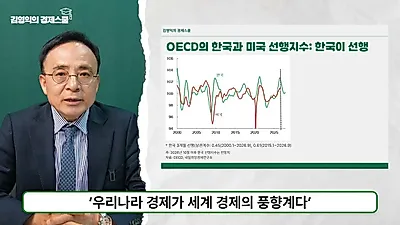
South Korea's Leading Index Peaked in July and is Declining... Warning of Possible US Recession
Professor Kim Young-ik predicts that the South Korean leading index peaked in July and is entering a downward phase, suggesting that the United States economy may face a slowdown or recession between November and December. He also warns of potential financial instability stemming from non-bank financial institutions (NBFI) and rising credit spreads.

US AI Investment Surge Causes Labor Market Polarization... Why is the Korean Stock Market Being Left Behind?
Economist Hong Chun-uk analyzes why the Korean stock market is underperforming despite the US market's record highs, highlighting the impact of the US ISM Manufacturing Index and the structural shifts caused by AI investment. He suggests a rebalancing strategy to move assets from overvalued markets to undervalued ones.

"An Era of 1 Million Self-Employed Closures"... Franchises and Income-Generating Real Estate Collapsing Under Interest Rate Shock
Lawyer Park Ki-tae warns that the self-employed sector is facing a severe crisis characterized by frequent franchise closures and high costs of shutting down businesses. Additionally, rising interest rates are driving investors in income-generating real estate toward bankruptcy as interest burdens outpace rental income.

National Tax Service to Help Small and Medium Liquor Producers Enter Global Markets via '2026 K-SUUL Awards'
The National Tax Service has announced the start of the '2026 K-SUUL Awards' to discover excellent local small and medium-sized liquor producers and support their entry into global markets. The awards aim to find diverse Korean liquors, ranging from Takju to fermented liquors, Soju, and distilled spirits, to represent South Korea.

"From Subscription Cancellation to Train Ticket Booking"... Meta's 'Muse' Signals an Agent Commerce Revolution
Meta's AI agent 'Muse' is ushering in an era of "Agent Commerce," moving beyond simple chatbots to perform practical tasks like managing subscriptions and booking travel. This shift marks a transition from AI as a "brain" to AI as "hands and feet" that can execute real-world actions.

The 25x Retirement Fund Rule: If You Dream of Being a FIRE Mover, Check Dividend Growth Rates
To prepare for early retirement as a FIRE mover, one must set specific financial goals and secure stable cash flow by focusing on dividend growth, cash flow, and tax-saving accounts.
The Flip Side of the AI Infrastructure Race: Once the Selection Process is Over, 'Skin-Clad Robots' Will Arrive
"Craving Growth" Vietnam vs. "Exhausted" China... Two Faces of the Asian Economy Observed by Dr. Gwak Su-jong
Heatwaves drive up agricultural prices by 0.5%p... Climate risks could cause 45 trillion won in losses to the financial sector
Revenue is not profit... Basic tax knowledge easy for novice business owners and N-jobbers to miss
"Even with 3 million won a month, there is no answer"... The vicious cycle of reckless youth investment and parental bankruptcy
KOSPI Plummets 8.8% in 4 Days... 'Psychological Fear' Spreads Ahead of End of Treasury Stock Buybacks
Startup subsidies may be included in business income... Proof of expenditure is key to tax saving
Tax Reduction for Young Entrepreneurs up to 100% Depending on Region... Business Registration Procedures Also Simplified
S&P500 Profit Growth Expected to Accelerate... AI Investment Sustainability is the Key Variable
The 'Gravity' of High Treasury Yields... A Process of Separating the Wheat from the Chaff in Asset Markets Begins
"Money increased 8 times, but gold only 1.4 times"... The paradox of 'gold' that protects asset value
Companies Accumulate Cash Instead of Borrowing... The Paradox of 'Capital Surplus' Driving Interest Rates Down
Semiconductor Technology Gap and the Collapse of the Middle Class: Diagnosing the Structural Crisis of the Korean Economy
"Supply Chain Control Over Efficiency"... Changing Global Trade Order and South Korea's Response Strategy
Why Amazon Blocked the AI Agent 'Muse', a Seismic Shift in the Commerce Market
Treasury yields hit 24-year high, driven by three key variables
US Treasury Yields Surpass 5%, Attention Focused on Interest Costs Exceeding Defense Spending
US stock markets hit record highs while South Korea plunges 27%, the secret of the interest rate time lag
South Korea's Leading Index Peaked in July and is Declining... Warning of Possible US Recession
US AI Investment Surge Causes Labor Market Polarization... Why is the Korean Stock Market Being Left Behind?
"An Era of 1 Million Self-Employed Closures"... Franchises and Income-Generating Real Estate Collapsing Under Interest Rate Shock
National Tax Service to Help Small and Medium Liquor Producers Enter Global Markets via '2026 K-SUUL Awards'
"From Subscription Cancellation to Train Ticket Booking"... Meta's 'Muse' Signals an Agent Commerce Revolution