
South Korea's Leading Index Peaked in July and is Declining... Warning of Possible US Recession
Professor Kim Young-ik predicts that the South Korean leading index peaked in July and is entering a downward phase, suggesting that the United States economy may face a slowdown or recession between November and December. He also warns of potential financial instability stemming from non-bank financial institutions (NBFI) and rising credit spreads.
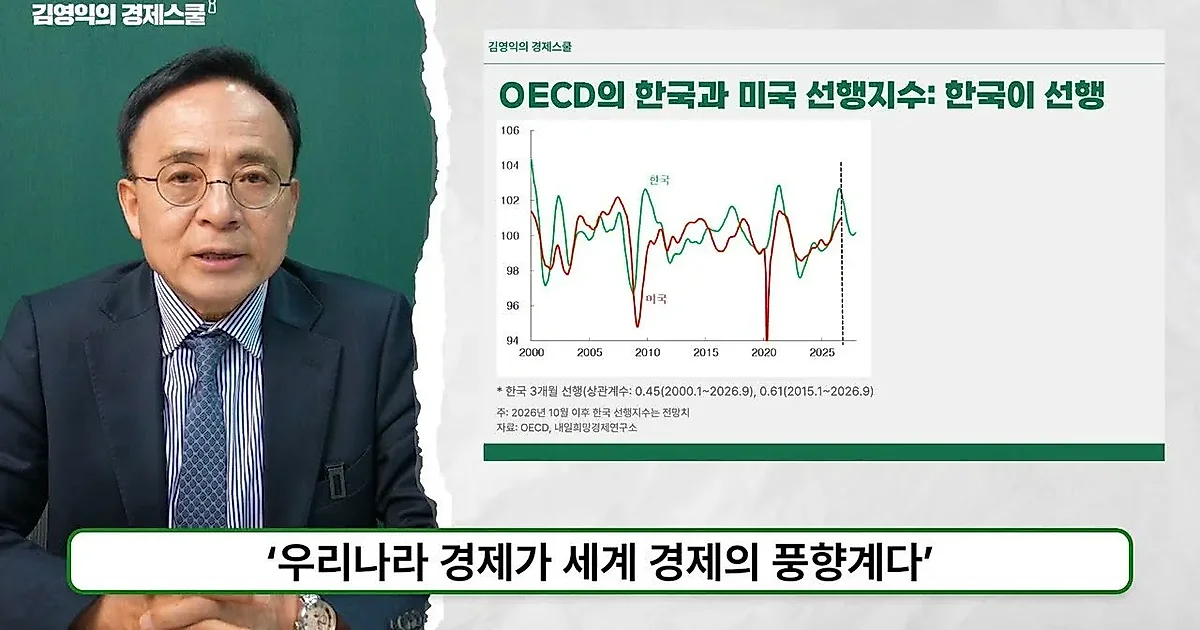
As the South Korean economy acts as a weather vane for the global economy, the movement of the domestic leading index can be used to predict the flow of the global economy, including the United States. Through recent analysis, Professor Kim Young-ik stated that South Korea's leading index has already entered a downward phase after peaking this past July.
South Korea's Leading Index Peaked in July... Predicting When the US Economy Will Slow Down
Professor Kim Young-ik diagnosed the economic trends of South Korea and the United States based on the leading index data of various countries released by the OECD. He analyzed that the South Korean leading index began to decline from August after peaking last July, and there is a high possibility that the downward phase will continue until it forms a bottom late next year or early the year after next. The South Korean economy has the characteristic of moving approximately 1 to 2 months ahead of the United States leading index.
Considering this leading nature, he predicted that the United States leading index, which showed an upward trend until September, will also peak soon and decline. In the video, he explained that there is a very high probability that the United States leading index will form a peak in September or October, and accordingly, there is a possibility that the growth of the United States economy will slow down or fall into a recession between November and December. In particular, citing that the S&P 500 index shows a leading pattern to our export growth rate, he also mentioned the possibility of a slowdown in export growth and stock price adjustments in the future.
Non-Bank Financial Institutions (NBFI) Holding Government Bonds and the Possibility of Financial Instability
The risk of non-bank financial institutions (NBFI) was identified as a potential risk factor in the United States financial market. Citing a report from the BIS, he pointed out that as recent United States Treasury yields rise, the loss margins for NBFIs holding large amounts of United States Treasuries are increasing. In fact, the proportion of NBFIs holding United States Treasuries, which was 44% in 2021, rose to 53% last year.
The analysis suggests that if hedge funds or pension funds with increased losses sell their government bonds, the price of United States Treasuries could plummet, leading to a financial market crisis. In the video, he warned that the next financial instability could start from the leverage and liquidity issues of non-bank financial institutions rather than the banking sector. In particular, he explained that unlike banks, it is difficult for the Fed to directly provide liquidity to non-bank financial institutions, and if quantitative easing is implemented, active responses may be limited due to inflationary pressures, which could increase the risk.
Investment Strategy to Reduce Stock Weight to Around 20% When the Leading Index Declines
Specific investment strategies according to changes in economic indicators were also presented. While Professor Kim has recommended maintaining more than 60% of financial assets when the leading index rises, he suggested that it would be good to reduce the stock weight to around 20% when the leading index falls. The intention is to consider that current United States stock prices are in an overvalued area and that consumption and AI investment may shrink as the economic slowdown progresses.
Rise in the TACO index and the Possibility of a Trend-wise Rise in US Credit Spreads
The TACO index, an indicator representing economic and political uncertainty, has recently reached a state where the risk index is very high. Additionally, while the United States credit spread is still lower than the average, he diagnosed that looking at the long term, it has surged recently and is in a phase of hitting a bottom and rising trend-wise. In the video, he explained that there is a considerably high possibility that the United States credit spread will surge in the future, and if that happens, the problems warned about by the BIS could occur.
Source: original video (YouTube)


0Comments
Comments are currently disabled.