
KOSPI Plummets 8.8% in 4 Days... 'Psychological Fear' Spreads Ahead of End of Treasury Stock Buybacks
The South Korean stock market has experienced a sharp decline, with the KOSPI falling 8.8% in just four days. Five key reasons, including rapid interest rate hikes and massive foreign capital outflows, are analyzed as the drivers behind this market collapse.
The South Korean stock market has shown exceptional weakness compared to global markets, plummeting 8.8% over the last four days. The KOSPI, which ranked first in the world in the first half of the year, has fallen 25% since entering the second half, crashing to the lowest levels globally. In particular, an analysis suggests that it has entered the territory of a "crash market," having fallen more than 30% from its peak on June 22. Five core reasons hidden behind why the South Korean stock market alone is collapsing like this, even in the absence of a special economic crisis, have been analyzed.
Interest Rate Hikes Steeper Than the United States, a 'Direct Hit' to the South Korean Economy
The first reason for the KOSPI decline analyzed by Park Jong-hoon's Knowledge Remedy is interest rates. While attention is often focused on interest rate hikes in the United States, the shock inflicted on the South Korean market is much larger than that of the United States. Based on figures from September 26 to September 28 of last year, South Korea's interest rate rose from 2.94% to 4.54%, an increase of approximately 1.6 percentage points. When converted to a growth rate, this reaches a staggering 54%. In contrast, during the same period, U.S. interest rates rose from 4.2% to 5.2%, with a growth rate of only around 24%. While the United States was already in a high state and became slightly higher, South Korea rose sharply from a low state.
Interest rates are the price of money and the measure of all value. When interest rates are low and suddenly surge, the shock felt by households and businesses is doubled. In particular, unlike the United States, a significant portion of loans in South Korea has a floating interest rate structure. While the United States has a high proportion of 30-year fixed interest rates, allowing it to endure for several months despite rising interest rates, South Korea has a structure where household consumption decreases immediately and corporate investment plans shrink as soon as interest rates rise. In fact, the proportion of floating-rate loans for South Korean companies reaches about 70%. Although the national debt-to-GDP ratio in the United States reaches 126%, while South Korea's is less than half, making it a situation where interest rates should not be rising, South Korea's 10-year government bond yield has exceeded 4% since May, maintaining a high-interest rate state for five months.
The movement of the National Pension Service is also behind this rise in interest rates. As the National Pension Service held much more stock than usual instead of bonds, the "hands" to buy bonds decreased, which resulted in pushing up bond yields. The amount the National Pension Service withdrew from bonds alone reaches a whopping 56 trillion won. Additionally, the bond proportion within funds decreased from 19.9% to 16.6%, and a vicious cycle occurred where the issuance of bank bonds increased by 46% compared to the previous year as individuals withdrew money from banks to invest in stocks, causing a shortage of funds in banks and again driving up government bond yields.
Foreigners Sell '224 Trillion Won'... Largest Capital Outflow Since the Founding of the Nation
The second and third reasons are the collapse of supply and demand. Recently, a record-breaking outflow of capital by foreigners has been observed in the South Korean stock market. The scale of stocks sold by foreigners reaches 224 trillion won. This is a scale as much as 7 times larger than the 34 trillion won, which was the largest selling amount during the 2008 financial crisis. It is a case where the strongest capital outflow since the founding of the nation has occurred. In addition, the fourth and fifth factors, such as semiconductor supply and demand issues and volatility following the U.S. midterm election results, are cited as important variables that will determine the future direction of the KOSPI.
As capital flowed out, liquidity within the market was rapidly exhausted. Individual investors also left the market, selling 18.1 trillion won worth of stocks during the month of September. While exports showed robust performance, recording an all-time high of 120.9 billion dollars as of September, domestic demand is already in an emergency state. Indicators such as the decrease in retail sales in August, facility investment (a 9.5% decrease), and real wages (a 0.3% decrease) are all retreating, showing an extreme divergence between exports and domestic demand. The fact that the Bank of Korea belatedly implemented interest rate hikes, increasing expectations for rising interest rates in the market, is also adding a burden to the current vulnerable economic strength.
Imminent End of Treasury Stock Buybacks... "Let's Sell Before It Ends" Psychological Fear
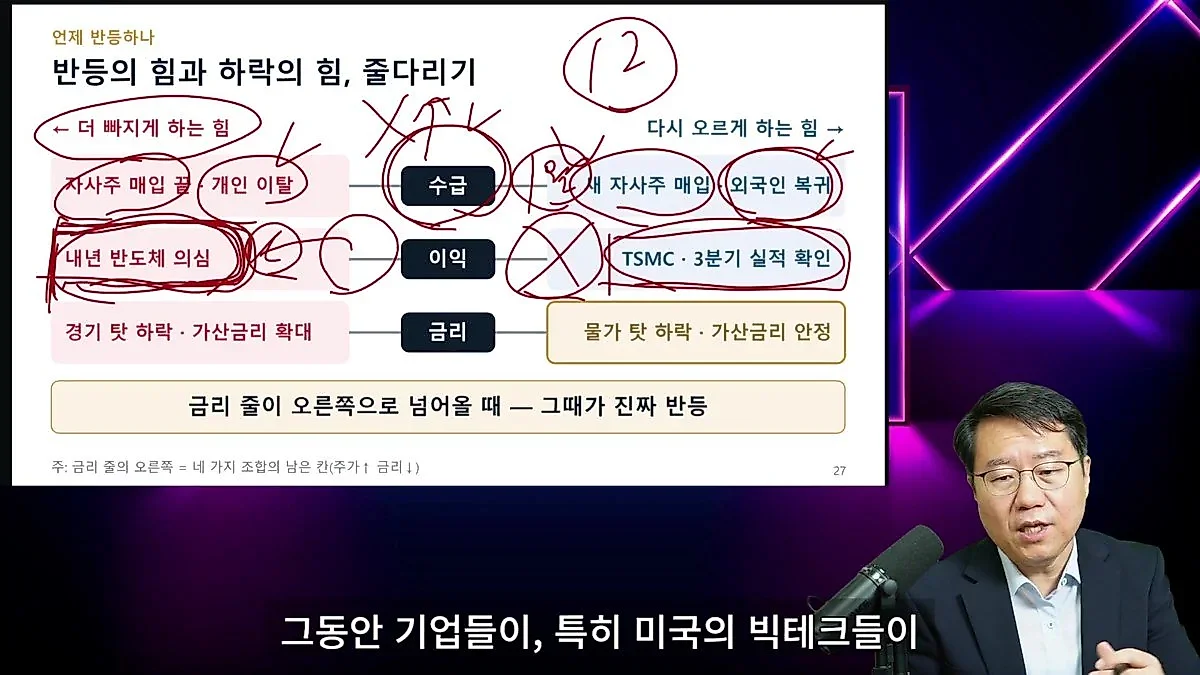
The last key variable is the timing of the end of treasury stock buybacks by companies. The only buying entity that has been supporting the KOSPI recently has been the treasury stock buybacks by companies. In the month of September alone, treasury stock buybacks worth 32 trillion won were carried out, defending the market's decline. However, the fear that this shield will soon disappear is dominating the market.
The video analyzed that as October 18, which is mentioned as the scheduled end date for treasury stock buybacks, approaches, urgency is spreading among investors with the sentiment, "We must sell and leave before the treasury stock buybacks end." The anxiety that stock prices may fall further once the power supporting stock prices through treasury stock buybacks is lost is creating a vicious cycle that further encourages selling by individuals and foreigners. In particular, uncertainty regarding whether the treasury stock buybacks will end on October 18 or drag on until October 25 is adding to the pressure on investor sentiment. Until the end date of the treasury stock buybacks is clearly confirmed or market anxiety is resolved, this psychological pressure is expected to be a major variable blocking the rebound of the KOSPI.
Source: original video (YouTube)



0Comments
Comments are currently disabled.